

TL;DR:
- Effective email marketing software integrates contact management, automated workflows, and analytics to optimize customer engagement. SMBs should prioritize features like CRM integrations, segmentation, drag-and-drop editors, and compliance support to ensure growth and legal adherence. Pricing varies based on contact volume and automation needs, making future scalability essential when selecting a platform.
Email marketing software is defined as a platform that manages contacts, designs personalized campaigns, schedules automated delivery, and tracks open and click metrics to drive customer growth. For small to mid-sized businesses, this category of tools, often called email marketing platforms or marketing automation software, is the most cost-effective channel for customer acquisition and retention. Platforms like Mailchimp, Brevo, and MailerLite have made professional-grade email marketing accessible at prices that fit SMB budgets. The right choice connects your contact list, your content, and your analytics into one system that works while you focus on running your business.
What core features should you look for in email marketing software?
Effective email marketing software includes drag-and-drop editors, automation workflows, landing pages, segmentation, personalization, and flexible pricing. These are not optional extras. They are the foundation of any campaign that converts. Here is what to prioritize when evaluating your options:
- Contact list management and segmentation. You need to group contacts by behavior, purchase history, or location so every message feels relevant. Sending the same email to your entire list is the fastest way to increase unsubscribes.
- Drag-and-drop email design editors and templates. You should not need a designer to send a professional-looking campaign. Look for editors with pre-built templates that match your brand.
- Automation workflows and triggered campaigns. Welcome sequences, abandoned cart reminders, and re-engagement flows should run without manual input. This is where email marketing pays for itself.
- Analytics and A/B testing. Open rates, click-through rates, and conversion tracking tell you what works. A/B testing subject lines or send times compounds those gains over time.
- CRM and ecommerce integrations. Your email platform should connect with tools like Shopify, WooCommerce, or your CRM so contact data stays current and campaigns stay targeted.
- Multi-channel messaging. SMS and WhatsApp messaging are increasingly offered alongside email by platforms like Brevo and Mailchimp, giving SMBs more touchpoints without adding another subscription.
Pro Tip: Before signing up for any platform, map out the three automation workflows you need most. Then test whether the free or entry plan actually supports them. Many platforms advertise automation but restrict the number of steps or triggers until you upgrade.
How does pricing typically work for email marketing software?
Most email marketing programs bill by the number of contacts in your list and the volume of emails you send each month. This model sounds simple, but it creates a trap for growing businesses. Your costs scale with your success, and the features you actually need often sit behind higher-priced tiers.
| Platform | Starting Price | Free Plan | Key Limitation |
|---|---|---|---|
| Mailchimp | $13/month (500 contacts) | Yes | Automation steps limited on Essentials |
| Brevo | $8.08/month | Yes | Daily send limit on free plan |
| MailerLite | $9/month | Yes | Limited automation on free tier |
| Moosend | $7/month | No (trial only) | No free plan |
| ActiveCampaign | $15/month | No | No free plan |
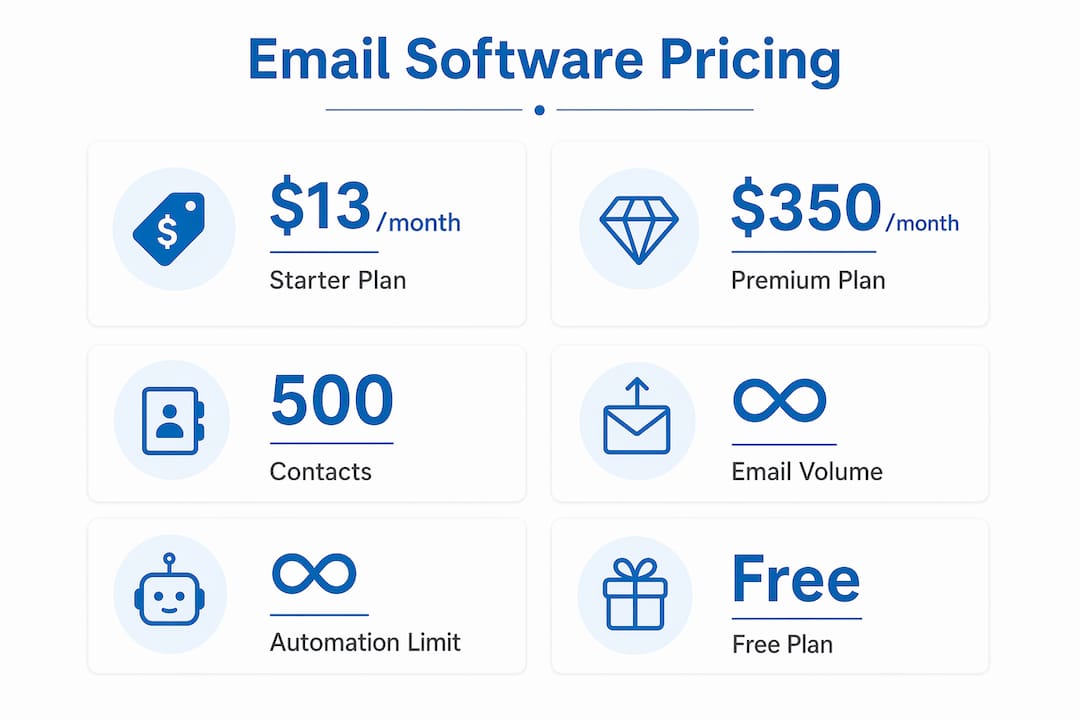
Mailchimp’s pricing ranges from $13 per month for 500 contacts on the Essentials plan to $350 per month for Premium with advanced features and larger contact capacity. That gap matters because the Essentials plan limits automation flow steps, which is precisely the feature most SMBs need most. Brevo and MailerLite offer more generous automation on lower tiers, making them stronger value for businesses that prioritize workflow depth over contact volume.
Affordable platforms often gate automation behind higher plans, forcing upgrades once send volumes or workflow complexity increase. The real cost of email marketing software is not the headline price. It is the tier you will actually need in six months.
Pro Tip: Calculate your projected contact list size at 12 months, not today. Then price each platform at that future tier. The cheapest option today often becomes the most expensive option once you grow.
How to ensure email marketing compliance and data privacy
Compliance is not a technicality. It is a legal requirement that carries real financial penalties for businesses that ignore it. UK GDPR and PECR require prior consent that is specific, freely given, and informed for B2C marketing emails. Pre-ticked boxes are invalid. Silence is not consent. Every contact on your list must have actively opted in.
Here is what your email marketing services must support to keep you compliant:
- Consent capture forms. Your platform should offer opt-in forms that record when and how a contact subscribed. This evidence matters if your practices are ever challenged.
- Double opt-in. While not legally required under UK GDPR, double opt-in is recommended as best practice because it creates a clear record of consent. Most reputable platforms support this natively.
- Unsubscribe flows. Every email must include a working unsubscribe link. Your platform should process opt-outs immediately and suppress those contacts from future sends.
- Data processing agreements. Your email platform processes personal data on your behalf, which makes it a data processor. You need a signed data processing agreement with your vendor.
- Data storage location. Tools like Brevo store data in the EU by default, which simplifies GDPR compliance for European businesses. US-based platforms can still be compliant through valid transfer mechanisms like the UK-US Data Bridge, but you need to verify this before signing up.
Choosing a vendor that handles compliance infrastructure correctly reduces your legal exposure significantly. For a plain-English breakdown of these rules, the UK GDPR email marketing guide from Babylovegrowth.ai covers the key requirements without the legal jargon.
What are the best affordable email marketing tools for SMBs in 2026?
The market for email marketing tools for small business has matured considerably. Most platforms now offer AI features, multi-channel capabilities, and CRM integrations that were enterprise-only five years ago. The table below compares the leading options by the criteria that matter most to SMBs.

| Platform | Best For | AI Features | Multi-Channel | Free Plan |
|---|---|---|---|---|
| Mailchimp | All-in-one beginners | Yes (content generation) | Email, SMS | Yes |
| Brevo | Multi-channel on a budget | Limited | Email, SMS, WhatsApp | Yes |
| MailerLite | Clean design, simple automation | Limited | Email only | Yes |
| Moosend | Ecommerce automation | Yes | Email only | No |
| ActiveCampaign | Advanced CRM integration | Yes | Email, SMS | No |
Mailchimp’s AI-driven content generation and campaign optimization tools improve engagement by reducing the time it takes to write and test campaigns. This is a meaningful advantage for SMB owners who write their own copy. Brevo stands out for businesses that want to reach customers across email, SMS, and WhatsApp without managing three separate platforms. MailerLite is the strongest option for businesses that prioritize clean design and straightforward automation at the lowest possible price point.
ActiveCampaign sits at the higher end of the SMB range but delivers the deepest CRM integration of any platform on this list. If your sales process involves multiple touchpoints and follow-up sequences, ActiveCampaign’s contact scoring and pipeline features justify the extra cost. Moosend is worth considering for ecommerce businesses that need product recommendation emails and cart abandonment flows without paying Mailchimp’s premium rates.
For SMBs that want email marketing automation combined with CRM, funnels, and reputation management in one system, all-in-one platforms built specifically for small business growth offer a compelling alternative to stitching together multiple subscriptions.
How can SMBs deploy email marketing software to drive real results?
Choosing the right platform is only the first step. How you set it up and use it determines whether you see results in 90 days or spend six months wondering why open rates are flat. Follow this sequence to get your email marketing working from day one.
- Start your trial with a real campaign, not a test. Import your actual contact list and send a real email during your trial period. This tells you whether the platform’s deliverability, editor, and reporting meet your needs before you pay.
- Segment your list immediately. Divide contacts into at least three groups: new leads, active customers, and lapsed customers. Each group needs different messaging. New leads need education. Active customers need upsell opportunities. Lapsed customers need a reason to return.
- Build your welcome sequence before anything else. A three-email welcome sequence sent over the first seven days after signup consistently outperforms one-off campaigns. Set this up as your first automation workflow.
- Use analytics to identify your best-performing subject lines. After your first four campaigns, you will have enough data to see patterns. Short subject lines, questions, and personalization tokens typically outperform generic announcements, but your audience will tell you what works.
- Connect your email platform to your CRM. Syncing contact data between your email marketing services and your CRM means your sales team sees email engagement history alongside deal status. This context makes follow-up conversations more relevant and more effective. For practical guidance on this, email marketing automation tips for SMB sales growth covers the integration setup in detail.
What I’ve learned from watching SMBs choose the wrong email platform
Most SMBs pick their email marketing software based on the free plan. That is understandable. Free is a compelling price. But the free plan is almost never the plan you will actually use once your business starts growing, and the cost of switching platforms after you have built automations, templates, and integrations is significant.
The businesses I see get the most from their email marketing tools are the ones that chose based on their 12-month needs, not their current situation. They asked which platform would still serve them when their list hit 5,000 contacts and they needed five active automation workflows. That question eliminates most free-tier decisions immediately.
Compliance is the other area where I see SMBs underinvest. A single complaint to a data protection authority costs far more in time and legal fees than the cost of choosing a compliant platform from the start. Double opt-in, proper consent capture, and a signed data processing agreement are not bureaucratic overhead. They are basic risk management.
The platforms I find most underrated for SMBs are Brevo and MailerLite. Both deliver more automation depth at lower price points than their market share suggests. Mailchimp’s brand recognition leads many SMBs to default to it, but for businesses that need multi-channel reach or clean automation without paying premium rates, Brevo and MailerLite consistently outperform on value. Test at least two platforms before committing. The difference in workflow between platforms is significant, and the one that feels most natural to your team is the one you will actually use.
— Go
Not Sure Which Email Marketing Approach Is Right for Your Business?
Let’s look at your audience, marketing goals, current tools, and customer journey to identify opportunities to improve your email campaigns, automate follow-ups, and turn more subscribers into customers.
Take your email marketing further with Goonlinenow
If you are ready to move beyond basic email campaigns and want automation that connects email, SMS, CRM, and lead nurturing in one place, Goonlinenow is built for exactly that.
Goonlinenow’s marketing automation for SMBs combines email, funnels, contact management, and reputation tools into one affordable system with done-for-you setup and real human support. No contracts, no hidden fees, and no complex tech to figure out on your own. If you want to see what a properly configured automation system looks like for a business your size, the SMB automation guide is a strong place to start.
FAQ
What is email marketing software?
Email marketing software is a platform that manages contact lists, designs and sends email campaigns, automates delivery based on triggers, and tracks performance metrics like open rates and clicks. It is the core tool for any business running structured email communication with customers or leads.
How much does email marketing software cost for small businesses?
Entry-level pricing starts as low as $7 per month with Moosend, $8.08 with Brevo, and $9 with MailerLite. Most platforms also offer free plans with send or contact limits, making it possible to start at no cost and upgrade as your list grows.
Do I need to worry about GDPR compliance with email marketing?
Yes. UK GDPR and PECR require explicit consent before sending B2C marketing emails, and pre-ticked boxes or assumed consent are not valid. Choose a platform that supports double opt-in, unsubscribe processing, and data processing agreements to stay compliant.
What is the best email marketing tool for a small business on a tight budget?
MailerLite and Brevo are consistently the strongest options for budget-conscious SMBs. Both offer free plans, generous automation on entry tiers, and pricing that stays manageable as your contact list grows.
Can email marketing software handle SMS and WhatsApp too?
Multi-channel platforms like Brevo include SMS and WhatsApp messaging alongside email, allowing SMBs to reach customers across multiple channels from a single platform without managing separate tools or subscriptions.