

TL;DR:
- Online marketing offers small businesses affordable, targeted, and measurable ways to reach prospects quickly.
- Combining brand storytelling with direct-response campaigns significantly boosts profitability and customer trust.
- Focusing on owned assets like websites and email lists creates sustainable growth and long-term marketing success.
Online marketing is not a privilege reserved for companies with massive budgets and dedicated marketing departments. If you run a small or mid-sized business, you can reach thousands of qualified prospects at a fraction of what a newspaper ad or billboard would cost. Affordable reach and real-time tracking are now standard features of digital channels, not premium add-ons. This article walks you through exactly what online marketing is, how to choose the right channels, how to blend brand and performance campaigns, and how to measure results without drowning in data. Simple, practical, and built for businesses like yours.
Key Takeaways
| Point | Details |
|---|---|
| Affordable reach | Online marketing enables SMBs to target billions precisely at a fraction of traditional advertising costs. |
| Channel integration | Combining brand and performance approaches results in significantly higher profit growth for small businesses. |
| Focus on owned assets | Building your website and email list creates long-term resilience and sustainable marketing results. |
| Effective measurement | Tracking simple, meaningful metrics like CAC and ROAS helps SMBs continually refine and improve marketing efforts. |
What is online marketing and why it matters
Having set the stage, let’s define online marketing and its unique benefits for smaller businesses.
Online marketing is the practice of promoting your products or services through internet-based channels to attract, engage, and convert potential customers. Think of it as your digital storefront, customer service desk, and sales team all working together, around the clock, without requiring you to add headcount. According to foundational guidance on digital marketing importance, SMBs that invest consistently in online channels outperform those relying solely on word of mouth or traditional advertising.
What separates online marketing from traditional methods like print or TV? Three things: cost, precision, and feedback speed. A Facebook ad can target a 35-year-old homeowner within a 10-mile radius of your salon. A Google search ad appears only when someone is actively searching for what you sell. An email goes directly to people who already raised their hand and said, “Yes, tell me more.” Traditional advertising casts a wide net and hopes for the best. Online marketing is a focused spear.
The practical benefit for SMBs is significant. You can start small, test quickly, and scale what works. If a campaign is not generating results after a week, you adjust it. There is no waiting for the next print run. The why digital marketing matters reality for small businesses is this: the barrier to entry has never been lower, and the upside has never been higher.
Here is a quick overview of how online marketing stacks up against traditional marketing:
| Factor | Online marketing | Traditional marketing |
|---|---|---|
| Cost | Low to moderate | High |
| Targeting precision | Very high | Low to moderate |
| Real-time feedback | Yes | No |
| Adjustability | Instant | Slow |
| Reach | Global or hyperlocal | Mostly local/regional |
| Measurability | Detailed analytics | Limited |
The core channels you will work with in online marketing include:
- Search Engine Optimization (SEO): Getting your website found on Google organically
- Social media marketing: Building relationships and brand awareness on platforms like Facebook, Instagram, and LinkedIn
- Email marketing: Nurturing leads and retaining customers with direct, personalized communication
- Pay-Per-Click advertising (PPC): Buying visibility on search engines and social platforms
- Content marketing: Creating blogs, videos, and guides that attract and educate your audience
Each channel has a role. The key is knowing which ones deserve your attention first, and that depends on your goals, your audience, and your budget. More on that in the next section.
Choosing the right online marketing channels
Understanding what online marketing is, the next step is picking channels that fit your needs and resources.
Not every channel is right for every business. A local plumbing company will have different priorities than an online coaching business or a boutique real estate agency. The good news is you do not need to be everywhere at once. Starting with two or three well-executed channels beats spreading yourself thin across six.
A practical way to think about digital campaign types is to group them by purpose: channels that build visibility over time (SEO, content, social media), channels that generate immediate results (PPC, paid social), and channels that retain and convert existing leads (email, retargeting).
Here is a side-by-side comparison of the main channel options for SMBs:
| Channel | Strength | Best use case | Time to results |
|---|---|---|---|
| SEO | Long-term visibility, low ongoing cost | Service businesses, local search | 3-6 months |
| Content marketing | Authority building, lead generation | Coaching, education, B2B | 2-6 months |
| Email marketing | High ROI, direct communication | Retention, nurture sequences | Immediate |
| PPC (Google Ads) | Immediate traffic, precise targeting | Product sales, lead generation | Days |
| Social media (paid) | Brand reach, audience targeting | Awareness, promotions, local | Days to weeks |
| Social media (organic) | Community building, trust | Brand storytelling, engagement | Weeks to months |
For budget allocation, research on SMB digital marketing recommends starting with your website and Google Business Profile, then allocating 25 to 30% of your marketing budget to SEO and content, 10 to 15% to email, and 20 to 25% each to paid search and social. This spread ensures you are building sustainable owned assets while also generating short-term results.
A typical starting setup for an SMB might look like this:
- A fast, mobile-friendly website with clear calls to action
- A Google Business Profile fully optimized with photos, reviews, and hours
- A basic email list with a lead magnet to grow subscribers
- One paid channel (Google Ads or Facebook Ads depending on your audience)
- Consistent publishing on one or two social media platforms your customers actually use
You can explore the digital marketing platforms that best match your industry to refine this starting list further.
Pro Tip: Own your website and email list above everything else. Social media platforms can change their algorithms overnight or limit your organic reach. Your website and email list are assets you control, and they build compound value over time. Use the digital marketing checklist to make sure your owned channels are fully optimized before you spend heavily on paid advertising.
Integrating brand and performance for best results
Once you’ve chosen your channels, optimizing their synergy is essential. Brand plus performance wins, every time.

There is a common misconception among SMB owners that brand marketing (building recognition and trust) and performance marketing (driving direct actions like clicks and purchases) are separate strategies with separate budgets. In practice, treating them as separate is one of the biggest mistakes you can make. The two reinforce each other, and the results when you combine them are hard to ignore.
Here is the reality: integrated marketing delivers 3.5 times higher profit growth compared to running brand and performance campaigns in isolation. That is not a marginal improvement. That is a fundamental shift in outcomes.
Why does this happen? Because brand marketing builds the trust and recognition that makes your performance ads more effective. When someone sees your Google search ad after already encountering your brand on social media or through a blog post, the conversion rate is significantly higher. They already know who you are. The ad is simply the final nudge.
“Integrating brand storytelling with direct-response campaigns produces 3.5x higher profit growth. The brand versus performance divide is a false one for businesses at any scale.”
For SMBs, integration does not have to be complicated. Here are simple ways to unite your brand and performance efforts:
- Consistent visuals and messaging: Use the same logo, colors, and tone across your ads, emails, social posts, and website
- Retargeting campaigns: Show performance ads to people who already engaged with your brand content
- Content-to-conversion funnels: Publish a helpful blog post (brand), then retarget readers with a specific offer (performance)
- Email sequences that tell a story: Open with your brand values and mission, then introduce an offer naturally
- Video ads that educate first: Lead with useful information, close with a clear call to action
You can see real-world service examples of how this integration works across different industries and campaign types.
Pro Tip: Every campaign, even a purely tactical one like a flash sale or a limited-time offer, should include at least one brand touchpoint. This could be a compelling image, a short customer story, or a headline that reinforces your values. Tactical campaigns that carry brand weight convert better and leave a lasting impression beyond the immediate transaction. For a deeper look at how to structure this, visit our marketing strategy tips page.
Measuring online marketing success without overwhelm
After integrating your strategy, knowing what and how to measure ensures continuous improvement.
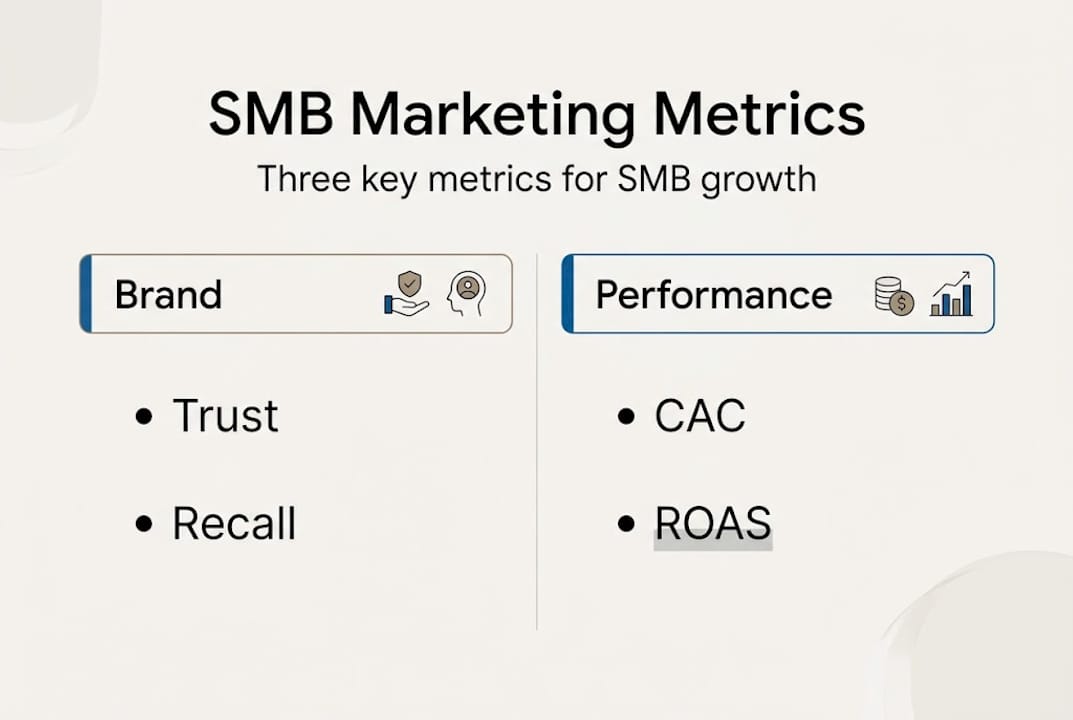
One of the most common challenges SMB owners face is not a lack of data. It is too much of it. Google Analytics, social media dashboards, ad platform reports, and email metrics can quickly become paralyzing. The solution is not to measure everything. It is to measure the right things consistently.
Three metrics form the foundation of any solid online marketing measurement framework:
-
Customer Acquisition Cost (CAC): How much does it cost to acquire one new customer? Calculate this by dividing your total marketing spend by the number of new customers gained in the same period. If you spent $1,000 and gained 10 customers, your CAC is $100.
-
Return on Ad Spend (ROAS): For every dollar you spend on advertising, how much revenue do you generate? A ROAS of 4 means you earn $4 for every $1 spent. Most SMBs should aim for a ROAS of at least 3 before scaling a campaign.
-
Customer Lifetime Value (CLV): How much revenue does a single customer generate over the entire time they do business with you? Knowing your CLV helps you understand how much you can afford to spend to acquire a customer. If a customer is worth $2,000 over three years, spending $150 to acquire them is a very good deal. Tracking CAC, ROAS, and CLV alongside real-time data allows you to make rapid adjustments and maximize your return.
Here is a practical reference table to help you understand these metrics and their SMB benchmarks:
| Metric | What it measures | Healthy benchmark | Action if off track |
|---|---|---|---|
| CAC | Cost to gain one customer | Varies by industry; lower is better | Review ad targeting, improve landing pages |
| ROAS | Revenue per ad dollar spent | 3x to 5x for most SMBs | Pause underperforming ads, test new creatives |
| CLV | Revenue per customer over time | 3x to 5x higher than CAC | Improve retention, add upsells or loyalty programs |
| Email open rate | Email engagement | 20% to 30% average | Improve subject lines, clean your list |
| Website conversion rate | Visitors who take action | 2% to 5% for most SMBs | Test headlines, CTAs, and page speed |
For tracking tools, start simple. Google Analytics 4 is free and provides detailed behavior data for your website. Your email platform will show open rates, click rates, and unsubscribe trends. Use the free GBP SEO report to evaluate your local search performance and identify gaps.
Once you are tracking consistently, review your numbers weekly for quick wins and monthly for strategic decisions. For SEO-specific tracking, a cost-effective SEO strategy paired with regular reporting helps you understand which content drives organic traffic and which pages need improvement.
Pro Tip: Pick three metrics and track them every week. Do not add a fourth until you have a clear handle on those three. Measurement should drive action, not analysis paralysis. When a metric moves in the wrong direction, you have a clear signal to investigate and adjust. When it moves in the right direction, you know what to do more of.
What most guides miss about online marketing
Most online marketing guides will give you a list of tools and tactics. Use this platform, run this type of ad, follow this posting schedule. That is all useful, but it misses the bigger point.
The SMBs that build sustainable marketing results over years, not just a good quarter, are the ones who invest consistently in owned channels. Your website, your email list, and your brand message are assets that compound in value over time. Social media platforms will limit your reach. Ad costs will rise. Algorithms will shift. But a well-built website that ranks for relevant searches and an email list full of engaged subscribers? Those belong to you.
We have seen this pattern consistently: businesses that focus their energy on building owned digital assets and maintain a steady, integrated marketing effort grow more predictably than those chasing the next trending tactic. It is not glamorous advice. But it works.
The businesses that struggle are often those that sprint on one campaign, see modest results, and then stop. Marketing is not a switch you flip. It is a system you build, test, and improve over time. Start with what you can sustain, own it fully, and build from there.
Next steps: Simplify your SMB marketing with Go Online Now
Ready to put these strategies to work? Here’s how Go Online Now can help.
Knowing what to do and having the time and tools to actually do it are two very different things. That is exactly where Go Online Now-Connect steps in. Our platform brings together everything covered in this article, email automation, CRM, lead tracking, SEO support, and paid campaign management, into one simple, affordable system built specifically for SMBs.
Whether you want to boost SMB conversions with automated funnels, get a clearer picture of your digital marketing impact, or explore our full range of tools through the marketing services overview, we have a straightforward path forward for you. No contracts, no hidden fees, and a real team ready to configure everything at no extra cost. Let’s build your marketing engine together.
Frequently asked questions
Which online marketing channel delivers the best ROI for small businesses?
SEO and content marketing typically offer the highest ROI for SMBs due to low ongoing costs and targeted reach, especially when paired with email marketing for customer retention. Budget guidance recommends allocating 25 to 30% to SEO and content and 10 to 15% to email for sustained results.
How much should an SMB spend on online marketing?
A practical split is 25 to 30% of your marketing budget on SEO and content, 10 to 15% on email, and 20 to 25% each on paid search and social channels. SMB budget guidance emphasizes prioritizing owned channels first for long-term sustainability.
What metrics are most important for measuring digital marketing effectiveness?
The three essential metrics for SMBs are CAC, ROAS, and CLV, which together reveal whether your marketing spend is generating profitable growth. Tracking these in real time allows you to make fast adjustments and maximize your return on investment.
Are brand marketing and performance marketing really separate strategies for SMBs?
No. Integrating both brand storytelling and performance campaigns consistently delivers far better outcomes. Integrated campaigns produce 3.5 times higher profit growth compared to running brand and performance efforts in isolation.