

Every small business owner knows the frustration of juggling multiple marketing tools while feeling outpaced by larger competitors. Digital transformation can seem overwhelming, but finding the right support can make all the difference. A digital growth partner gives American and British businesses access to tailored technology, operational efficiency, and guidance needed for real progress. This overview explains what a digital growth partner is and how the right partnership can help your company overcome automation obstacles and achieve measurable impact.
Defining a Digital Growth Partner for SMBs
A digital growth partner is a specialized strategic ally that helps small and medium-sized businesses (SMBs) navigate the complex digital transformation landscape. By offering comprehensive support and tailored technological solutions, these partners enable businesses to overcome digital adoption challenges and unlock competitive advantages.
According to recent research, digital growth partners provide SMBs with critical support in implementing transformational digital strategies. Their core mission involves helping businesses leverage technologies like cloud computing, analytics, and automation to enhance operational efficiency and customer engagement.
The key responsibilities of a digital growth partner typically include:
- Developing customized digital transformation roadmaps
- Identifying and implementing appropriate technology solutions
- Training staff on new digital tools and processes
- Providing ongoing strategic guidance and technical support
- Measuring and optimizing digital performance metrics
Pro tip: When selecting a digital growth partner, prioritize providers with proven track records in your specific industry and a demonstrated ability to deliver measurable, scalable results.
Types of Digital Growth Partnerships and Services
Digital growth partnerships for small and medium-sized businesses (SMBs) encompass a diverse range of collaborative models designed to accelerate technological adoption and competitive advantage. University and enterprise partnerships represent one critical approach, offering SMBs access to cutting-edge research, talent development, and innovative technological solutions.
Research identifies several key types of digital growth partnerships, including:
- Strategic technology alliances
- Research and development collaborations
- Knowledge transfer programs
- Entrepreneurship and innovation networks
- Joint venture technology initiatives
- Market access and networking partnerships
These partnerships enable SMBs to overcome significant digital transformation barriers by providing access to specialized expertise, advanced technologies, and collaborative resources that would typically be unavailable or cost-prohibitive for smaller organizations. The goal is to create symbiotic relationships that drive digital capabilities, enhance operational efficiency, and unlock new growth opportunities.
The following table summarizes how different types of digital growth partnerships benefit SMBs:
| Partnership Type | Primary Benefit | Typical Example |
|---|---|---|
| Strategic technology alliances | Access to leading-edge tech | Joint software development |
| R&D collaborations | Accelerated innovation | Shared product research |
| Knowledge transfer programs | Employee skill enhancement | Training workshops |
| Innovation networks | Startup support and funding | Business incubators |
Successful digital growth partnerships require careful alignment of strategic objectives, clear communication channels, and a shared commitment to technological innovation. Companies must evaluate potential partners based on their track record, technological capabilities, cultural compatibility, and ability to deliver measurable business outcomes.
Pro tip: When exploring digital growth partnerships, prioritize collaborations that offer not just technological solutions but also ongoing strategic guidance and adaptable support tailored to your specific business needs.
How Integrated Marketing Automation Drives Results
Marketing automation has become a critical technology for small and medium-sized businesses seeking to streamline their digital marketing efforts and drive measurable results. Marketing technology research reveals that automated systems can dramatically improve campaign efficiency, targeting precision, and overall marketing performance.
The key components of integrated marketing automation that drive tangible business outcomes include:
- Automated campaign management
- Data-driven customer segmentation
- Real-time performance tracking
- Personalized communication workflows
- Predictive analytics and targeting
- Seamless multi-channel engagement
By leveraging artificial intelligence and advanced analytics, marketing automation transforms how businesses approach customer interactions. These technologies enable companies to create highly personalized marketing experiences, optimize resource allocation, and make data-driven decisions that directly impact revenue growth. The ability to automate repetitive tasks while maintaining a sophisticated, targeted approach allows businesses to compete more effectively in increasingly complex digital markets.

Successful implementation requires a strategic approach that goes beyond simple task automation. Businesses must focus on creating integrated systems that connect customer data, marketing channels, and sales processes into a cohesive ecosystem that adapts and improves continuously.
Pro tip: Start small by automating one specific marketing process, measure its impact, and gradually expand your automation strategy to build confidence and demonstrate tangible business value.
Key Responsibilities and Growth Strategies in Practice
Digital growth partners play a crucial role in transforming small and medium-sized businesses by implementing strategic business growth approaches that align technology with organizational objectives. These partners go beyond traditional consulting by actively integrating innovative solutions that drive sustainable competitive advantage.
Key responsibilities of a digital growth partner typically encompass:
- Conducting comprehensive digital readiness assessments
- Identifying strategic technology opportunities
- Developing customized digital transformation roadmaps
- Implementing scalable technological solutions
- Providing ongoing strategic guidance and performance optimization
- Facilitating organizational change management
- Bridging technology and business strategy gaps
Successful digital growth strategies require a holistic approach that combines technological expertise with deep understanding of business dynamics. This means moving beyond simple technology implementation to create integrated ecosystems that enable continuous innovation, adaptability, and data-driven decision making. The most effective partnerships focus on building internal capabilities, empowering teams, and creating frameworks that support long-term digital resilience.
Understanding that each business has unique challenges, digital growth partners must remain flexible and responsive. They must develop nuanced strategies that consider industry-specific constraints, organizational culture, existing technological infrastructure, and future growth potential. This requires a combination of technical knowledge, strategic thinking, and a collaborative approach to problem solving.
Pro tip: Prioritize digital growth partners who demonstrate a track record of adaptability and can provide evidence of measurable outcomes in businesses similar to your own.
Financial Impact and Hidden Risks to Watch For
Digital transformation initiatives can deliver significant financial benefits, but they also carry substantial risks that businesses must carefully navigate. Digital transformation projects demonstrate a stark reality: approximately 70% fail due to inadequate strategic planning and misaligned financial measurement approaches.
Key financial risks and potential impact areas include:
- Unexpected technology implementation costs
- Potential revenue disruption during transition
- Unplanned infrastructure upgrades
- Cybersecurity vulnerability expenses
- Potential productivity loss during system integration
- Training and workforce adaptation costs
- Potential non-compliance penalty risks
Businesses must approach digital growth investments with a comprehensive risk management strategy that goes beyond surface-level financial projections. This means conducting thorough cost-benefit analyses, establishing clear performance metrics, and maintaining flexibility to adapt strategies as technological landscapes evolve. Understanding that financial risks are not just about direct monetary losses, but also include potential market reputation damage and competitive disadvantage, is crucial for sustainable digital transformation.
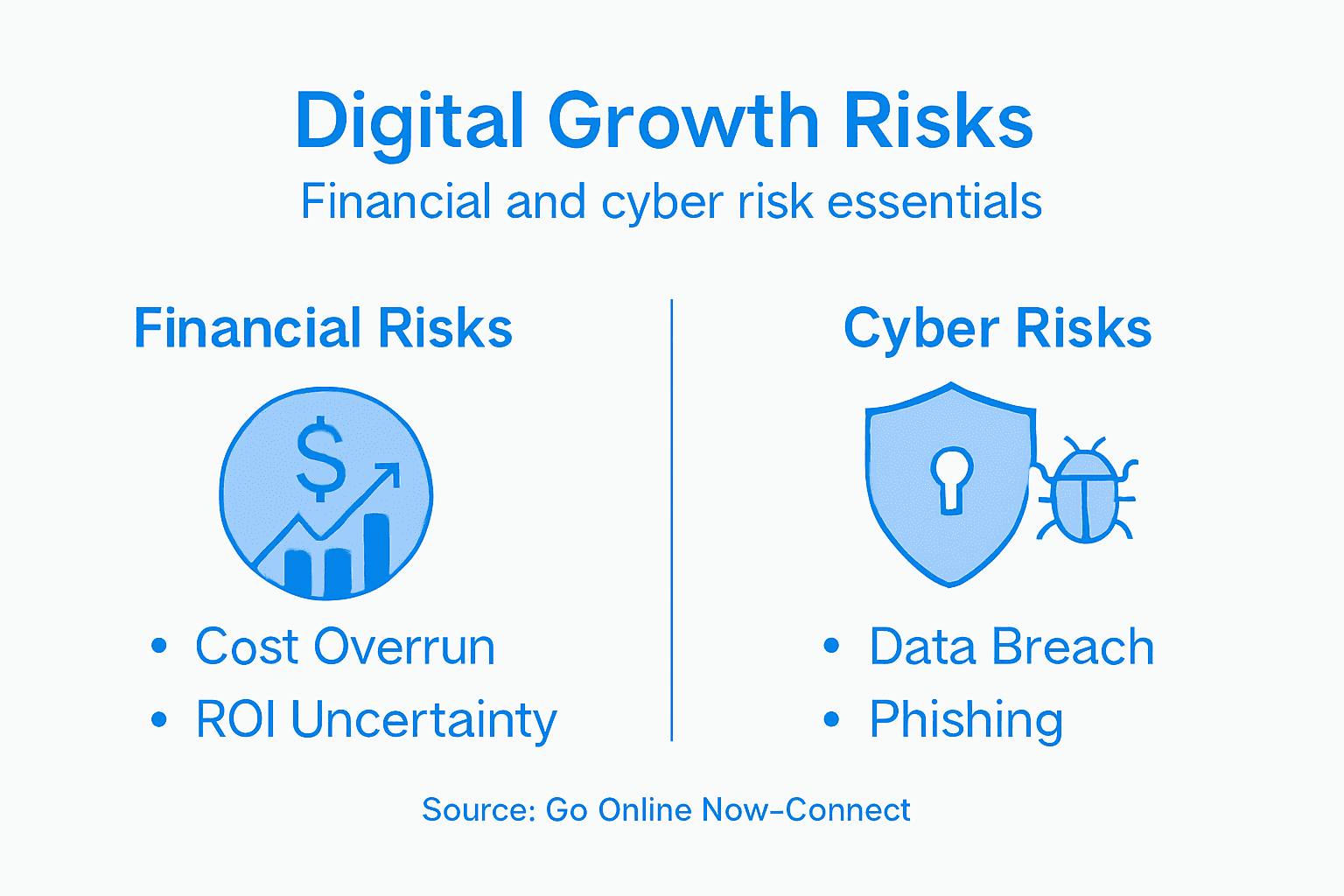
Cyber risks represent another critical financial consideration. With increasing digital complexity, organizations must proactively invest in robust security frameworks, continuous employee training, and adaptive risk management protocols. The potential financial consequences of data breaches or technological failures can far outweigh the initial investment in comprehensive digital protection strategies.
The table below compares common financial risks with recommended mitigation strategies in digital transformation:
| Financial Risk | Example Scenario | Recommended Mitigation |
|---|---|---|
| Unexpected tech costs | Platform upgrade overages | Structured vendor contracts |
| Revenue disruption during transition | Delayed ecommerce site launch | Phased rollout plan |
| Cybersecurity vulnerability | Data breach from integration | Proactive security audits |
| Training and adaptation expenses | Extensive employee retraining | Incremental skill programs |
Pro tip: Develop a detailed financial risk assessment matrix that quantifies potential technological investment outcomes and includes contingency budgets for unexpected challenges.
Unlock Smarter Growth with a Trusted Digital Growth Partner
If your small or medium-sized business struggles with complex, costly digital transformation or juggling multiple disconnected tools, you are not alone. The article highlights key challenges such as implementing adaptive technology solutions, managing marketing automation efficiently, and overcoming hidden financial risks. Your goal is clear: to grow smarter, not harder, with a unified strategy that aligns technology with business growth.
Go Online Now-Connect offers the perfect solution by combining essential marketing automation software, an all-in-one CRM, and expert digital marketing services with real human support. Our platform simplifies your digital growth journey while helping you maximize conversions, save time, and avoid costly pitfalls outlined in the research. From automated email campaigns to streamlined lead management, everything is designed to empower SMBs like yours with proven, scalable results.
Ready to transform challenges into opportunities? Explore how our Digital Marketing Archives – Go Online Now can boost your strategy with expert insights. Learn how our Virtual Assistance Archives – Go Online Now support further lightens your workload. Visit Go Online Now today to start your simple, affordable, and done-for-you digital growth partnership.

Don’t wait for digital risks to hold you back. Connect with Go Online Now-Connect now to experience the all-in-one system designed to power smarter business success with real human guidance and proven results.
Frequently Asked Questions
What is the role of a digital growth partner for SMBs?
A digital growth partner helps small and medium-sized businesses navigate digital transformation by offering tailored technological solutions, strategic guidance, and ongoing support to enhance operational efficiency and customer engagement.
How do digital growth partnerships benefit small and medium-sized businesses?
Digital growth partnerships provide access to specialized expertise, advanced technologies, and collaborative resources, enabling SMBs to overcome digital transformation barriers and leverage innovative solutions for competitive advantage.
What are some key components of integrated marketing automation?
Key components of integrated marketing automation include automated campaign management, data-driven customer segmentation, real-time performance tracking, personalized communication workflows, and predictive analytics, which improve marketing efficiency and drive measurable results.
What risks should businesses be aware of when pursuing digital transformation?
Businesses should consider risks such as unexpected technology implementation costs, potential revenue disruption, cybersecurity vulnerabilities, and training expenses, all of which require careful planning and robust risk management strategies.
Recommended
- Understanding Digital Growth Strategies for SMBs – Go Online Now
- What is Digital Growth? Understanding Its Impact – Go Online Now
- Understanding Why Digital Marketing for SMBs Matters – Go Online Now
- Understanding Digital Marketing Strategies for SMEs – Go Online Now
- Conversion Rate Optimization 101: Transform Visitors into Customers