

Running an American small business means every dollar and minute counts, especially when you need effective marketing without the luxury of a big budget or tech team. Affordable marketing tools are designed with this reality in mind, offering practical features that actually help service businesses grow. You get immediate value, simple setup, and responsive customer support without the overwhelm or unnecessary costs, so your marketing works for you instead of adding to your workload.
Defining Affordable Marketing Tools for SMBs
Affordable marketing tools are built for businesses like yours. They deliver real results without requiring a massive budget or a dedicated tech team. These solutions are designed to be accessible, practical, and focused on what actually moves the needle for small business growth.
What makes a tool “affordable” goes beyond the price tag. True affordability means getting immediate value from what you pay for. The best options have simple setups that don’t require hours of configuration, transparent pricing with no hidden fees, and responsive customer support when you need it. They fit your actual budget constraints while still giving you powerful features that typically cost far more elsewhere.

Affordable marketing tools typically fall into clear categories based on what you need. Email marketing platforms, CRM systems, social media scheduling, SEO tools, content creation software, and analytics platforms all have affordable versions designed specifically for SMBs. Instead of paying thousands monthly for enterprise solutions, you can access professional-grade tools for just a few dollars per month or even free with limited features.
These tools share common characteristics that make them genuinely useful for service-based businesses. They require minimal training to get started. They integrate with tools you already use. They provide meaningful reporting so you can see what’s working. Most importantly, they scale with your business without forcing you into expensive upgrades the moment you grow.
The key difference between affordable marketing tools and expensive alternatives isn’t always the features. It’s the philosophy behind the product. Affordable tools strip away complexity and focus on essentials that directly impact your bottom line. They’re built by teams that understand small business constraints, not enterprise requirements.
Pro tip: Start by identifying your single biggest marketing pain point whether it’s managing emails, tracking leads, or scheduling posts then choose one affordable tool that solves that specific problem before adding more tools to your stack.
Types of Affordable Marketing Automation Software
Marketing automation software comes in many flavors, each designed to solve different business challenges. Rather than a one-size-fits-all approach, you can choose tools that match your specific needs and budget constraints. Understanding the main types helps you pick exactly what your business requires right now.
Email marketing automation is often where SMBs start. These platforms handle sending campaigns, nurturing leads through sequences, and tracking opens and clicks. Tools like Mailchimp and Brevo give you professional email capabilities without the enterprise price tag. They’re straightforward to set up and deliver immediate results for businesses that rely on email communication.
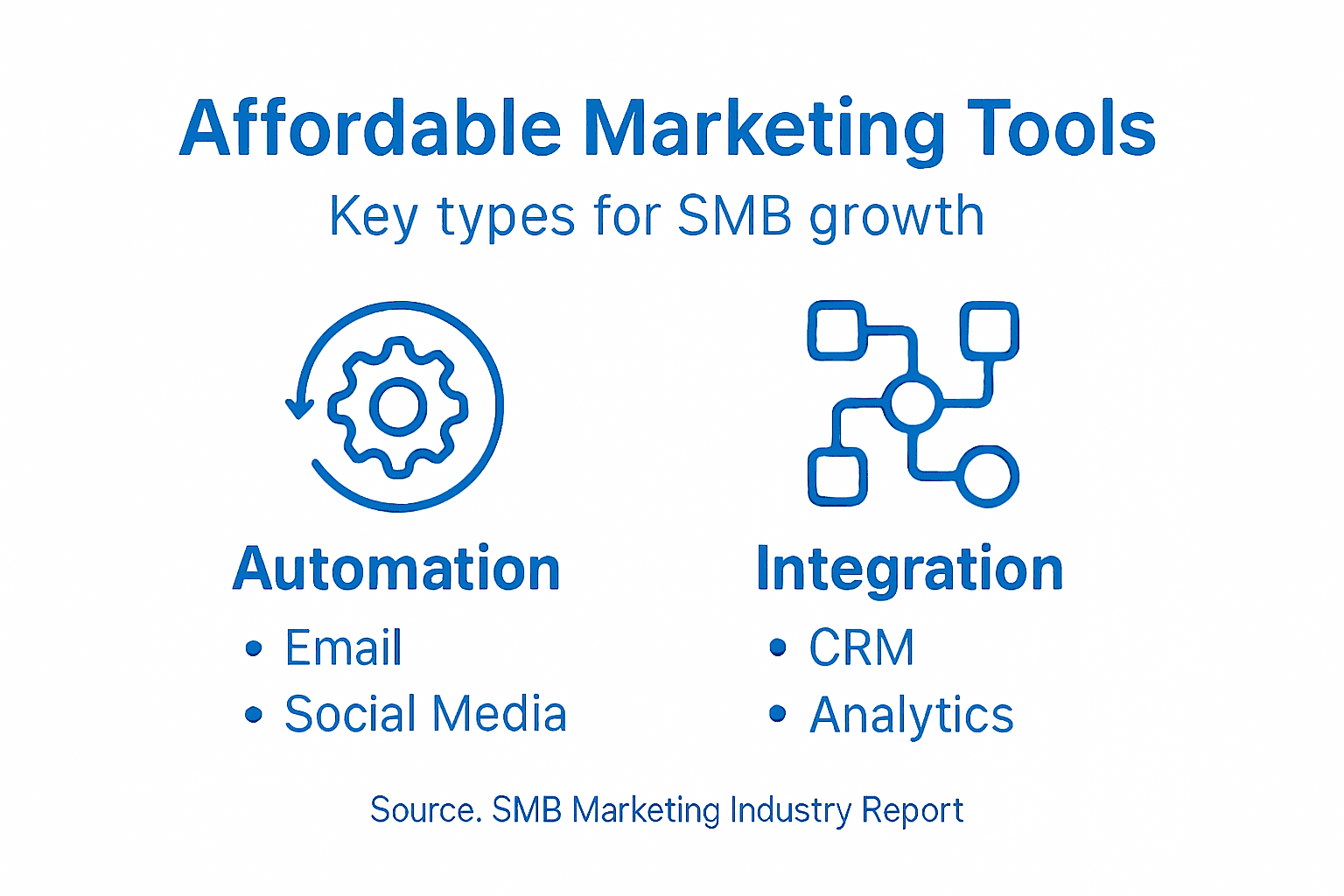
Customer journey automation takes things further by connecting multiple touchpoints. Instead of isolated emails, you can build workflows that respond to customer actions across channels. When someone downloads your lead magnet, they automatically enter a nurture sequence. When they visit your website, you can trigger different messages. This type of marketing automation software allows you to personalize experiences at scale without manual work.
Social media automation handles scheduling posts, monitoring mentions, and managing multiple accounts from one dashboard. These tools save significant time by batching your social content planning instead of logging in daily to different platforms.
All-in-one platforms combine email, CRM, landing pages, and analytics in a single system. ActiveCampaign and Omnisend exemplify this approach, letting you manage your entire customer lifecycle without juggling multiple subscriptions.
SMS and multi-channel automation adds text messaging to your toolkit. This matters because email open rates are declining while text message read rates stay above 95 percent. Affordable platforms now include SMS alongside email for reaching customers where they actually pay attention.
The best part about these options is pricing flexibility. Most use monthly subscription models that scale with your business, meaning you pay for what you actually use without massive upfront investments.
Here’s a summary comparing the main types of affordable marketing automation tools for SMBs:
| Type of Tool | Primary Purpose | Typical SMB Benefit |
|---|---|---|
| Email Marketing Automation | Send campaigns, nurture leads | Boosts engagement, low learning curve |
| Customer Journey Automation | Automate multi-channel workflows | Personalizes experience at scale |
| Social Media Automation | Schedule posts, monitor mentions | Saves time, manages multiple accounts |
| All-in-One Platforms | Combine marketing essentials | Centralizes tasks, reduces logins |
| SMS & Multi-Channel | Add text messaging channels | Improves response, boosts reach |
Pro tip: Map out your customer journey first before choosing tools, then select software that automates your biggest bottleneck rather than buying the most feature-rich platform.
Core Features SMBs Actually Need
You don’t need every bell and whistle. The best marketing tools for SMBs focus on what actually drives results for your business. Trying to use features you’ll never touch wastes time and money. Smart feature selection means picking tools that solve your real problems.
Email automation with segmentation matters most because it lets you send the right message to the right person at the right time. Instead of blasting everyone the same email, segmentation means a salon owner can send hair care tips to clients who recently booked appointments while new leads get introductory offers. This targeted approach increases engagement without you doing manual work.
Lead nurturing workflows automatically move prospects through your sales process. When someone fills out a contact form, they enter a sequence that educates them about your services without you sending individual emails. This keeps your business top of mind while you focus on serving existing clients.
CRM capabilities for tracking and follow-up create a single source of truth for all your customer interactions. You see every email exchange, meeting note, and purchase history in one place. No more digging through different apps to remember what a client said last month. Lead tracking and CRM systems help service businesses stay organized as they grow.
Social media scheduling saves hours by batching your content planning. Instead of logging in daily, you write several posts at once and schedule them across the week. Your presence stays consistent without the daily time drain.
Analytics reporting shows you what’s actually working. Real numbers tell you whether your email campaigns convert, which social posts get engagement, and where new clients come from. This data guides your decisions instead of guessing.
Skip features you won’t use. A hairdresser doesn’t need advanced advertising automation. A consultant doesn’t need complex inventory management. The best tool for your business focuses on these core features and ignores everything else.
Pro tip: List the top three tasks your marketing team does manually each week, then prioritize tools that automate those specific tasks first.
How Affordable Tools Drive Business Growth
Affordable marketing tools aren’t just cost cutters. They’re competitive multipliers that level the playing field between you and larger competitors. When you automate what drains your time, you free up energy for what grows your business.
Time savings translate directly to revenue. When email sequences run automatically, you’re not manually sending follow-ups at night. When social media posts schedule themselves, you’re not logging in between client appointments. A small business owner working 60-hour weeks suddenly has breathing room. That time becomes capacity for acquiring new clients, serving existing ones better, or actually planning your business strategy instead of drowning in execution.
Data-driven decision making matters more than you think. Most SMBs operate on gut feel and tradition. Affordable tools with solid analytics show you what actually works. You see which marketing messages convert, which customer segments spend most, and which channels deliver your best leads. Armed with real numbers, every marketing dollar goes further.
Customer engagement improves at scale when you use personalization. Instead of generic emails to everyone, segmented messaging speaks directly to each customer’s needs. Affordable marketing tools help SMBs understand customer behavior deeply through analytics and automation, creating experiences that feel personal even though they’re systematic. Customers feel seen, not marketed to.
Scalability without proportional cost is the real magic. Hiring another marketing person costs thousands monthly. Adding leads through a better automation system might cost 50 dollars. You grow your revenue while keeping your overhead flat. That’s how small businesses become medium businesses.
Competitive advantage accelerates when tools level the field. A hairdresser with solid CRM and email automation can compete on customer service with salons ten times their size. A real estate agent using lead nurturing workflows can process more buyers with a smaller team. Tools amplify what you’re already good at.
Pro tip: Track one key metric before and after implementing your first automation tool whether it’s sales cycle length, customer retention rate, or email response rate to prove ROI to yourself.
Comparing Affordable vs. Expensive Platforms
Here’s the truth nobody says out loud: expensive doesn’t mean better for your business. Enterprise platforms charge premium prices because they serve enterprises with complex, global operations requiring custom integrations and dedicated support teams. That sophistication costs thousands monthly. For you, it’s overkill.
Expensive platforms come loaded with features you’ll never use. They include advanced AI workflows, multi-language support across 50 countries, and custom API integrations for massive corporations. Their onboarding process takes months. Their training requires dedicated staff time. By the time you’re productive, you’ve already spent thousands just getting started.
Total cost of ownership is where expensive platforms break the budget. Monthly fees are just the beginning. You pay for implementation services, employee training, data migration, and ongoing support. One enterprise platform might cost 5,000 dollars monthly plus another 10,000 in setup and training. An affordable alternative costs 99 dollars monthly with free setup included.
Affordable platforms focus on what actually matters. They skip the enterprise complexity and deliver core features that drive real business results. Essential capabilities in affordable tools provide better ROI for SMBs because they’re built for businesses like yours, not Fortune 500 companies.
Implementation speed is where affordable wins decisively. You can launch a campaign in hours, not months. Your team gets productive immediately instead of waiting for training and setup. That means generating revenue faster rather than spending money before seeing any return.
The following table highlights key differences between affordable and expensive marketing platforms for SMBs:
| Factor | Affordable Platforms | Expensive Platforms |
|---|---|---|
| Pricing Model | Low, transparent monthly | High, often hidden fees |
| Implementation Time | Hours or days | Weeks or months |
| Feature Complexity | Essential, focused | Extensive, often unnecessary |
| Scalability Approach | Flexible and modular | Locked-in, costly to change |
| Training Requirements | Minimal, user-friendly | Extensive, often mandatory |
Scalability works differently too. Expensive platforms assume you’ll grow within their ecosystem. Affordable tools let you switch or expand freely. If you outgrow one affordable platform, switching costs minimal time and money. Enterprise systems lock you in with expensive migration costs.
The right choice depends on your actual needs, not prestige. A dental practice needs CRM and email automation, not global workflow complexity. A consulting firm needs lead tracking and proposal automation, not enterprise hierarchy management. Match your tool to your reality.
Pro tip: Request free trials from both affordable and expensive platforms, then calculate total first year cost including setup, training, and implementation to see the real difference.
Common Pitfalls When Choosing Marketing Tools
Most SMBs make the same mistakes when selecting marketing tools. These missteps cost time, money, and momentum. Knowing what to avoid prevents expensive wrong turns down the road.
Choosing based on price alone is the fastest way to waste money. A 29 dollar monthly tool that doesn’t fit your workflow becomes expensive at any price. You’ll abandon it after three months, buy another tool, and waste the learning curve all over again. The cheapest option isn’t always the best value.
Building a chaotic tech stack happens when you add tools randomly. You start with email marketing, then add CRM, then social scheduling, then analytics. Suddenly you have seven disconnected systems that don’t talk to each other. Data doesn’t flow between platforms. You manually copy information from one tool to another. Overcomplicating your tech stack creates friction instead of efficiency.
Ignoring integration needs causes frustration fast. Your CRM should connect to your email platform. Your email tool should link to your analytics. If tools don’t integrate, you’re managing data in silos instead of having one unified view of each customer.
Neglecting user training sabotages adoption. You buy excellent software, then nobody uses it properly. Your team doesn’t understand features. They default to old habits. The tool sits unused while you keep doing everything manually. Investment in training pays back immediately through actual usage.
Forgetting about scalability sets you up for future pain. A tool that works perfectly at 100 leads monthly might break at 1,000. Check whether platforms grow with you before committing. Can you add users easily? Do prices stay reasonable as volume increases?
Skipping the evaluation process means missing better options later. Tools evolve. New competitors emerge. What worked six months ago might not be optimal today. Set a quarterly review rhythm to assess whether you’re still getting value and using features effectively.
Pro tip: List your top three business problems before shopping for tools, then only evaluate platforms that directly address those specific issues.
Simplify Your Growth with Affordable Marketing Tools Designed for SMBs
The article highlights a common challenge faced by small business owners: navigating complex and expensive marketing tools that drain time and resources without delivering clear results. If you feel overwhelmed by juggling multiple platforms or frustrated with tools that do not match your budget and business needs, you are not alone. The key is finding simple, affordable marketing automation software that combines the essential features like email automation, lead nurturing, and CRM in one easy-to-use system.
Go Online Now-Connect was built specifically for SMBs facing exactly these struggles. Our platform offers all-in-one marketing solutions including automation, CRM, and digital marketing services — plus personalized human support and done-for-you setup that lets you focus on growing your business instead of wrestling with technology. Experience the power of a system designed for your real-world needs with no hidden fees or unnecessary feature overload.
Discover how to save time, boost customer engagement, and scale efficiently with our proven approach. Explore insights and practical tips in the Digital Marketing Archives – Go Online Now for small business success and learn how our team can help you automate smarter. For service providers needing ongoing support, our Virtual Assistance Archives – Go Online Now also provide valuable resources.
Ready to replace your scattered tools with one affordable, transparent platform designed for SMBs like yours? Visit Go Online Now today and start growing smarter, not harder. Take the next step in simplifying your marketing and unlocking measurable results now.
Frequently Asked Questions
What are affordable marketing tools for SMBs?
Affordable marketing tools are solutions designed for small and medium-sized businesses that deliver effective marketing results without requiring a large budget. They focus on accessibility, ease of use, and transparency in pricing.
How can affordable marketing tools drive business growth?
Affordable marketing tools help automate time-consuming tasks, allowing SMB owners to focus on strategic growth activities. By using these tools, businesses can make data-driven decisions and improve customer engagement, leading to increased revenue.
What core features should I look for in affordable marketing tools?
Essential features to look for include email automation with segmentation, lead nurturing workflows, CRM capabilities, social media scheduling, and analytics reporting. These features help address common marketing challenges and streamline operations for SMBs.
Why is it important to avoid expensive marketing platforms?
Expensive marketing platforms often come with unnecessary complexity and features that SMBs may never use. They also carry high total costs of ownership, including setup and training fees, resulting in a poorer return on investment compared to affordable alternatives designed for smaller businesses.
Recommended
- Understanding Why Digital Marketing for SMBs Matters – Go Online Now
- Role of Digital Marketing for SMBs: Complete Guide – Go Online Now
- Boost Sales: Top Marketing Tips for SMBs Success – Go Online Now
- 9 Examples of Digital Marketing Services for SMBs – Go Online Now
- Marketing Insights & SEO News | HYPED