

Over 90 percent of American businesses now recognize that efficient customer management is crucial for long-term growth. As competition heats up across every industry, companies cannot afford to lose track of important customer relationships or sales opportunities. Learning what a CRM actually does could be the difference between thriving and falling behind. This article uncovers how a smarter approach to managing customer data gives American small businesses a real edge.
What Is a CRM and Why It Matters
A Customer Relationship Management (CRM) system is far more than just software – it’s a comprehensive strategic approach for managing interactions with current and potential customers. At its core, a CRM represents an enterprise-wide initiative that connects multiple business functions like sales, marketing, human resources, and customer service into a unified platform designed to enhance customer relationships and drive business growth.
Understanding CRM goes beyond basic contact tracking. Customer relationship management is a holistic strategy focused on acquiring, retaining, and developing partnerships with selective customers to create superior value for both the company and its clients. Modern CRM systems enable businesses to centralize customer data, track interactions, streamline communication, and generate actionable insights that can dramatically improve operational efficiency.
For small businesses, a CRM becomes a critical tool for scaling operations intelligently. It transforms disconnected customer interactions into a structured, data-driven approach that helps companies:
- Centralize customer communication channels
- Track sales pipelines and opportunities
- Automate follow-up processes
- Personalize marketing and engagement strategies
- Improve customer retention and satisfaction
By integrating customer information across different departments, CRM systems break down traditional organizational silos and create a more cohesive, responsive business environment. The result is not just improved record-keeping, but a fundamental shift in how businesses understand and serve their customers.
Key CRM Features for Small Businesses
Small businesses require robust CRM features that streamline operations and maximize efficiency. Marketing automation software plays a crucial role in selecting the right CRM platform that meets specific business needs and growth objectives.

Modern CRM solutions offer several key features designed to empower small business productivity. Some of the most critical capabilities include centralized content repositories that consolidate sales and marketing resources into a single, accessible location. These systems often provide template libraries with customizable forms, emails, and landing pages, which dramatically reduce administrative overhead and ensure consistent brand messaging across different communication channels.
The most effective CRM platforms for small businesses typically incorporate the following essential features:
- Contact Management: Comprehensive tracking of customer interactions, communication history, and preferences
- Sales Pipeline Tracking: Real-time visualization of potential deals and conversion opportunities
- Communication Automation: Scheduled follow-ups, personalized email sequences, and integrated messaging
- Reporting and Analytics: Detailed insights into sales performance, customer behavior, and business metrics
- Document Management: Centralized storage for proposals, contracts, and critical business documents
By integrating these powerful features, small businesses can transform their customer relationship strategies from reactive to proactive. The right CRM becomes more than just a tool – it’s a strategic partner that helps companies understand their customers deeper, streamline internal processes, and ultimately drive sustainable growth.
How CRMs Streamline Sales and Marketing
Streamlining sales and marketing processes is a critical challenge for small businesses seeking sustainable growth. Affordable marketing automation tips can transform how companies approach customer engagement and conversion strategies.
CRM systems act as powerful connectors between sales and marketing teams, breaking down traditional communication barriers and creating a unified approach to customer acquisition. By centralizing customer data, tracking interactions, and automating communication workflows, these platforms enable businesses to create more personalized and targeted marketing campaigns. The integration allows marketing teams to develop more precise audience segmentation, while sales professionals gain deeper insights into customer preferences and behaviors.
Key ways CRMs streamline sales and marketing collaboration include:
- Unified Customer Data: Comprehensive profile tracking across all touchpoints
- Lead Scoring: Automated qualification of potential customers based on interaction history
- Seamless Communication Tracking: Complete visibility into customer interactions
- Automated Marketing Campaigns: Personalized communication triggered by specific customer behaviors
- Performance Analytics: Real-time insights into marketing and sales effectiveness
The true power of a CRM lies in its ability to transform disconnected marketing and sales efforts into a cohesive, data-driven strategy. By providing a holistic view of the customer journey, these systems enable businesses to create more targeted approaches, reduce manual administrative work, and ultimately drive more efficient growth.
Cost Savings and Risks of Not Using a CRM
Small businesses operate in an increasingly competitive landscape where every operational decision can significantly impact bottom-line performance. What you’re losing without automation reveals the hidden costs of manual processes and disconnected customer management strategies.
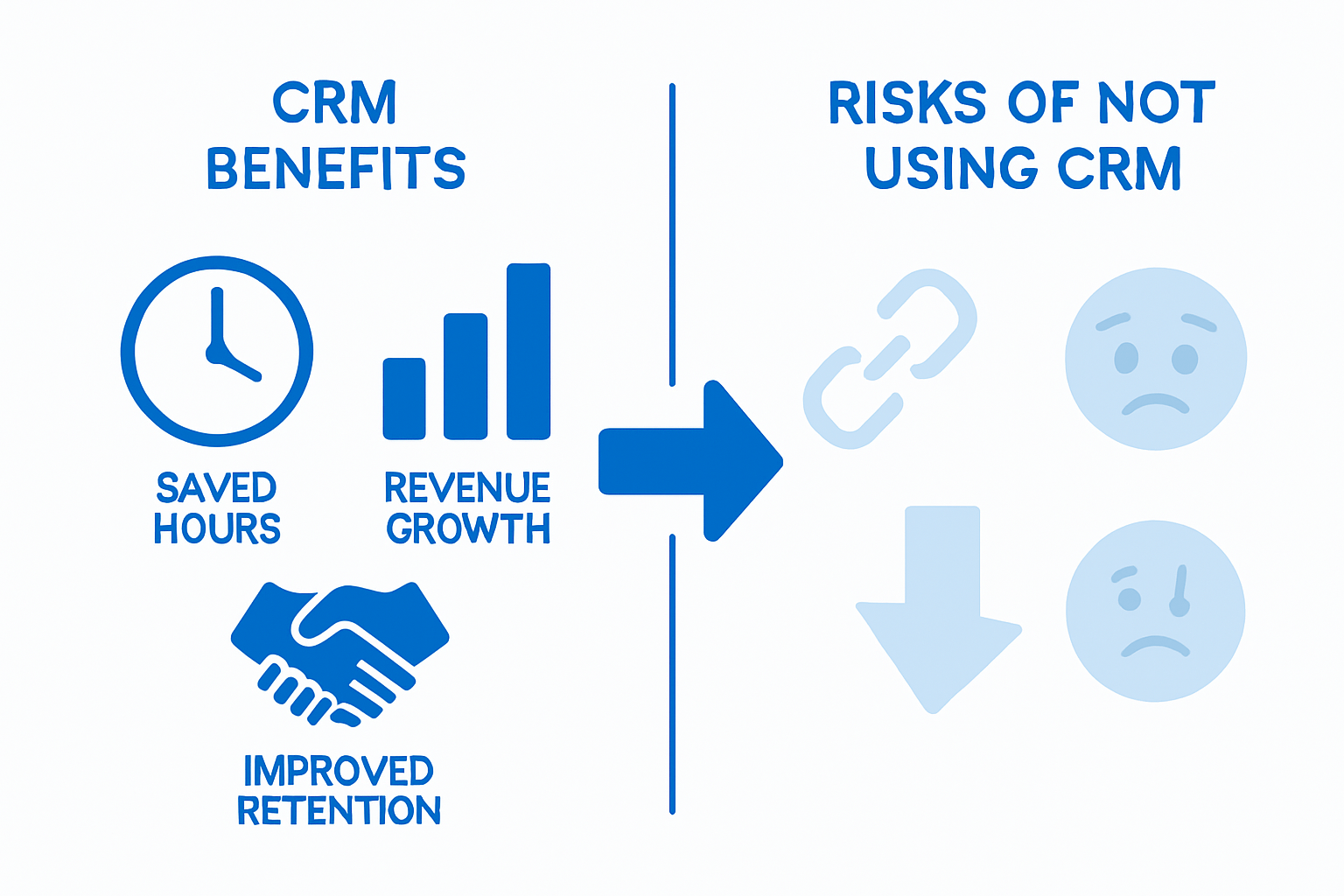
The financial risks of neglecting a CRM system extend far beyond simple data management. Without a centralized platform, businesses face substantial productivity losses, missed sales opportunities, and inefficient communication workflows. Manual tracking of customer interactions becomes time-consuming, prone to errors, and ultimately restricts a company’s ability to scale and respond quickly to market changes. The opportunity cost of not implementing a CRM can translate into significant revenue leakage and reduced competitive advantage.
Key financial and operational risks of avoiding CRM implementation include:
- Inefficient Customer Tracking: Increased time spent managing customer information manually
- Lost Sales Opportunities: Missed follow-ups and incomplete lead management
- Inconsistent Communication: Fragmented customer interactions across different team members
- Limited Performance Insights: Lack of data-driven decision-making capabilities
- Higher Administrative Overhead: More manual work and reduced team productivity
Ultimately, the cost of not investing in a CRM far outweighs the initial implementation expense. Small businesses that continue to rely on spreadsheets, email chains, and disparate systems are essentially choosing to limit their growth potential and operational efficiency. A strategic CRM investment represents not just a technology upgrade, but a fundamental approach to smarter, more responsive business management.
Comparing CRM Solutions for SMBs
Choosing the right CRM solution requires careful consideration of a small business’s unique operational needs and growth objectives. Top digital marketing solutions for SMBs provide critical insights into selecting the most appropriate platform for streamlined customer management.
Modern CRM solutions offer increasingly sophisticated features designed to simplify business operations. Automation capabilities can automatically send follow-up emails, create task reminders, and update customer records, significantly reducing administrative overhead and minimizing human error. Some advanced platforms even provide templates for critical sales documents like proposals and contracts, further enhancing team productivity and standardizing communication processes.
When evaluating CRM solutions, small businesses should prioritize the following key comparison criteria:
- Cost Effectiveness: Transparent pricing with no hidden fees
- Schaalbaarheid: Ability to grow with your business
- User Interface: Intuitive design requiring minimal training
- Integratiemogelijkheden: Seamless connections with existing tools
- Customization Options: Flexible workflows matching business processes
- Mobile Accessibility: Full functionality across devices
- Customer Support: Responsive technical assistance
The ideal CRM solution transforms from a simple software tool into a strategic business partner. Smart small businesses recognize that the right platform can provide more than just contact management – it becomes a comprehensive system for understanding customer behaviors, streamlining communications, and driving sustainable growth.
Unlock Smarter Growth with an All-In-One CRM and Automation Solution
Struggling to keep customer interactions, sales pipelines, and marketing efforts organized can hold your business back from the growth it truly deserves. This article highlights that without a unified system, many small businesses face costly inefficiencies like lost sales, fragmented communications, and overwhelming manual tasks. If you want to transform your customer relationships into a streamlined, proactive growth strategy, it is time to embrace integrated digital tools that actually work for you.
Bij Ga nu online, our all-in-one marketing automation software and CRM platform empower SMBs to centralize contact management, automate follow-ups, and optimize lead nurturing — all in one affordable system designed specifically for growing businesses. Backed by expert support and done-for-you setup, our platform eliminates the hassle of juggling disconnected apps so you can save time and boost conversions. Explore our Automatiseringsarchieven to see how our tools simplify workflows and deliver proven results.
Ready to stop losing leads and wasted hours to scattered systems? Visit Go Online Now to discover a simple, transparent solution that grows with you. Leverage powerful marketing automation and an all-in-one CRM tailored for your business today. For additional help streamlining your operations, check out our Virtual Assistance Archives and see how expert services can support your team. Take the next step toward smarter growth—your customers and bottom line will thank you.
Veelgestelde vragen
What is a CRM system and how does it benefit small businesses?
A Customer Relationship Management (CRM) system is a strategic approach that helps manage interactions with current and potential customers. For small businesses, CRMs centralize customer data, streamline communication, and improve customer retention, ultimately driving growth.
What key features should small businesses look for in a CRM?
Small businesses should seek CRM features that include contact management, sales pipeline tracking, communication automation, reporting and analytics, and document management to enhance productivity and streamline operations.
How can a CRM system help streamline sales and marketing efforts?
A CRM connects sales and marketing teams by centralizing customer data, automating communication workflows, and providing performance analytics, which fosters collaboration and allows for more targeted and effective customer engagement strategies.
What are the risks of not implementing a CRM system in a small business?
Without a CRM system, small businesses risk inefficient customer tracking, lost sales opportunities, inconsistent communication, limited performance insights, and higher administrative overhead, all of which can hinder growth and operational efficiency.
Aanbevolen
- Understanding Digital Growth Strategies for SMBs – Go Online Now
- Why Small and Midsized Businesses Need Marketing Automation in 2024 – Go Online Now
- Understanding the Small Business Marketing Automation Process – Go Online Now
- Marketing Automation Software: Complete Guide for SMBs – Go Online Now
- Tech for Small Businesses: Complete Guide for 2025 – Projector Display
- 4 Easy Steps To Unleash The Power of CRM & Email Marketing
- Rôle Du Web Dans La Croissance D’Entreprise : Guide Complet – IT-Pascaud