
Small business owners often juggle scattered customer data across multiple tools, losing opportunities and wasting time. A unified CRM platform can transform this chaos into streamlined operations that drive measurable growth. Studies show that CRM implementation can increase sales conversion rates by up to 85% within 90 days for SMBs. This guide explores how the right CRM solution simplifies customer management, automates repetitive tasks, and positions your business for scalable success in 2026.
Key takeaways
| Point | Details |
|---|---|
| CRM boosts conversions | Sales conversion rates increase by up to 85% for SMBs using CRM effectively. |
| Saves administrative time | Automation eliminates 75% of repetitive tasks, freeing teams for strategic work. |
| Essential features matter | Unified inbox, pipeline tracking, and appointment scheduling streamline operations. |
| Myths debunked | Affordable, simple CRM platforms exist with done-for-you setup and real support. |
| Selection criteria critical | Choose user-friendly, transparent pricing, and integrated marketing automation. |
How CRM drives business growth: mechanisms and impact
CRM isn’t just contact management software. It’s a growth engine that transforms how SMBs acquire, nurture, and retain customers. When you centralize customer data and automate workflows, your team stops chasing information and starts closing deals.
The numbers tell a compelling story. CRM implementation can increase sales conversion rates by up to 85% within 90 days for SMBs. That’s not a marginal improvement. That’s the difference between stagnation and explosive growth.
Here’s how these gains happen:
- Time savings cascade into revenue: CRM automation saves SMBs 75% of time spent on administrative and marketing tasks, redirecting effort toward customer conversations that close.
- Lead nurturing becomes systematic: Integration with marketing automation benefits creates continuous touchpoints that boost lead-to-customer conversion by 50%.
- Response times accelerate: Unified communication channels mean customers never wait, building trust that converts into loyalty.
- Data clarity improves decisions: Real-time pipeline visibility helps you forecast accurately and allocate resources where they matter most.
When repetitive tasks vanish, your team focuses on what actually grows your business: building relationships and solving customer problems. CRM drives sales growth by removing friction from every stage of your customer journey.
Key CRM features that streamline SMB operations
Not all CRM features deliver equal value. SMBs need tools that solve immediate pain points without adding complexity. The right features turn daily chaos into predictable workflows.
Unified inbox consolidates emails, SMS, social messages, and chat into one interface. You stop switching between tabs and start responding faster. Every conversation lives in context with customer history, making personalization effortless.
Appointment scheduling eliminates the back-and-forth of finding meeting times. Customers book directly into your calendar, automated reminders reduce no-shows, and your team reclaims hours every week.
Pipeline tracking provides instant visibility into every deal stage. You see exactly where opportunities stall, which leads need attention, and what revenue to expect next quarter. No more guesswork.
Contact management goes beyond storing names and numbers. It consolidates purchase history, interaction logs, and preferences into profiles that enable truly personalized service. When customers feel known, they buy more and stay longer.
These capabilities combine to create something powerful: operational efficiency that scales without adding headcount. Unified inbox, appointment scheduling, pipeline tracking and contact management reduce complexity and improve customer response time for SMBs facing resource constraints.
The result? Your small team operates like a much larger organization, delivering experiences that win customer loyalty and referrals.
Common misconceptions about CRM in SMBs
Many business owners avoid CRM because of outdated beliefs about cost, complexity, and implementation barriers. Let’s clear up these myths with current realities.
Myth 1: CRM systems are too complex and expensive for small businesses.
Reality: Enterprise platforms like Salesforce and HubSpot created this perception, but the market has evolved. Affordable, all-in-one CRM platforms exist with done-for-you setups and support, making CRM accessible without enterprise budgets or complexity.
Myth 2: CRM requires extensive IT resources and technical expertise.
Reality: Modern SMB-focused platforms offer done-for-you implementation. Vendors configure your system, import data, and set up automations before you touch the interface. You start using the system immediately instead of spending weeks learning it.
Myth 3: CRM systems don’t integrate well with marketing tools.
Reality: Today’s all-in-one platforms combine CRM and marketing automation natively. Email campaigns, SMS sequences, and lead nurturing workflows operate from the same system that tracks your sales pipeline. No integration headaches.
Professionele tip: Choose a CRM vendor that includes live onboarding calls and real human support, not just documentation. When questions arise during adoption, quick answers prevent frustration and keep your team engaged.
These CRM myths debunked reveal a simple truth: the barriers that existed five years ago have vanished. The only real obstacle now is outdated thinking.
Comparing CRM options for SMBs: what to look for
Choosing CRM software requires clarity on what actually matters for small business success. Enterprise features impress in demos but create daily frustration. Focus on these criteria instead.
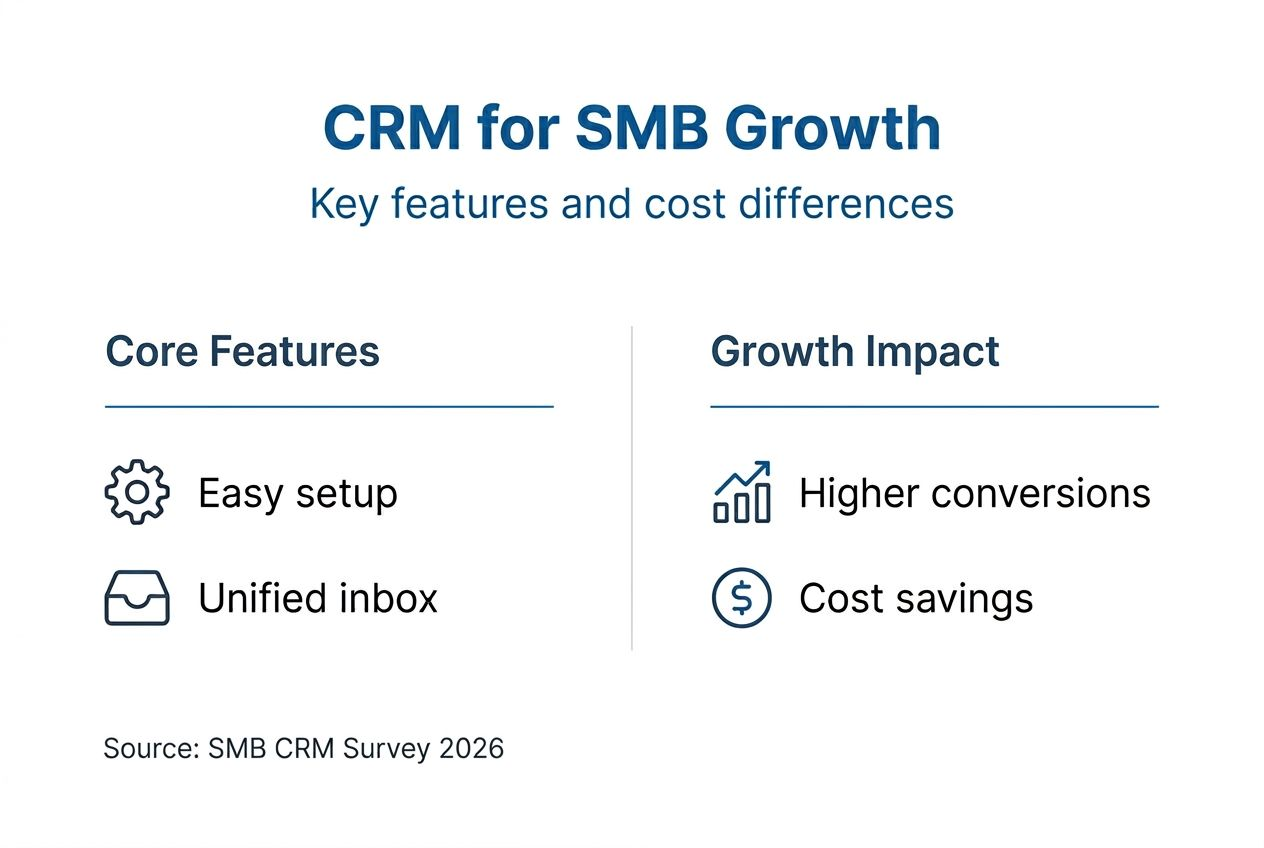
Ease of use determines whether your team adopts the system or abandons it. Interfaces should feel intuitive from day one, with minimal training required. If you need a manual to send an email or update a deal stage, it’s too complex.
Transparent pricing prevents budget surprises. Look for clear monthly costs with no hidden fees for features you’ll actually use. Contracts that lock you in signal vendor uncertainty about their value.
Done-for-you setup accelerates time to value. When vendors configure your workflows, import contacts, and build automations before launch, you start seeing ROI immediately instead of after months of configuration.
Integrated marketing automation is non-negotiable for growth. Separate systems for CRM and marketing create data silos and manual work. SMB-focused CRMs offer simpler interfaces, transparent pricing, done-for-you setup, and integrated marketing automation as standard features.
Here’s how enterprise and SMB-focused platforms compare:
| Functie | Enterprise CRM | SMB-Focused CRM |
|---|---|---|
| Monthly Cost | $150+ per user | $97-$297 total |
| Setup Process | Self-service, weeks | Done-for-you, days |
| Interface Complexity | Steep learning curve | Intuitive from day one |
| Marketing Integration | Requires separate tools | Built-in automation |
| Support Model | Ticket system, slow | Live chat and phone |
| Contract Terms | Annual commitments | Month-to-month flexibility |
The right choice aligns with your operational reality: limited time, constrained budgets, and need for immediate results. SMB CRM comparison criteria should prioritize getting started fast over feature checklists you’ll never use.
Practical implementation and optimization of CRM for growth
Adopting CRM successfully requires a clear process that moves from selection through optimization. Follow these steps to maximize value while minimizing disruption.
-
Assess your current customer processes. Document how leads enter your business, where they get stuck, and what manual tasks consume the most time. This clarity reveals which CRM features deliver immediate impact.
-
Choose a simple, affordable CRM with integrated capabilities. Prioritize platforms offering marketing automation, unified communications, and done-for-you setup. Avoid feature bloat that sounds impressive but complicates daily use.
-
Implement with vendor support and centralize data. Let your provider handle configuration, contact imports, and workflow automation. Consolidate customer information from spreadsheets, email, and scattered tools into one system.
-
Train your team and monitor key metrics. Focus training on the specific workflows your team uses daily, not every possible feature. Track conversion rates, response times, and deal velocity to measure impact.
-
Optimize workflows based on performance data. Review pipeline reports monthly to identify bottlenecks. Adjust automation triggers, refine lead scoring, and streamline stages that slow deals.
Professionele tip: Maintain strict pipeline hygiene by requiring weekly deal updates and regular cleanup of stale opportunities. Accurate data powers accurate forecasting, which drives better resource allocation decisions.
Aligning CRM workflows, leveraging automation, and focusing on pipeline transparency accelerate SMB growth and adoption success when combined with consistent team habits.
Avoid these common mistakes: choosing overly complex platforms that overwhelm users, neglecting vendor onboarding resources, and failing to define clear success metrics before implementation. When you need deeper expertise, consider partnering with expert CRM consulting specialists who understand SMB constraints.
The goal isn’t perfect implementation. It’s rapid adoption that delivers measurable improvements within your first 90 days.
Case studies: SMB success stories with affordable CRM solutions
Real businesses across industries prove that affordable CRM platforms deliver enterprise-level results without enterprise complexity or cost.

Coaching business transformation: A UK-based business coaching firm struggled with manual follow-up and lost opportunities. After implementing an all-in-one CRM with marketing automation, they increased sales conversion by 80% and cut administrative time by 70% within six months. Automated email sequences nurtured leads consistently, while pipeline visibility helped prioritize high-value prospects.
Real estate efficiency gains: A Canadian real estate SMB managed client communications across email, text, and phone without central tracking. Adopting a unified inbox and pipeline tracking system improved customer response times by 40%. Agents stopped missing follow-ups, and transaction coordination became seamless through shared visibility.
Ecommerce lead conversion: An online education provider in the UK integrated marketing automation with their CRM to create behavior-triggered campaigns. When leads viewed specific course pages or abandoned carts, automated sequences re-engaged them with personalized offers. This approach boosted lead-to-customer conversion by 50% while reducing marketing team workload.
These examples share common patterns: businesses started with fragmented systems, chose affordable all-in-one platforms, received implementation support, and saw measurable improvements within months. None required IT teams or massive budgets.
The lesson? CRM success depends less on company size and more on choosing solutions designed specifically for SMB realities: limited resources, need for speed, and focus on practical results over theoretical capabilities.
Conclusion: unlocking sustainable growth with CRM
CRM has evolved from enterprise luxury to SMB necessity. The platforms available in 2026 remove traditional barriers of cost, complexity, and implementation difficulty that once kept small businesses stuck with spreadsheets and scattered tools.
The evidence is clear:
- CRM drives measurable growth: Conversion rates jump up to 85%, while administrative time drops by 75%.
- Affordable solutions exist: All-in-one platforms deliver CRM, marketing automation, and support for less than enterprise platforms charge per user.
- Implementation barriers vanished: Done-for-you setup and live support mean you start seeing value in days, not months.
- Real businesses prove it works: SMBs across industries achieve rapid ROI with the right platform and support.
Your next steps are straightforward. Assess where customer data and manual processes slow your growth. Choose a CRM platform offering simplicity, transparency, and integrated marketing automation. Let vendor support handle implementation while you focus on what matters: building customer relationships that fuel sustainable growth.
The businesses thriving in 2026 aren’t necessarily the largest. They’re the ones that moved faster by working smarter with tools designed for their reality.
Explore Go Online Now’s CRM solutions for SMB growth
Ready to transform scattered customer data into systematic growth? Go Online Now offers exactly what this guide recommends: affordable, all-in-one CRM for SMBs solutions with done-for-you setup and real human support.
Their platform combines unified inbox, pipeline tracking, and marketing automation software for SMBs in one simple system. No scattered tools, no hidden fees, no complex implementation.
Explore proven CRM workflow setup guide resources and see how businesses like yours boost conversions by up to 85% while cutting administrative time by 75%. Get started with a platform built specifically for SMB realities: limited resources, urgent needs, and focus on measurable results. Your growth partner is ready when you are.
Frequently asked questions
What is the primary role of CRM in small business growth?
CRM centralizes customer data and automates workflows to increase sales efficiency and customer retention. It removes manual bottlenecks that limit how many leads your team can handle effectively. By providing pipeline visibility and automated follow-up, CRM helps small teams operate with the effectiveness of much larger organizations.
How quickly can SMBs see results after implementing CRM?
Most SMBs report measurable improvements within 30 to 90 days of proper implementation. The fastest gains come from automation eliminating repetitive tasks and unified communications reducing response times. Conversion rate improvements build more gradually as lead nurturing workflows mature and teams refine their pipeline processes.
Do I need technical expertise to implement and use CRM effectively?
Modern SMB-focused CRM platforms require no technical skills when you choose vendors offering done-for-you setup. They handle configuration, data migration, and automation building before you start using the system. Daily use involves simple actions like updating deal stages and sending emails through intuitive interfaces designed for non-technical users.
What’s the real cost difference between enterprise and SMB CRM solutions?
Enterprise platforms typically charge $150 or more per user monthly, adding up fast for growing teams. SMB-focused all-in-one solutions often cost $97 to $297 total per month regardless of user count. Beyond subscription costs, enterprise systems require expensive implementation consultants and ongoing IT support that SMB platforms eliminate through included setup and support.
How does CRM integrate with existing marketing and sales tools?
All-in-one CRM platforms include marketing automation natively, eliminating integration complexity entirely. For businesses with specialized tools they want to keep, modern CRMs offer API connections and native integrations with popular platforms. However, the simplest approach consolidates everything into one system from the start, avoiding data sync issues and reducing tool sprawl.
Can CRM really save 75% of administrative time for small businesses?
Yes, when you automate repetitive tasks that currently consume your day. Email sequences replace manual follow-up, automated appointment reminders reduce no-show coordination, pipeline tracking eliminates status update meetings, and unified inbox stops tool switching. The time savings compound quickly across multiple team members handling these tasks daily.
Aanbevolen
- Role of CRM for Small Business: Boost Sales 29% in 2026 – Go Online Now
- How CRM Drives Sales Growth for SMBs – Go Online Now
- Why Use a CRM: Transforming Small Business Growth – Go Online Now
- CRM for SMBs Explained: Smarter Growth Without Stress – Go Online Now
- Affärskonsult för Commercial Excellence & RevOps