
Many small business owners believe reputation management is reserved for large corporations with big marketing budgets. That assumption is costing them customers every day. Research confirms that ORM positively impacts small business performance in measurable ways, from revenue growth to customer trust. Whether you run a salon, a coaching practice, or a local service business, your online reputation is one of your most valuable assets. This guide breaks down exactly what reputation management means for small businesses, which strategies actually work, and how to get started without spending a fortune.
Key Takeaways
| Point | Details |
|---|---|
| ORM drives growth | Effective reputation management can significantly boost your business’s trust, star ratings, and revenue. |
| Small steps, big results | Simple actions like review requests and prompt responses make a measurable difference in public perception. |
| Affordable tools exist | Free or low-cost digital tools enable even solo owners to efficiently manage their online reputation. |
| Measure and adjust | Regularly track star ratings and feedback to continually improve your reputation strategy. |
Why reputation management matters for small businesses
Reputation management, often called ORM (online reputation management), is the practice of monitoring, influencing, and improving how your business appears online. It covers everything from Google reviews and social media mentions to how your website ranks in search results. For small businesses, it is not a luxury. It is a growth strategy.
The numbers tell a clear story. Studies show that ORM directly influences business performance (β=0.53) and Google Star Rating (β=0.32) for small businesses. That means the effort you put into managing your reputation has a statistically significant effect on both your visibility and your bottom line.
“Your reputation is not what you say about yourself. It is what customers say about you when you are not in the room.”
In competitive local markets, this effect compounds. A business with 4.7 stars and 200 reviews will consistently outperform a competitor with 3.9 stars and 40 reviews, even if the products or services are nearly identical. Customers trust volume and consistency.
Begrip building trust and growth through ORM is the foundation. Here is a quick look at what a strong reputation delivers for small businesses:
- Increased customer trust: Positive reviews and active engagement signal reliability to new prospects.
- Better customer retention: Customers who feel heard are more likely to return and refer others.
- Improved star ratings: Consistent review management lifts your average rating over time.
- Higher local search ranking: Google rewards businesses with fresh, high-volume reviews.
- Competitive advantage: A strong reputation is hard to copy and even harder to buy.
Exploring the value of online reputation management helps you see why this is one of the highest-return activities available to a small business owner.
Core components of a strong online reputation
Now that you see the business case, let’s break reputation management down into its essential components. Effective ORM is not a single task. It is a system made up of several moving parts that work together.
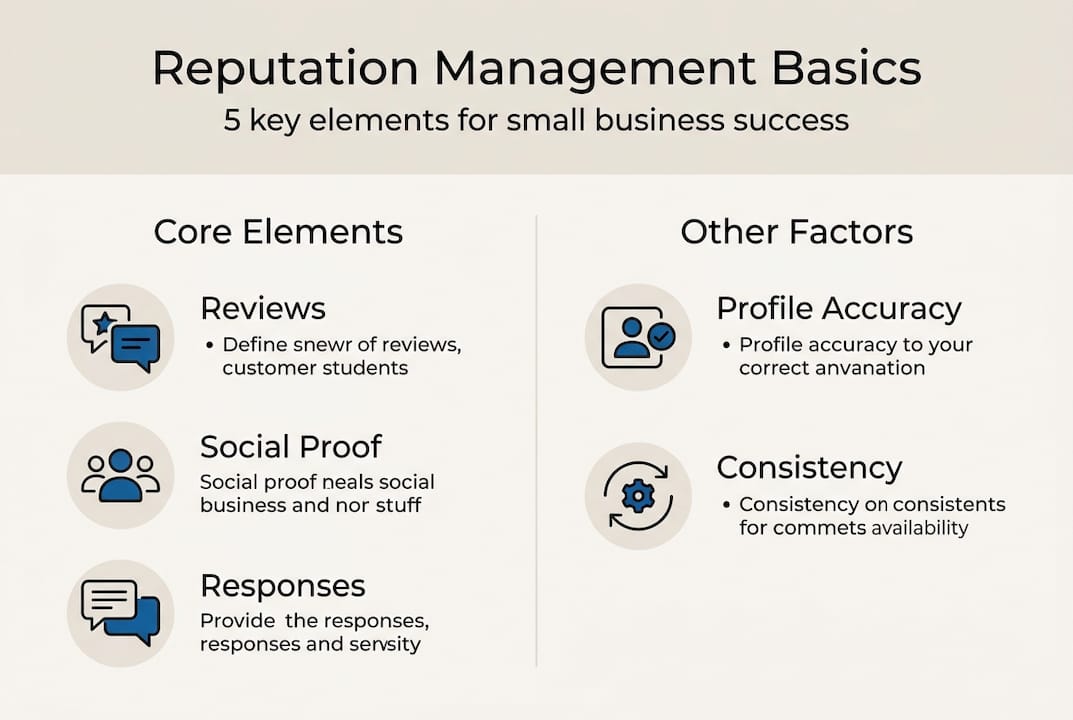
The five core elements are: customer reviews, social proof (testimonials, case studies, user-generated content), responses to feedback, SEO and content management, En presence management (claiming and updating your profiles across platforms). Research confirms that customer orientation and self-efficacy amplify ORM effectiveness, meaning your mindset and commitment matter as much as the tools you use.
Here is a comparison of proactive versus reactive ORM tactics:
| Factor | Proactive ORM | Reactive ORM |
|---|---|---|
| Actions | Request reviews, publish content, update profiles | Respond to complaints, remove false reviews |
| Kosten | Low to moderate | Moderate to high |
| Speed | Gradual, compounding | Immediate but short-term |
| Risk | Minimal | High if delayed |
| Best for | Long-term growth | Crisis control |
Proactive ORM always wins over time. Reactive ORM is necessary, but it should never be your only strategy. The online reputation process works best when you build habits before problems arise.
Here is a simple checklist to get your ORM foundation in place:
- Claim your Google Business Profile and fill out every field completely.
- Audit your presence on Yelp, Facebook, and any industry-specific directories.
- Set up a system to request reviews from customers after each transaction.
- Create a response template for both positive and negative reviews.
- Publish at least one piece of fresh content (blog post, social update) per week.
Voor protecting SMB growth long-term, consistency in these steps matters more than any single tactic.
Pro Tip: Set up Google Alerts for your business name at no cost. You will receive an email notification any time your business is mentioned online, giving you a real-time view of your reputation without paying for a monitoring tool.
How to manage reviews and respond to feedback
With the main ORM components in place, your next step is mastering customer reviews and public feedback. Reviews are the most visible part of your reputation. They influence buying decisions before a potential customer ever visits your website.
Not all review platforms carry equal weight. Prioritize these based on your industry:
- Google Business Profile: The most important platform for local search visibility.
- Facebook: High trust for service businesses and community-based brands.
- Yelp: Essential for restaurants, salons, and local service providers.
- Industry-specific sites: Houzz for home services, Zocdoc for healthcare, Avvo for legal, and so on.
- Trustpilot or G2: Valuable for B2B and software-adjacent businesses.
Encouraging satisfied customers to leave reviews is simpler than most owners think. Ask at the right moment, right after a positive interaction. A short follow-up text or email with a direct link to your Google review page removes all friction. Review volume and response rate are among the most critical factors in ORM success, and both are entirely within your control.
Voor improving digital reputation, how you respond to negative reviews matters just as much as the reviews themselves. A professional, empathetic response signals to future customers that you take quality seriously.

When responding to a negative review, follow this structure: acknowledge the issue, apologize without making excuses, offer a resolution, and invite the customer to continue the conversation privately. Keep it brief and factual.
Pro Tip: Never ignore a negative review. Even a brief, professional response shows prospective customers that you are attentive and accountable. Silence reads as indifference. Explore how tech and trust in reputation management can help you streamline this process.
Affordable tools and tactics for managing your reputation
If keeping up with reviews and feedback sounds overwhelming, don’t worry. Affordable tools and smart workflows can help you stay on top of it all without adding hours to your day.
Building internet self-efficacy, which means your confidence and ability to use digital tools effectively, is a key factor in ORM success for small businesses. You do not need to be a tech expert. You just need the right starting point.
Here is a breakdown of budget-friendly tools worth considering:
| Tool | Key feature | Free plan | Best for |
|---|---|---|---|
| Google Bedrijfsprofiel | Review management, local SEO | Yes | All local businesses |
| Google Alerts | Brand mention monitoring | Yes | Any business |
| Birdeye | Review requests, automation | Paid | Multi-location SMBs |
| Podium | SMS review requests | Paid | Service businesses |
| Ga nu online - Maak verbinding | All-in-one CRM and reputation tools | Affordable plans | SMBs wanting one platform |
| Mention | Social and web monitoring | Limited free | Brand tracking |
Use this three-step workflow to integrate ORM into your daily routine without it feeling like extra work:
- Morning check (5 minutes): Scan Google Alerts and your review platforms for new mentions or reviews. Respond to anything that came in overnight.
- Weekly review request (10 minutes): Send a batch of review request messages to recent customers using a template or automation tool.
- Monthly audit (30 minutes): Check your average star rating, total review count, and local search ranking. Note any trends and adjust your approach.
Pair this workflow with a solid digital marketing checklist and a clear sociale media strategie to amplify your reputation across every channel.
Tracking, measuring, and improving reputation over time
Once you have set your reputation foundation, ongoing measurement is key for continued growth and resilience. You cannot improve what you do not track.
“Treat your reputation like you treat your sales pipeline. Check it regularly, act on what you find, and never let it go unattended for too long.”
Here are the key performance indicators (KPIs) every small business should monitor:
- Average star rating: Your overall score across Google, Yelp, and Facebook.
- Review volume: Total number of reviews and the rate at which new ones come in.
- Share of positive responses: The percentage of reviews that are 4 or 5 stars.
- Response rate: How consistently you reply to reviews, both positive and negative.
- Local search rank: Where your business appears in Google Maps and local search results.
- Brand mentions: How often your business is referenced online outside of review platforms.
It is worth noting that ORM measurement gaps still exist in the academic literature, particularly for long-term SME studies. But for practical purposes, the six KPIs above give you a reliable picture of where you stand and where to focus.
Set a monthly calendar reminder to review your numbers. Compare month over month. If your average rating drops or your review volume stalls, that is a signal to increase your review request activity or revisit how you are engaging with customers. Explore the reputation management explained resources to deepen your measurement approach.
A smarter approach to small business reputation: lessons from the field
Most ORM advice focuses heavily on crisis response. What to do when a bad review goes viral. How to handle a disgruntled customer. That is useful, but it misses the bigger picture entirely.
The businesses that build lasting reputations are not the ones with the best crisis playbook. They are the ones that never needed it in the first place. Consistent, genuine engagement with customers, before problems arise, is what separates the businesses that thrive from the ones that scramble.
We have seen this pattern repeatedly. An SMB that commits to responding to every single review, positive and negative, within 48 hours, sees a measurable lift in customer retention and word-of-mouth referrals within three to six months. No expensive tools required. Just discipline and a genuine interest in customer experience.
The uncomfortable truth is that most small business owners wait until something goes wrong to think about their reputation. By then, the damage is already visible to hundreds of potential customers. Proactive reputation management, as outlined in SMB reputation insights, is not about vanity. It is about protecting the business you have worked hard to build.
Tech matters far less than mindset. Start with the basics, stay consistent, and your reputation will grow on its own momentum.
Take your reputation to the next level with the right digital tools
Managing your reputation manually across multiple platforms takes real time and energy. As your business grows, that becomes harder to sustain without the right support.
Go Online Now-Connect gives small business owners an affordable, all-in-one platform that handles reputation management, review requests, CRM, and marketing automation in one place. You get boost SMB conversions tools built specifically for businesses like yours, with proven ROI gains that justify every dollar spent. Whether you are just starting out or ready to scale, our platform is designed for driving SMB growth without the complexity or the high price tag. No contracts, no hidden fees, and real human support from day one.
Frequently asked questions
What is the easiest way for small businesses to start managing their online reputation?
Claim your Google Business Profile and ask satisfied customers to leave reviews right after a positive experience. Consistent action on these two steps builds ORM effectiveness faster than any paid tool.
Does responding to negative reviews really help my business?
Yes. Responding promptly and professionally builds trust with future customers and can turn a frustrated reviewer into a loyal one. Review response rates are directly linked to improved business performance.
Are reputation management tools expensive for small business owners?
Many powerful tools are free or low-cost, and most small businesses can start with what is already available to them. Internet self-efficacy enables you to adopt ORM technology even on a tight budget.
What key results should I track to measure my business reputation?
Focus on average star rating, total review count, share of positive responses, and local search ranking. While ORM measurement gaps exist in research, these simple metrics give you a reliable and actionable starting point.
Aanbevolen
- Importance of Reputation Management for SMB Success – Go Online Now
- Reputation Management—Why It Matters for SMB Success – Go Online Now
- Reputation Management Explained: Protecting SMB Growth – Go Online Now
- Reputation Management for SMEs: Building Trust and Growth – Go Online Now
- Improving Local Search Visibility for Small Businesses