
Every small business owner knows how one online review can shape what people believe about your services. In the crowded markets of coaching or real estate, how others see your reputation often determines if new clients choose you or look elsewhere. By understanding the value of a strong intangible asset like reputation, you can discover practical ways to build trust, safeguard your business image, and stand out across both digital and local communities.
Defining Reputation Management for SMEs
Reputation management is a strategic approach small and medium-sized enterprises (SMEs) use to actively shape and monitor their public perception across digital and traditional channels. At its core, reputation management involves intentional efforts to create, maintain, and protect the organization’s image among key stakeholders.
Relevant research highlights that reputation represents a critical intangible asset for SMEs, directly connected to competitive advantage and organizational success. Strategic reputation behaviors specifically involve management actions designed to positively influence how external audiences perceive the organization’s identity, goals, and social impact.
Key components of reputation management for SMEs typically include:
- Monitoring online reviews and feedback
- Responding professionally to customer interactions
- Developing consistent brand messaging
- Managing social media presence
- Vertrouwen opbouwen door transparante communicatie
The landscape of reputation management has transformed dramatically with digital technologies, making online perception more complex and immediate. SMEs must now navigate multiple platforms and rapidly respond to potential reputation challenges.
Reputation management strategies differ significantly from traditional marketing approaches. While marketing focuses on promoting products or services, reputation management centers on building credibility, trust, and positive relationships with stakeholders.
Reputation is not just about what you say about yourself, but what others say and believe about your business.
Pro tip: Implement a systematic process for regularly monitoring your online reputation across review sites, social media platforms, and industry-specific forums.
Types of Reputation: Online and Offline
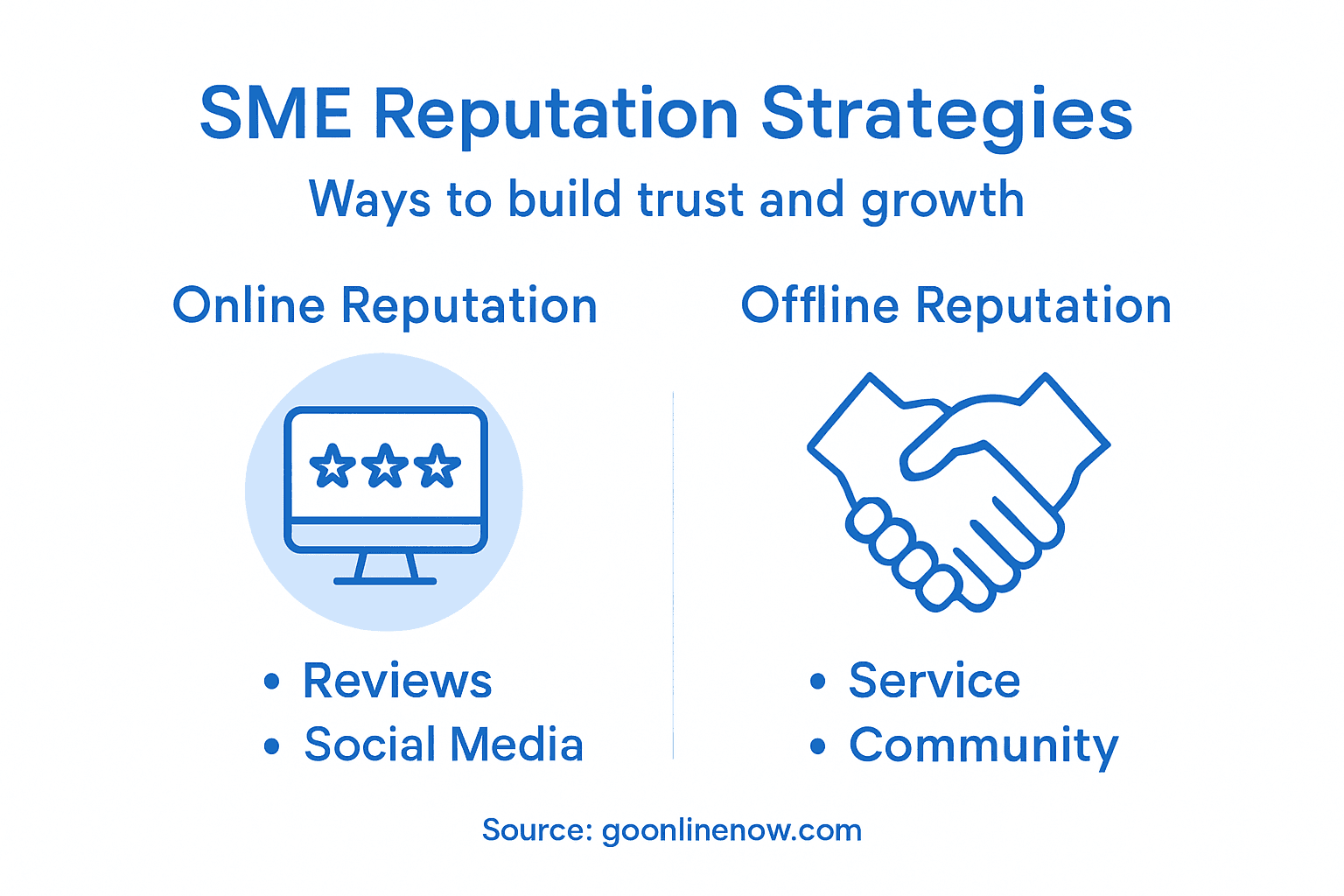
Reputation for small and medium-sized enterprises (SMEs) exists across two critical domains: online and offline, each playing a unique role in shaping stakeholder perceptions and organizational credibility. Digital reputation dimensions have become increasingly complex, encompassing multiple platforms and interaction channels that collectively influence business perception.
Online reputation represents the digital footprint of an organization, primarily shaped through:
- Social media interactions
- Customer reviews and ratings
- Search engine results
- Digital content and engagement
- Website user experience
Offline reputation, while more traditional, remains equally significant. This dimension involves direct personal interactions, word-of-mouth recommendations, physical product quality, and in-person customer service experiences. These tangible touchpoints continue to profoundly impact how customers perceive and trust a business.

The interconnected nature of online and offline reputation means that experiences in one domain rapidly influence perceptions in the other. A negative online review can diminish offline trust, while exceptional in-person service can generate positive digital word-of-mouth.
Here’s a comparison of online versus offline reputation factors for SMEs:
| Reputation Domain | Primary Channels | Key Impact | Risk Amplification |
|---|---|---|---|
| Online | Social media, reviews, search engines | Immediate public perception | Issues spread rapidly |
| Offline | In-person service, word-of-mouth, product quality | Long-term stakeholder trust | Damage may persist locally |
Modern SMEs must recognize that reputation is no longer compartmentalized but exists as a holistic, integrated ecosystem of perceptions.
Pro tip: Develop a comprehensive reputation management strategy that synchronizes your online and offline brand messaging to create a consistent, trustworthy business image.
Key Strategies for Building SME Trust
Building trust is a multifaceted process for small and medium-sized enterprises that requires strategic planning and consistent execution. Digital transformation strategies have become critical in establishing credibility and creating meaningful connections with stakeholders across multiple channels.
Key strategies for building SME trust include:
- Maintaining transparent communication
- Demonstrating consistent reliability
- Showcasing authentic customer testimonials
- Implementing robust data protection measures
- Responding promptly to customer feedback
- Establishing clear ethical business practices
Digital technologies play a significant role in trust-building, enabling SMEs to create more accessible and responsive customer interactions. By leveraging digital platforms, businesses can demonstrate their commitment to customer experience and organizational integrity.
Leadership commitment is fundamental in driving trust-building initiatives. Successful SMEs recognize that trust is not a one-time achievement but an ongoing process requiring continuous investment in relationship management, technological adaptation, and stakeholder engagement.
Trust is built through consistent actions, transparent communications, and genuine commitment to customer success.
Pro tip: Create a dedicated feedback mechanism that allows customers to share their experiences transparently, demonstrating your commitment to continuous improvement and accountability.
Managing Reputational Risks and Crises
Small and medium-sized enterprises (SMEs) must develop robust strategies to anticipate, mitigate, and recover from potential reputation challenges. Crisis management capabilities are critical for maintaining organizational resilience and protecting stakeholder trust during unexpected disruptions.
Key components of effective reputational risk management include:
- Developing a comprehensive crisis communication plan
- Establishing real-time monitoring systems
- Creating predefined response protocols
- Training team members in crisis communication
- Maintaining transparency and accountability
- Implementing rapid response mechanisms
Reputational risks can emerge from multiple sources, including customer complaints, digital platform controversies, product quality issues, or unexpected operational challenges. The speed and authenticity of an organization’s response often determine the extent of potential reputation damage.
Below is a summary of reputation risk sources and effective response actions for SMEs:
| Risk Source | Typical Scenario | Best Response Action |
|---|---|---|
| Negative customer review | Unfavorable rating online | Swift, sincere reply |
| Digital platform crisis | Social media controversy | Publish clear statement |
| Product quality failure | Defective product complaints | Initiate recall and notify |
| Operational disruption | Service interruption | Communicate proactively |
Successful SMEs understand that crisis management is not about perfection but about demonstrating genuine commitment to stakeholder concerns. Proactive communication, ethical behavior, and a willingness to learn and improve are fundamental to navigating potential reputation challenges.
Reputation is built in years but can be damaged in moments – preparation is key to resilience.
Pro tip: Develop a detailed crisis response flowchart that outlines specific communication steps, spokesperson responsibilities, and approval processes to ensure swift and coordinated action during unexpected challenges.
Legal and Ethical Factors for SMEs
Legal and ethical considerations form the cornerstone of sustainable reputation management for small and medium-sized enterprises. Digital footprint management requires a comprehensive approach that balances regulatory compliance with stakeholder trust and organizational integrity.
Key legal and ethical dimensions for SMEs include:
- Ensuring data privacy and protection
- Maintaining transparent communication practices
- Complying with industry-specific regulations
- Implementing robust cybersecurity measures
- Protecting customer and employee information
- Adhering to corporate social responsibility standards
Ethical leadership plays a critical role in shaping an organization’s reputation. Small businesses must go beyond mere legal compliance, demonstrating a genuine commitment to responsible business practices that align with stakeholder expectations and societal values.
Navigating the complex landscape of legal and ethical requirements demands continuous learning and proactive risk management. SMEs must develop adaptive strategies that anticipate regulatory changes while maintaining a core commitment to transparency, fairness, and accountability.
Ethical behavior is not a cost of doing business, but the foundation of sustainable success.
Pro tip: Conduct regular ethics and compliance training for your entire team, and establish clear internal guidelines that translate legal requirements into practical, actionable workplace behaviors.
Avoiding Common Reputation Mistakes
Reputation management requires strategic awareness and proactive prevention of potential pitfalls that can undermine small and medium-sized enterprises. Stakeholder communication errors represent a critical area where SMEs frequently compromise their credibility and organizational perception.
Common reputation mistakes that SMEs must carefully avoid include:
- Inconsistent brand messaging across platforms
- Ignoring or delaying customer feedback
- Failing to monitor online reputation
- Responding defensively to criticism
- Neglecting transparency in business operations
- Overpromising and underdelivering
- Lack of clear communication during challenges
Digital platforms have amplified the potential impact of reputation mistakes, making every interaction visible and potentially permanent. Small businesses must recognize that a single poorly handled customer interaction can quickly escalate into a significant reputation challenge that reverberates across multiple channels.
Effective reputation management demands continuous learning, adaptability, and a commitment to genuine, transparent communication. SMEs must develop robust internal processes that prioritize stakeholder trust and proactively address potential reputation risks before they become significant problems.
Reputation is built through consistent, authentic actions – not through damage control.
Pro tip: Implement a weekly reputation audit process that reviews customer interactions, online mentions, and feedback across all digital platforms to identify and address potential issues before they escalate.
Strengthen Your SME’s Reputation with Simplified Digital Solutions
Managing your small or medium-sized enterprise’s reputation involves constant monitoring, transparent communication, and swift responses to challenges. This article highlights how vital these reputation management strategies are to building trust and sustaining growth. Yet juggling online reviews, social media engagement, and customer feedback can quickly become overwhelming without the right tools and support.
At Go Online Now, we understand these pain points deeply. Our alles-in-één marketingautomatiseringssoftware brings together reputation management with email marketing automation, lead nurturing, and powerful CRM features into one easy-to-use platform. With real human support and done-for-you setup, your business gains the confidence to monitor and respond professionally across all channels. Explore our Digital Marketing Archives – Go Online Now to discover how tailored marketing strategies can boost your credibility.

Ready to build trust and grow smarter with a platform designed specifically for SMBs and SMEs? Visit Ga nu online to learn how our combined marketing automation, CRM, and recruitment solutions save time and maximize conversions. Take control of your reputation today with help from our Virtuele assistentie archieven – Ga nu online services that keep your communications timely and consistent. Start creating a consistent and trustworthy business image now by partnering with us for your digital growth journey.
Veelgestelde vragen
What is reputation management for SMEs?
Reputation management for SMEs is a strategic approach designed to actively shape and monitor the public perception of a small or medium-sized enterprise across both digital and traditional channels. It focuses on creating, maintaining, and protecting the organization’s image among stakeholders.
Why is reputation important for small and medium-sized enterprises?
Reputation is a critical intangible asset for SMEs as it can be directly connected to competitive advantage and organizational success. A positive reputation helps build trust and fosters strong relationships with customers, leading to business growth.
How can SMEs effectively build trust with their stakeholders?
SMEs can effectively build trust by maintaining transparent communication, demonstrating reliability, showcasing authentic customer testimonials, responding promptly to feedback, and implementing robust data protection measures.
How should SMEs respond to negative online reviews?
SMEs should respond to negative online reviews promptly and professionally. A swift and sincere reply can mitigate damage and demonstrate the organization’s commitment to customer satisfaction and transparency.
Aanbevolen
- Improving Online Reputation Process for Business Growth – Go Online Now
- Value of Online Reputation Management for Business Owners
- How to Improve Digital Reputation for Real Estate Firms – Go Online Now
- Understanding Digital Marketing Strategies for SMEs – Go Online Now
- KI Search 2026: Auswirkungen auf Online-Shops & SEO | HYPED