
Customer acquisition costs drain your budget faster than almost any other business expense. For small to mid-sized businesses, inefficient processes don’t just waste money, they slow growth and limit your ability to compete. The good news? Integrated marketing automation transforms how you attract and convert customers by streamlining workflows, improving targeting, and reducing overhead. This guide walks you through practical steps to analyze your current process, prepare your data and systems, execute optimized automation strategies, and verify results that drive sustainable growth.
Key Takeaways
| Point | Details |
|---|---|
| Calculate CAC baseline | Compute total marketing and sales expenses for a period and divide by the number of new customers to establish a baseline CAC. |
| Industry CAC benchmarks | Compare your CAC to sector ranges to set realistic improvement goals and priorities. |
| Journey mapping | Map every customer touchpoint to reveal bottlenecks and opportunities before implementing automation. |
| Data hygiene | Clean duplicates, standardize records, and fill critical gaps to ensure automation messages reach the right people. |
| Targeted segmentation | Segment by behavior, demographics, and stage in the buying journey to tailor messages and improve conversion. |
Understanding your current customer acquisition process and setting benchmarks
Before you can improve anything, you need to know where you stand. Calculating your current customer acquisition cost gives you a baseline to measure progress against. CAC represents the total cost of sales and marketing efforts divided by the number of new customers acquired in a specific period. Without this number, you’re flying blind.
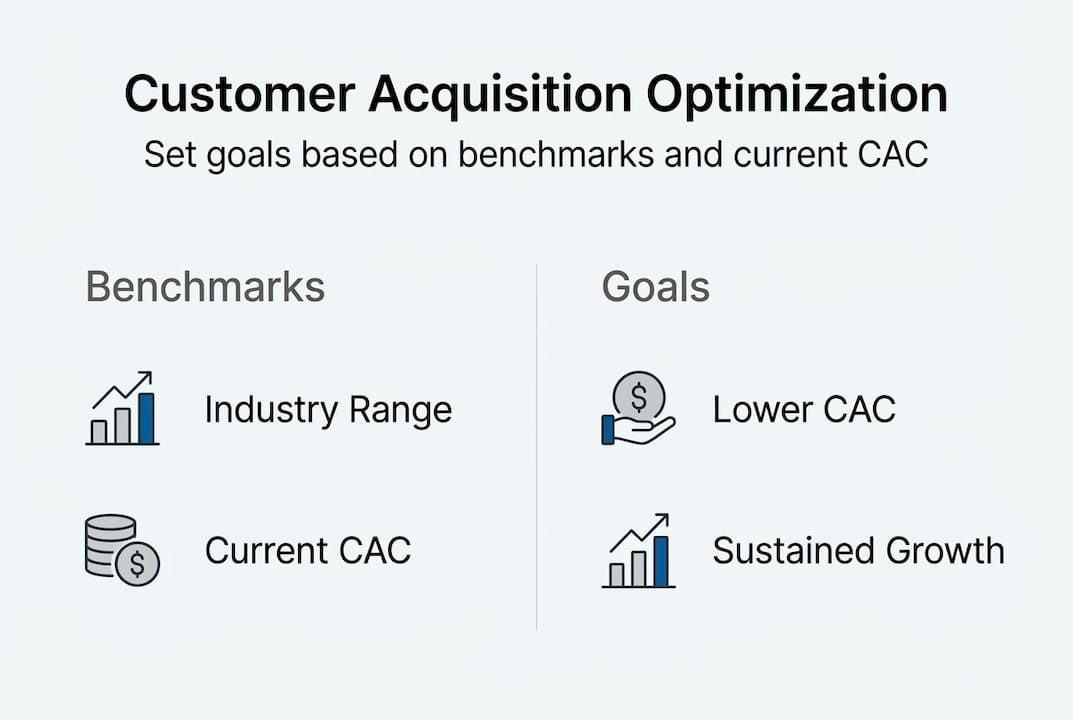
Industry benchmarks provide context for your performance. SMB CAC benchmarks vary by industry: eCommerce typically ranges from $45 to $120, SaaS and tech companies see $200 to $1,000, and professional services fall between $150 and $500. These ranges reflect different sales cycles, average transaction values, and competitive landscapes.
| Industrie | Average CAC Range | Key Factors |
|---|---|---|
| eCommerce | $45-$120 | High volume, lower transaction value, paid ads |
| SaaS/Tech | $200-$1,000 | Longer sales cycles, higher LTV, content marketing |
| Professionele diensten | $150-$500 | Relationship-driven, referrals, local marketing |
| Coaching/Education | $100-$300 | Personal brand, webinars, social proof |
| Vastgoed | $300-$800 | High-value transactions, local SEO, networking |
To calculate your baseline CAC, add up all marketing and sales expenses for a quarter, including advertising spend, software subscriptions, salaries, and content creation costs. Divide that total by the number of customers you acquired during the same period. If you spent $15,000 and gained 50 customers, your CAC is $300.
Track these core metrics alongside CAC:
- Conversion rates at each funnel stage to identify bottlenecks
- Customer lifetime value to ensure acquisition costs remain profitable
- Time to conversion to understand how quickly prospects become customers
- Channel-specific CAC to allocate budget toward your best performers
Set practical optimization goals based on your industry benchmark and current performance. If your CAC sits above the average for your sector, aim to reduce it by 15 to 25 percent over six months through optimized marketing automation processes. If you’re already below average, focus on scaling volume while maintaining or slightly improving efficiency.
Preparing your acquisition process: journey mapping, data hygiene, and segmentation
Automation amplifies whatever process you feed it. If your customer journey is unclear or your data is messy, automation will scale those problems instead of solving them. Journey mapping visualizes every touchpoint a prospect experiences from awareness to purchase, revealing gaps, friction points, and opportunities for improvement.
Start by documenting how customers currently discover you, what actions they take before buying, and where they drop off. A coaching business might map: social media ad, landing page visit, lead magnet download, email sequence, discovery call booking, and purchase. Each step represents a potential optimization point.

Data hygiene makes or breaks automation effectiveness. Duplicate contacts, outdated information, and incomplete records cause workflows to misfire, sending the wrong message to the wrong person at the wrong time. Clean your database before launching any automation by removing duplicates, standardizing formatting, and filling critical gaps in contact records.
Segmentation transforms generic broadcasts into personalized conversations. Group contacts by behavior, demographics, purchase history, or engagement level to deliver relevant messages that resonate. A professional services firm might segment by industry, company size, and stage in the buying journey, tailoring content to each group’s specific needs.
Common preparation mistakes that sabotage automation outcomes include:
- Automating before journey mapping, creating workflows that don’t match actual customer behavior
- Poor segmentation that treats all prospects identically, reducing relevance and engagement
- Over-automation that removes human touch, making interactions feel robotic and impersonal
- Ignoring data hygiene, allowing errors to compound across automated campaigns
- Set-and-forget workflows that never get reviewed or updated based on performance
Effective segmentation drives personalized interactions by ensuring each contact receives content matched to their interests, needs, and readiness to buy. Instead of blasting everyone with the same email, you send targeted messages that speak directly to where they are in their journey. A prospect researching solutions needs educational content, while someone who attended a demo needs pricing information and case studies.
Pro Tip: Schedule quarterly data audits to review contact quality, remove inactive leads, and update segmentation criteria based on new insights. Regular maintenance prevents small data issues from becoming major automation problems.
Implementing marketing automation best practices during preparation sets the foundation for sustainable success. Document your processes, test workflows with small groups before full deployment, and establish clear ownership for ongoing maintenance. The time invested in proper preparation pays dividends through higher conversion rates and lower acquisition costs.
Begrip why automating customer communication matters helps frame these preparation steps as essential rather than optional. Clean data and clear journeys enable automation to enhance relationships instead of damaging them.
Executing optimized customer acquisition through integrated marketing automation
With preparation complete, you’re ready to implement automation that reduces CAC and increases conversions. Follow these steps to build efficient workflows:
- Start with your highest-value touchpoints where automation delivers immediate impact, such as lead nurturing sequences or appointment reminders
- Connect your email platform, CRM, and analytics tools so data flows seamlessly between systems without manual exports or imports
- Build simple workflows first, testing each step before adding complexity to ensure reliability
- Set up tracking for key metrics at every stage so you can measure performance and identify improvement opportunities
- Create personalized content variations for different segments, using dynamic fields to customize messages at scale
- Establish triggers based on specific behaviors, like downloading a resource or abandoning a cart, to deliver timely follow-up
- Schedule regular reviews of workflow performance, pausing underperforming campaigns and scaling successful ones
Integrating email, social media, CRM, and analytics platforms creates a unified system where insights from one channel inform actions in another. When a prospect engages with your social content, your CRM logs the interaction and triggers a relevant email sequence. When they open that email and click through, your analytics track the journey and your workflow adapts the next message accordingly.
Automation reduces overhead by 12%, boosts productivity 14.5%, and organic-dominant brands achieve 41% lower CAC through efficient processes that eliminate repetitive manual tasks. These gains compound over time as your team focuses on strategy and relationship-building instead of administrative work.
| Platform Type | Key Features for SMBs | Integration Priority | Typical Cost |
|---|---|---|---|
| All-in-one solutions | Email, CRM, automation, analytics in one system | High (reduces complexity) | $97-$297/month |
| Email-focused platforms | Advanced segmentation, A/B testing, deliverability | Medium (core channel) | $20-$150/month |
| CRM-first systems | Contact management, pipeline tracking, reporting | High (central data hub) | $25-$125/month |
| Social automation tools | Scheduling, engagement tracking, ad management | Low (supplementary) | $15-$99/month |
| Analytics platforms | Conversion tracking, attribution, ROI measurement | Medium (insights driver) | $0-$200/month |
Pro Tip: Begin with one or two simple workflows, like a welcome series for new subscribers or a re-engagement campaign for inactive contacts. Master these before expanding to complex, multi-channel sequences. Early wins build confidence and provide data to inform more sophisticated strategies.
Continuous monitoring and campaign refinement separate successful automation from wasted effort. Review performance weekly during the first month, then shift to biweekly or monthly as workflows stabilize. Look for declining open rates, drop-offs at specific steps, or segments that underperform compared to others.
Marketing automation software designed for SMB conversions combines these capabilities in accessible packages that don’t require technical expertise. The right platform grows with your business, adding features as your needs evolve.
Understanding the broader impact of marketing automation on business growth helps you prioritize which workflows to build first and where to invest optimization effort for maximum return.
Verifying results and avoiding common pitfalls for sustained acquisition success
Measuring results accurately requires tracking the right metrics and understanding what they reveal about your acquisition process. Monitor CAC trends over time rather than fixating on single data points, looking for consistent improvement across quarters. Compare channel-specific CAC to identify your most efficient sources and reallocate budget accordingly.
Common mistakes to watch for after launching automation:
- Set-and-forget workflows that never get updated, causing performance to drift as market conditions change
- Robotic automation that removes personality, making prospects feel like numbers instead of people
- Ignoring data hygiene after initial cleanup, allowing quality to degrade and errors to multiply
- Failing to test variations, missing opportunities to improve conversion rates through optimization
- Over-relying on automation without maintaining strategic human touchpoints at critical moments
Calculate ROI properly by comparing total automation costs, including software, setup time, and content creation, against the value generated through improved conversion rates and reduced manual labor. If automation cuts your CAC from $300 to $225 while maintaining the same customer volume, and you acquire 200 customers per quarter, you save $15,000 quarterly or $60,000 annually.
| Aspect | Manual Process | AI-Driven Automation | Voordeel |
|---|---|---|---|
| Targeting accuracy | Static segments, periodic updates | Dynamic segments, real-time adaptation | AI adjusts to behavior changes instantly |
| Personalization depth | Basic merge tags, manual customization | Predictive content, behavioral triggers | AI delivers relevance at scale |
| Resource efficiency | High labor costs, limited scale | Low overhead, unlimited scale | AI handles volume without adding staff |
| Optimization speed | Monthly or quarterly reviews | Continuous testing and improvement | AI identifies winning variations faster |
| CAC reduction potential | 10-15% through process improvement | 25-40% through intelligent targeting | AI finds efficiencies humans miss |
AI automations adapt in real-time, reducing CAC through better targeting and optimizing customer lifetime value by predicting which prospects are most likely to convert and become long-term customers. Machine learning algorithms analyze patterns across thousands of interactions, identifying signals that indicate purchase intent or churn risk.
Best practices for ongoing data hygiene and segmentation include:
- Automated data validation rules that flag incomplete or suspicious entries for review
- Regular deduplication processes that merge duplicate records and preserve the most complete information
- Progressive profiling that gradually collects additional details without overwhelming prospects with long forms
- Behavioral scoring that updates contact priorities based on engagement and buying signals
- Quarterly segment reviews that retire outdated criteria and introduce new ones based on business evolution
AI automation’s role in sustained growth extends beyond efficiency gains to strategic advantages. Predictive analytics forecast which campaigns will perform best with specific segments. Natural language processing personalizes messaging at a granular level. Recommendation engines suggest next-best actions for each contact based on similar customer journeys.
Comparing marketing automation versus manual processes reveals not just time savings but qualitative improvements in consistency, personalization, and scalability that manual approaches can’t match.
Implementing affordable marketing automation tips ensures you maximize value without overspending on features you don’t need or complexity that slows adoption.
Optimize your customer acquisition with specialized marketing automation software
You’ve learned how to analyze, prepare, execute, and verify an optimized acquisition process. Now it’s time to implement these strategies with tools built specifically for SMB success. Go Online Now-Connect delivers everything you need in one affordable platform: email automation, SMS campaigns, funnel builders, CRM, and analytics that work together seamlessly.
Unlike enterprise platforms that overwhelm you with complexity and cost, our system is designed for business owners who want results without the hassle. We configure your automations, build your funnels, and integrate your systems at no extra cost. You get proven workflows that have helped SMBs achieve up to 85% more conversions and 75% time saved in 90 days.
Our marketing automation software for SMB conversions combines powerful features with straightforward pricing: no contracts, no hidden fees, and a fair pricing guarantee that matches or refunds competitor quotes. Real human support guides you through setup and optimization, ensuring you maximize marketing automation software ROI from day one. Explore our complete marketing automation software SMB guide to see how integrated tools transform acquisition efficiency.
Frequently asked questions
How long does it take to see results from optimizing the customer acquisition process?
Most SMBs notice measurable improvements within 30 to 60 days of implementing optimized automation workflows. Early wins include higher email open rates and better lead response times. Significant CAC reductions typically emerge after 90 days once you’ve gathered enough data to refine targeting and messaging. The timeline depends on your sales cycle length, with shorter cycles showing faster results.
What budget should SMBs allocate for marketing automation?
Plan to invest between $100 and $500 monthly for automation software, depending on your contact volume and feature needs. Add 10 to 20 hours of initial setup time and 5 to 10 hours monthly for ongoing optimization. Most SMBs recover this investment within three to six months through improved conversion rates and reduced manual labor. Affordable marketing automation strategies help you maximize impact while controlling costs.
Which automation tools work best for small to mid-sized businesses?
All-in-one platforms that combine email, CRM, and analytics deliver the best value for SMBs by eliminating integration headaches and reducing total cost. Look for systems with pre-built templates, drag-and-drop builders, and included support to minimize setup time. Avoid enterprise platforms with complex pricing tiers and features you’ll never use. The right tool should feel intuitive within days, not months.
How do I measure and track acquisition improvements effectively?
Track CAC monthly by dividing total marketing and sales costs by new customers acquired. Monitor conversion rates at each funnel stage to identify specific bottlenecks. Compare channel performance to allocate budget toward your most efficient sources. Use cohort analysis to see how acquisition quality changes over time. Most automation platforms include built-in reporting that surfaces these metrics automatically.
What are common mistakes to avoid when automating customer acquisition?
Common mistakes include automating before journey mapping, which creates workflows that don’t match actual customer behavior. Ignoring data hygiene leads to errors that compound across campaigns. Over-automation removes the human touch that builds trust and relationships. Treating all prospects identically through poor segmentation reduces message relevance. Set-and-forget workflows never improve without regular review and optimization.
How can AI improve my customer acquisition process?
AI automations adapt in real-time, reducing CAC through better targeting that identifies high-intent prospects and optimizes customer lifetime value. Machine learning analyzes behavioral patterns to predict which contacts are most likely to convert, allowing you to prioritize outreach accordingly. AI personalizes content dynamically based on individual engagement history, delivering relevance at scale that manual processes can’t match. Predictive analytics forecast campaign performance before you invest significant budget, reducing wasted spend on underperforming strategies.
Aanbevolen
- Top 7 SMB marketing strategies for growth in 2026 – Go Online Now
- Examples of automated marketing campaigns for growth – Go Online Now
- Why Automate Customer Engagement? 85% More Conversions – Go Online Now
- Funnels in Customer Acquisition: Unlocking 85% More Conversions – Go Online Now
- Leadgeneratie Duitsland: succesvolle strategie voor meer klanten – Duitsewebsite.nl