
Over 70 percent of American small businesses say saving time is their top priority when it comes to marketing. For service companies trying to compete with national chains, finding user-friendly solutions is not just a wish, it is a necessity. This guide explains how marketing automation software empowers American business owners to handle more leads and grow revenue using simple, affordable tools that eliminate unnecessary manual tasks.
Marketing automation software explained for SMBs
Marketing automation software represents a powerful technological solution designed to help small and medium-sized businesses streamline their digital marketing efforts and boost conversions. At its core, these platforms enable businesses to automate repetitive marketing tasks and manage multi-channel interactions more efficiently than traditional manual approaches.
The primary function of marketing automation software involves transforming complex marketing processes into simplified, systematic workflows. Small businesses can leverage these tools to automatically send targeted emails, track customer interactions, segment audiences, and nurture leads without requiring extensive technical expertise. By integrating multiple communication channels like email, SMS, and social media, these platforms create a cohesive strategy that increases engagement and reduces the manual workload for business owners.

Key capabilities of marketing automation software typically include lead capture, email marketing campaigns, customer segmentation, performance tracking, and personalized communication strategies. Small businesses benefit from features that allow them to design automated workflows that respond to specific customer behaviors, such as sending a welcome sequence when someone signs up or triggering a follow-up message after a potential customer downloads a resource. These intelligent systems help SMBs compete with larger enterprises by providing sophisticated marketing capabilities without requiring significant additional staffing or technical infrastructure.
Pro tip: Start by mapping out your current marketing processes and identifying repetitive tasks that could be automated to maximize the potential of your marketing automation software.
Types of automation: Email, CRM, and beyond
Marketing automation encompasses several critical types that help small businesses optimize their digital marketing strategies. Different automation platforms offer specialized capabilities across multiple marketing channels, enabling businesses to create more efficient and targeted communication approaches.
Email automation represents the foundational layer of marketing automation, allowing businesses to send personalized, timed messages based on specific customer behaviors or predefined triggers. Beyond email, Customer Relationship Management (CRM) automation helps track and manage customer interactions, storing critical data about leads, monitoring communication history, and facilitating more intelligent follow-up strategies. These systems can automatically update contact information, score leads based on engagement, and streamline sales pipeline management.
Additional automation types extend well beyond email and CRM, including social media scheduling, SMS marketing, advertising campaign management, and comprehensive workflow builders. Small businesses can leverage these tools to automate repetitive tasks like posting social media content, sending text message reminders, tracking advertising performance, and creating complex multi-step marketing sequences that respond dynamically to customer actions. By implementing these diverse automation strategies, companies can reduce manual workload, improve response times, and create more personalized customer experiences.
Here’s a summary of key automation types and their business impact:
| Automation Type | Core Function | Main Business Benefit |
|---|---|---|
| E-mailautomatisering | Sends triggered campaigns | Drives customer engagement |
| CRM Automation | Manages customer data | Improves lead management |
| Social Media Automation | Schedules posts | Saves time on content distribution |
| SMS Automation | Sends targeted texts | Increases timely communication |
| Advertising Automation | Manages ad campaigns | Enhances ad effectiveness |
| Workflow Builders | Creates multi-step sequences | Streamlines marketing processes |
Pro tip: Start by identifying the most time-consuming marketing tasks in your business and prioritize automating those processes to maximize efficiency and return on investment.
Key features that drive higher conversions
Marketing automation software offers several critical features designed to transform how small businesses approach customer engagement and sales generation. Advanced automation tools provide sophisticated mechanisms for tracking and improving conversion rates, enabling businesses to make data-driven decisions that directly impact revenue.
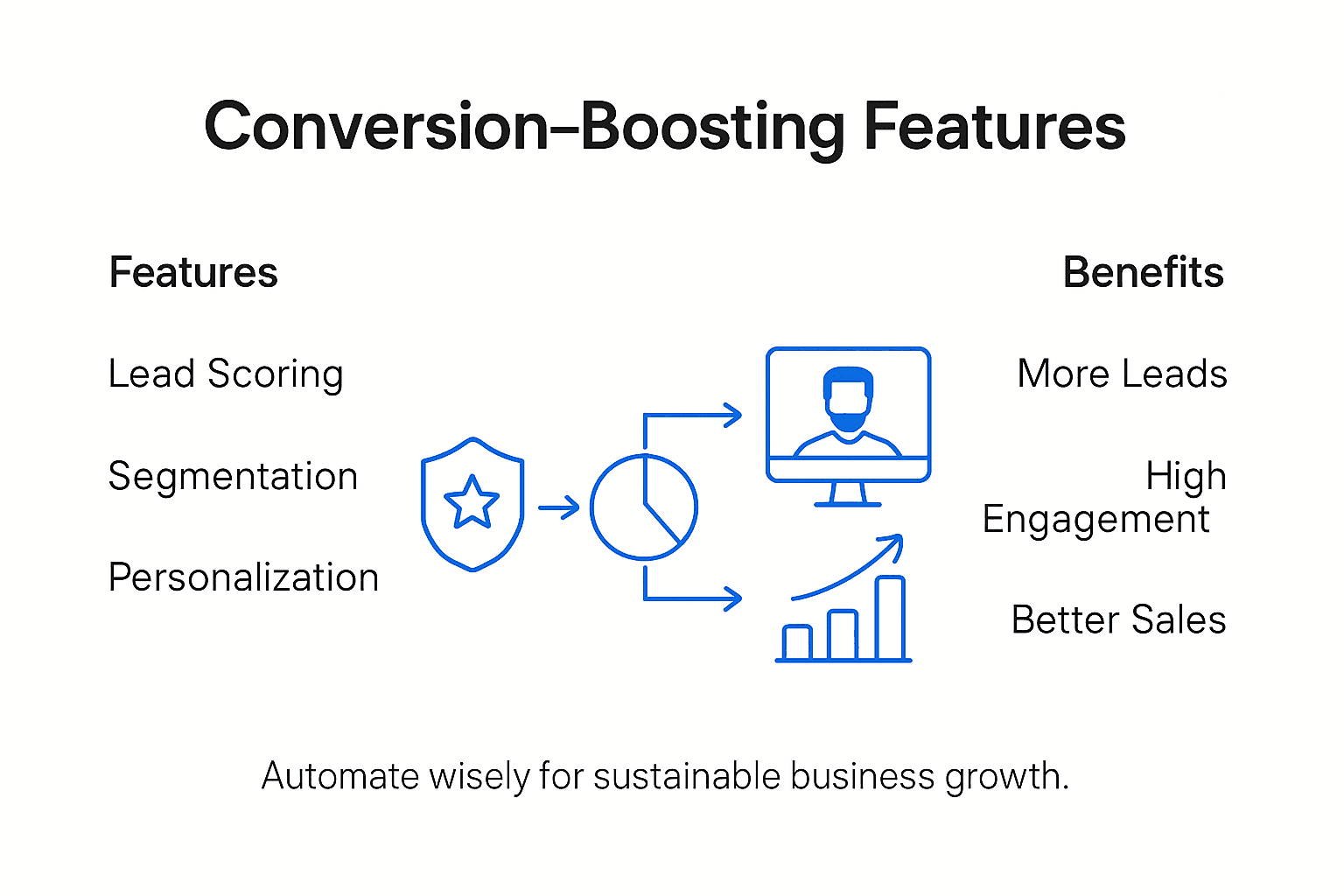
Lead scoring represents a powerful feature that helps businesses prioritize and segment potential customers based on their interactions and behaviors. By assigning numerical values to different customer actions like email opens, website visits, content downloads, and engagement levels, companies can automatically identify the most promising leads. This intelligent ranking system allows sales teams to focus their energy on prospects most likely to convert, dramatically improving efficiency and conversion potential.
Personalization and dynamic content targeting constitute another crucial conversion-driving feature of modern marketing automation platforms. These tools enable businesses to create highly customized experiences by automatically adjusting website content, email messaging, and marketing materials based on individual user characteristics, past interactions, and predictive analytics. Small businesses can now deliver precisely targeted communications that feel individually crafted, increasing the likelihood of engagement and purchase. Advanced segmentation capabilities allow for granular targeting, ensuring that each customer receives content most relevant to their specific needs and interests.
Pro tip: Implement a systematic approach to testing and tracking your automation workflows, regularly analyzing which personalization strategies generate the highest conversion rates.
Lead nurturing, segmentation, and smart targeting
Lead nurturing represents a sophisticated approach to transforming potential customers into committed buyers through strategic, targeted communication. Advanced AI technologies now enable more intelligent segment recognition and customer interaction analysis, allowing small businesses to create more personalized and effective marketing strategies.
Effective segmentation goes beyond basic demographic grouping, diving deep into behavioral patterns, engagement levels, and predictive indicators. Marketing automation platforms help businesses create dynamic customer segments that automatically update based on real-time interactions. These intelligent systems can track nuanced signals like website browsing behavior, email interaction rates, content download preferences, and purchasing history to create microsegments that enable hyper-targeted marketing approaches.
Smart targeting takes segmentation to the next level by enabling businesses to craft individualized communication journeys. Using advanced machine learning algorithms, marketing automation tools can predict customer needs, recommend personalized content, and trigger specific communication workflows based on individual customer actions. This approach transforms generic marketing into a precision-driven strategy where each interaction feels uniquely tailored, increasing the likelihood of conversion and building stronger customer relationships.
Pro tip: Regularly audit and refresh your customer segments to ensure your targeting remains accurate and responsive to evolving customer behaviors and preferences.
Costs, pitfalls, and maximizing ROI with automation
Marketing automation represents a significant investment for small businesses, with potential returns that can dramatically transform operational efficiency. Research reveals critical considerations regarding the financial and strategic challenges of implementing marketing automation platforms, highlighting the importance of strategic planning and comprehensive cost assessment.
The total cost of marketing automation extends far beyond the monthly software subscription. Hidden expenses often include team training, system integration, content creation, and ongoing technical support. Small businesses must budget for initial setup costs, potential customization fees, and the time investment required to develop effective automation workflows. Many companies underestimate the complexity of implementing these systems, leading to unexpected expenses and reduced initial return on investment.
This table highlights potential hidden costs and ROI considerations for SMBs:
| Cost Factor | Why It Matters | ROI Strategy |
|---|---|---|
| Training | Ensures team adoption | Schedule regular skill updates |
| Integratie | Enables systems to work together | Start with core platform, expand later |
| Inhoud creëren | Fuels all workflows | Reuse top-performing content |
| Ongoing Support | Resolves technical issues | Plan for long-term assistance |
| Initial Setup | Delivers basic functionality | Phase rollout by business priority |
Maximizing ROI requires a methodical approach that goes beyond simple tool selection. Successful implementation demands alignment between marketing and sales teams, clear performance metrics, continuous learning, and a willingness to experiment and refine automation strategies. Small businesses should start with core automation features, measure their impact meticulously, and gradually expand their capabilities. This incremental approach allows for controlled spending, realistic expectation management, and the ability to demonstrate tangible business value before making substantial additional investments.
Pro tip: Create a detailed implementation roadmap with specific, measurable goals and allocate a contingency budget for unexpected training or integration expenses.
Unlock the Power of Marketing Automation for Your SMB Today
Many small and medium-sized businesses struggle with managing repetitive marketing tasks, lead nurturing, and complex CRM processes as detailed in this article. If you want to boost conversions and save valuable time by simplifying multi-channel marketing efforts like email automation, lead scoring, and dynamic customer segmentation, you need a solution tailored specifically to your unique business needs.
Bij Ga nu online, we offer an all-in-one marketing automation software designed to help SMBs grow smarter not harder. Our platform combines essential marketing automation tools, a unified CRM, and digital marketing services with real human support and done-for-you setup. This means you do not have to worry about complicated tech setups or hidden integration costs. Discover more insights and proven strategies in our Automatiseringsarchieven and sharpen your marketing edge in our Digitale marketingarchieven.
Stop letting manual marketing tasks drain your energy and budget. Take control of your lead management and CRM with a simple, affordable system that delivers up to 85 percent more conversions and saves 75 percent of your time within 90 days. Visit Go Online Now and start your journey towards hassle-free marketing automation that works for you.
Veelgestelde vragen
What is marketing automation software?
Marketing automation software is a technological solution that helps small and medium-sized businesses automate repetitive marketing tasks, manage multi-channel interactions, and improve efficiency in their digital marketing efforts.
How can marketing automation software improve SMB conversions?
By automating processes such as lead nurturing, email campaigns, and customer segmentation, marketing automation software enables SMBs to engage customers more effectively, deliver personalized communications, and enhance overall conversion rates.
What are the key features of marketing automation software?
Key features typically include lead capture, email marketing, customer relationship management (CRM), performance tracking, and advanced segmentation, allowing businesses to create tailored marketing strategies and workflows.
What costs should SMBs consider when implementing marketing automation?
In addition to the subscription fee, SMBs should consider costs associated with training, system integration, content creation, and ongoing support. Proper budgeting and planning can help maximize return on investment.
Aanbevolen
- Marketing Automation Software: Complete Guide for SMBs – Go Online Now
- Marketing Automation Software: Complete Guide for SMBs – Go Online Now
- Marketing Automation Software: Smarter Growth for SMBs – Go Online Now
- 7 Affordable Marketing Automation Tips for SMB Success – Go Online Now
- Best Lead Generation Software 2025 – Expert Comparison – Jarrod Harman