
Nearly 62 percent of American small businesses struggle to keep up with growing marketing demands and customer expectations. For marketing directors, juggling manual tasks, analyzing customer data, and creating engagement strategies can drain time and resources quickly. This overview explains how affordable automation platforms empower American service-based businesses to streamline everyday marketing processes, boost customer engagement, and drive smarter growth without stretching budgets.
What Is Marketing Automation Software?
Marketing automation software is a powerful digital platform designed to streamline and optimize marketing processes for small and mid-sized businesses. At its core, marketing automation transforms repetitive manual tasks into efficient, intelligent workflows that help businesses grow smarter and faster.
The primary goal of marketing automation technologies is to consolidate multi-channel marketing interactions, tracking, and analytics into one integrated system. By automating tasks like email campaigns, lead scoring, and customer segmentation, these platforms enable marketing teams to focus on strategic initiatives rather than getting bogged down in administrative work. Modern marketing automation goes beyond simple task replacement – it uses advanced algorithms to analyze customer data, predict behavior, and personalize marketing experiences at scale.
Key capabilities of marketing automation software typically include:
- Automated email marketing campaigns
- Lead generation and nurturing workflows
- Customer segmentation and targeting
- Performance tracking and reporting
- Integration with customer relationship management (CRM) systems
- Gepersonaliseerde contentlevering
Pro tip: Start with mapping out your existing marketing workflows to identify repetitive tasks that could benefit most from automation.
Essential Features and Platform Types Explained
Modern marketing automation platforms offer a complex array of features designed to transform how small and mid-sized businesses approach customer engagement. Marketing automation technologies encompass sophisticated tools that go far beyond basic email campaigns, integrating multiple channels and intelligent data processing to create seamless marketing experiences.

These platforms typically fall into three primary categories:
Here’s a quick overview of the main marketing automation platform types and their core business purpose:
| Platform Type | Primary Focus | Example Benefit |
|---|---|---|
| Marketing Intelligence | Analyzing customer behavior | Improved targeting strategies |
| Marketingautomatisering | Lead nurturing and content delivery | Higher conversion rates |
| Marketing Orchestration | Coordinating multi-channel efforts | Seamless campaign execution |
- Marketing Intelligence Platforms: Focus on tracking and analyzing customer behavior
- Marketing Automation Platforms: Specialize in lead nurturing and targeted content delivery
- Marketing Orchestration Platforms: Coordinate multi-channel marketing strategies
Key features that distinguish advanced marketing automation software include:
- Comprehensive email marketing capabilities
- Advanced lead scoring and segmentation
- Cross-channel interaction tracking
- Real-time performance analytics
- Customer relationship management (CRM) integration
- Personalized content recommendation engines
- Social media interaction monitoring
Advanced technology platforms are increasingly leveraging artificial intelligence to process complex user interactions and automatically optimize marketing workflows. This means businesses can now access predictive analytics, dynamic content personalization, and intelligent campaign management without requiring extensive technical expertise.
Pro tip: When evaluating marketing automation platforms, create a detailed checklist of your specific business needs to ensure you select a solution that aligns with your unique marketing strategy.
How Automation Accelerates SMB Growth
Marketingautomatisering represents a transformative strategy for small and mid-sized businesses seeking sustainable growth. Advanced automation technologies enable businesses to dramatically optimize workflows, reduce manual effort, and redirect human resources toward high-value strategic activities.
The growth acceleration happens through several critical mechanisms:
- Efficient Lead Management: Automatically capturing, scoring, and nurturing potential customers
- Personalized Customer Interactions: Delivering targeted communications based on individual behavior
- Productivity Enhancement: Reducing time spent on repetitive administrative tasks
- Datagestuurde besluitvorming: Providing real-time insights into marketing performance
- Kostenreductie: Minimizing manual labor and improving operational efficiency
Marketingautomatisering fundamentally transforms how SMBs approach customer acquisition and retention. By marketing automation processes that intelligently track customer interactions, businesses can create more meaningful engagement pathways. This approach allows smaller organizations to compete with larger enterprises by implementing sophisticated marketing strategies without requiring extensive resources.
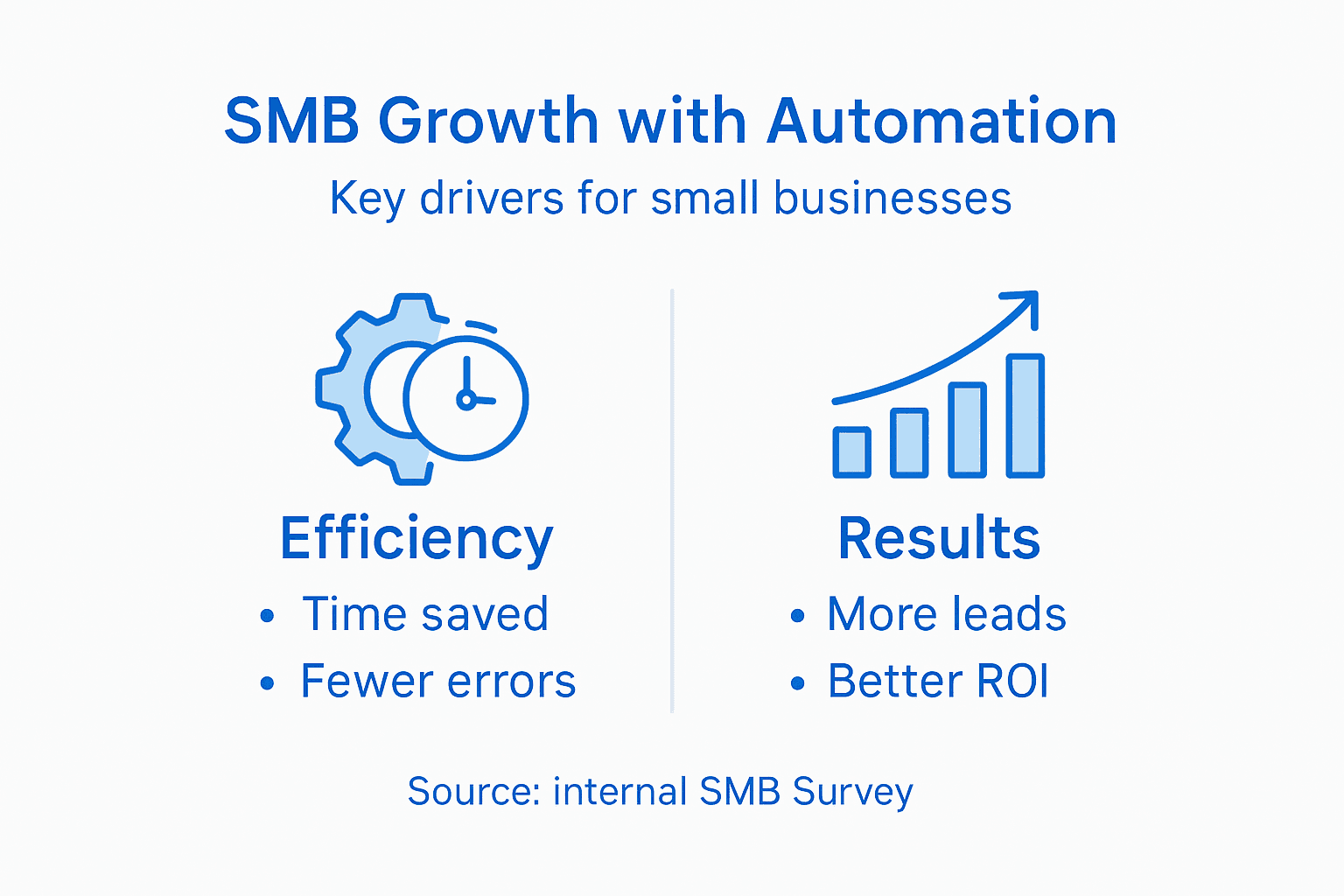
The key is implementing automation strategically – focusing on solutions that provide maximum impact with minimal complexity. Modern platforms offer SMBs the ability to create sophisticated, personalized marketing campaigns that were previously accessible only to large corporations with extensive marketing departments.
Pro tip: Start by mapping your current marketing workflows and identify three repetitive tasks that could be immediately automated to free up your team’s strategic bandwidth.
Key Benefits: Engagement, ROI, and Productivity
Marketingautomatisering delivers transformative benefits for small and mid-sized businesses by creating more intelligent, efficient, and data-driven marketing strategies. Generative AI technologies are revolutionizing how businesses approach customer engagement, enabling unprecedented levels of personalization and strategic insight.
The three primary benefits of marketing automation include:
-
Verbeterde klantbetrokkenheid
- Personalized communication based on individual customer behaviors
- Timely and relevant interactions across multiple channels
- Improved customer experience through targeted messaging
-
Increased Return on Investment (ROI)
- Optimized marketing spend through data-driven decisions
- Improved conversion rates by targeting high-potential leads
- Detailed tracking of marketing campaign performance
-
Productivity Optimization
- Automation of repetitive marketing tasks
- Reduced manual administrative workload
- Enabling team members to focus on strategic initiatives
Marketing automation platforms provide small businesses with capabilities previously accessible only to large corporations. By consolidating customer data, tracking interactions, and creating intelligent workflows, these tools enable SMBs to compete more effectively in increasingly digital marketplaces.
The most successful businesses will be those that view marketing automation not as a technology replacement, but as a strategic partner that amplifies human creativity and decision-making capabilities.
Pro tip: Begin your automation journey by selecting three specific, repetitive marketing tasks that consume significant time and map out how automation could streamline these processes.
Risks, Costs, and Common Pitfalls for SMBs
Marketingautomatisering requires careful strategic implementation to avoid potential risks that could undermine business growth. Small business cybersecurity risks represent a critical consideration that many SMBs overlook when adopting new technological solutions.
Common risks and pitfalls include:
Below is a summary of key risks and solutions for SMBs considering marketing automation:
| Risk Area | Common Challenge | How to Mitigate |
|---|---|---|
| Financial | High setup or unused features | Start with essential core tools |
| Operational | Complex system integration | Opt for scalable, modular platforms |
| Strategic | Lacking clear automation goals | Develop a defined implementation plan |
-
Financial Risks
- High initial setup and training costs
- Unexpected maintenance expenses
- Potential underutilization of purchased technologies
-
Operational Challenges
- Insufficient technical expertise
- Complex implementation processes
- Integration difficulties with existing systems
-
Strategic Implementation Risks
- Lack of clear automation strategy
- Poor data quality and management
- Overreliance on automated processes
Marketing automation implementation demands a nuanced approach that balances technological capabilities with human insight. SMBs must carefully evaluate their specific needs, technical capabilities, and long-term strategic objectives before investing in comprehensive automation platforms.
Successful implementation requires a holistic approach that considers not just technological features, but also the unique workflow and culture of the specific business. The most effective marketing automation strategies integrate technology as a supportive tool that enhances human creativity and decision-making.
Pro tip: Conduct a thorough internal audit of your current marketing processes and skill sets before investing in any marketing automation platform.
Unlock SMB Growth with Simplified Marketing Automation
The article highlights how small and mid-sized businesses face challenges like managing repetitive marketing tasks, creating personalized customer journeys, and navigating complex platforms. If you are looking to save valuable time and boost conversions without the headache of expensive over-engineered systems, Go Online Now-Connect is designed just for you. Our all-in-one marketing automation software solves key pain points like lead nurturing, multi-channel campaign coordination, and CRM integration — all in a simple and affordable system with real human support.
Discover how our platform combines essential marketing automation tools with digital marketing services to accelerate your growth with less effort. Whether you need email marketing automation, lead management and CRM, or expert help executing your strategy, we are your strategic partner. Don’t let complexity or cost hold you back — explore our flexible solutions tailored for SMBs by visiting Automation Archives – Go Online Now En Digital Marketing Archives – Go Online Now. Ready to grow smarter and faster? Get started today at Ga nu online and experience marketing automation made simple.
Veelgestelde vragen
What is marketing automation software?
Marketing automation software is a digital platform designed to streamline and optimize marketing processes for businesses. It automates repetitive tasks such as email campaigns, lead scoring, and customer segmentation, allowing marketing teams to focus on strategic initiatives.
What are the key features of marketing automation platforms?
Key features typically include automated email marketing campaigns, lead generation and nurturing workflows, customer segmentation, performance tracking, CRM integration, and personalized content delivery.
How can marketing automation accelerate SMB growth?
Marketing automation accelerates growth by improving lead management, personalizing customer interactions, enhancing productivity, enabling data-driven decisions, and reducing operational costs, allowing small and mid-sized businesses to compete effectively.
What are common risks associated with implementing marketing automation?
Common risks include high setup costs, complex system integration, lack of technical expertise, and the absence of a clear automation strategy. It’s essential to assess specific needs and develop a strategic implementation plan to mitigate these risks.
Aanbevolen
- Marketing Automation Software: Complete Guide for SMBs – Go Online Now
- Marketing Automation Software: Complete Guide for SMBs – Go Online Now
- Marketing Automation Software: Smarter Growth for SMBs – Go Online Now
- 7 Affordable Marketing Automation Tips for SMB Success – Go Online Now
- Optimiser conversion site : guide pour PME ambitieuses – ByTheWise