More than 60 percent of American small businesses report faster customer response times after investing in digital growth tools. For entrepreneurs and marketing managers in coaching and real estate, balancing daily client demands with technology adoption feels daunting but crucial. This guide breaks down proven ways to use digital strategies that increase operational efficiency and help every American business owner create more powerful customer experiences.
Defining Digital Growth for SMBs
Digital growth represents a strategic transformation where small and medium businesses leverage technology to enhance operational capabilities, customer interactions, and overall competitive positioning. Unlike traditional business expansion, digital growth focuses on using digital tools and platforms to drive efficiency, innovation, and scalable performance.
For SMBs, digital growth means systematically integrating technology across core business functions. This approach goes beyond simply having a website or social media presence. Digital transformation strategies encompass comprehensive changes in how businesses operate, communicate, and deliver value to customers.

Key dimensions of digital growth include operational efficiency, customer engagement, and revenue generation. Small businesses adopting digital technologies can streamline processes, create more personalized customer experiences, and unlock new revenue streams. This might involve implementing marketing automation, developing data-driven insights, or creating digital service channels that expand market reach.
Key Components of Digital Growth:
- Technology integration across business functions
- Data-driven decision making
- Enhanced customer experience platforms
- Scalable digital infrastructure
- Continue leren en aanpassing
Pro tip: Start small by identifying one digital process to optimize, then gradually expand your technology ecosystem to build sustainable digital growth capabilities.
Types of Digital Growth Strategies
Small and medium businesses have multiple strategic pathways for digital transformation, each designed to enhance competitive positioning and operational effectiveness. Digital business strategies are fundamentally categorized into three primary approaches: Organizational Redesign, Ecosystem Reconfiguration, and Business Model Reinvention.
Organizational Redesign focuses on internal technological integration, where businesses restructure workflows, implement digital tools, and create more agile operational frameworks. This strategy involves adopting technologies that streamline communication, automate routine tasks, and improve overall organizational efficiency. Small businesses might invest in cloud-based project management systems, digital collaboration platforms, or integrated customer relationship management tools.
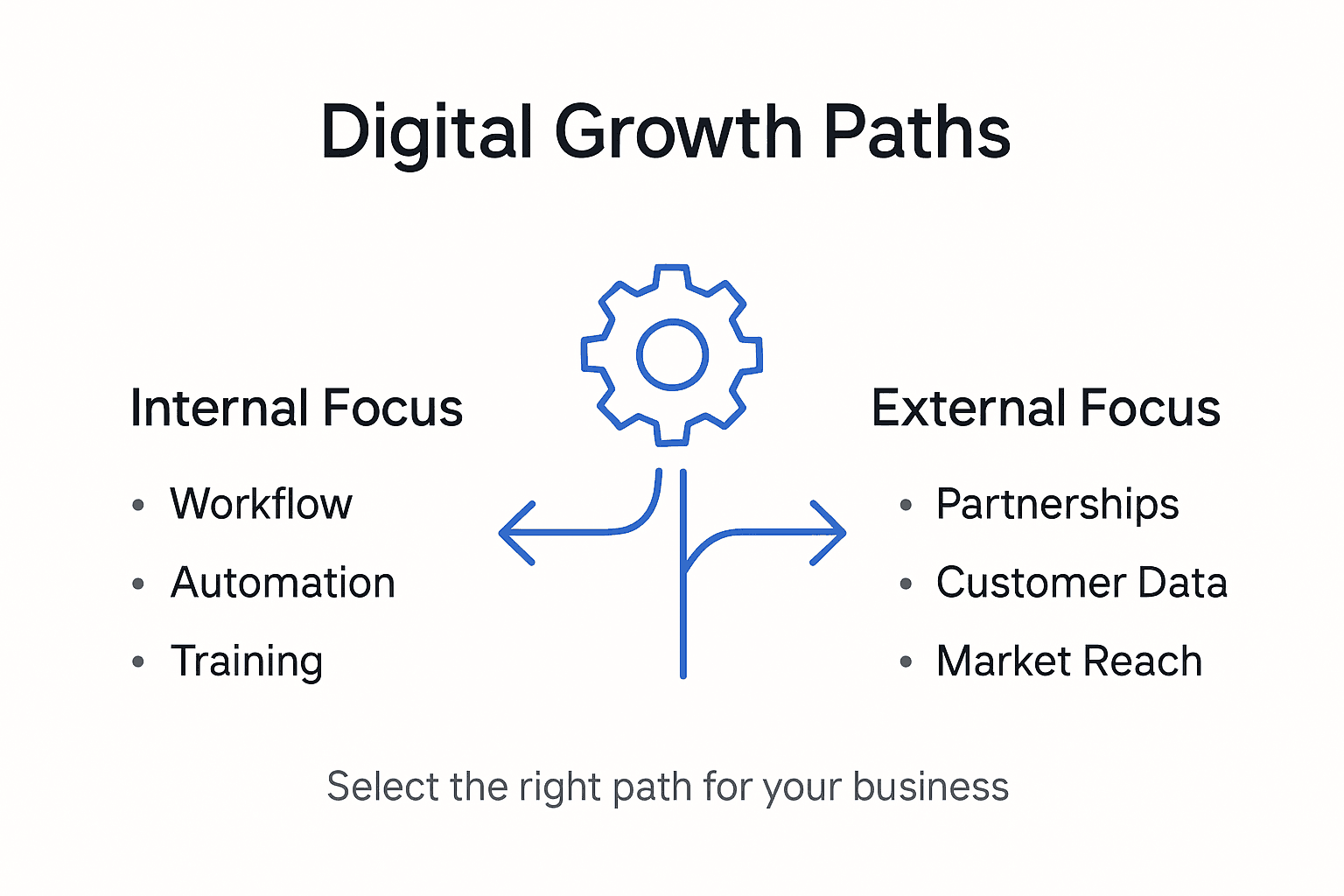
Ecosystem Reconfiguration represents a more expansive approach, where businesses reimagine their external relationships and digital interactions. This strategy involves developing digital platforms that connect multiple stakeholders, including customers, suppliers, and partners. By creating interconnected digital ecosystems, SMBs can expand their market reach, develop new revenue streams, and create more responsive business networks.
Key Digital Growth Strategy Types:
Here’s a comparison of digital growth strategy types and their core focus areas:
| Strategy Type | Core Focus | Typical Outcomes |
|---|---|---|
| Organizational Redesign | Internal process upgrades | Improved efficiency, cost savings |
| Ecosystem Reconfiguration | External partnerships | Expanded market reach |
| Business Model Reinvention | Service/product evolution | New revenue streams |
| Customer Experience Transformation | Enhanced interactions | Higher loyalty, engagement |
- Organizational Redesign
- Ecosystem Reconfiguration
- Business Model Reinvention
- Datagestuurde besluitvorming
- Customer Experience Transformation
Pro tip: Begin your digital growth journey by conducting a comprehensive digital capability assessment to identify the most suitable strategy for your specific business context and market positioning.
How Marketing Automation Drives Success
Marketing automation represents a transformative approach for small and medium businesses to streamline their marketing efforts and drive significant growth. Marketing automation technologies help SMBs automate repetitive tasks, personalize customer communications, and enhance overall marketing efficiency by creating targeted, intelligent engagement strategies.
The core strength of marketing automation lies in its ability to segment audiences, personalize interactions, and deliver precise communications at the right moment. By leveraging advanced data analytics and automated workflows, businesses can dramatically improve customer targeting. Research indicates that 66% of marketers experience meaningful success with automation strategies, highlighting its potential to revolutionize traditional marketing approaches and create more responsive, efficient business processes.
Small businesses can benefit from marketing automation across multiple dimensions, including lead generation, customer nurturing, and performance tracking. Automated systems enable companies to create sophisticated email campaigns, track customer interactions, and develop more intelligent marketing strategies without requiring extensive manual intervention. This approach allows entrepreneurs to focus on strategic decision making while technology handles routine marketing tasks.
Key Benefits of Marketing Automation:
- Personalized customer communication
- Efficient lead nurturing
- Improved marketing analytics
- Reduced manual marketing tasks
- Enhanced customer engagement
- Data-driven decision making
Pro tip: Start with a single, well-defined marketing automation workflow and gradually expand your capabilities as you understand the technology and its impact on your business.
Key Features of All-in-One CRM Tools
All-in-one CRM tools have revolutionized how small and medium businesses manage customer relationships, offering comprehensive solutions that integrate multiple business functions into a single platform. Centralized data management systems enable businesses to streamline operations, automate routine tasks, and gain real-time insights into customer interactions and business performance.
The core functionality of modern CRM tools extends far beyond simple contact tracking. These integrated platforms provide sophisticated features like contact management, interaction tracking, marketing automation, sales pipeline management, and advanced analytics. By consolidating these critical business functions, small businesses can create more efficient workflows, maintain more responsive customer relationships, and make data-driven decisions without investing in multiple complex software systems.
Specifically, all-in-one CRM tools offer powerful capabilities that transform how SMBs approach customer relationship management. These platforms enable businesses to track customer interactions across multiple channels, segment audiences, personalize communications, and monitor sales performance in real-time. The ability to integrate various business functions means entrepreneurs can access comprehensive insights, reduce manual data entry, and focus on strategic growth initiatives instead of administrative tasks.
Key CRM Tool Features:
- Centralized customer data management
- Automated marketing workflows
- Sales pipeline tracking
- Customer interaction history
- Performance analytics
- Integrated communication channels
Pro tip: Select a CRM tool that offers scalable features and seamless integration with your existing business software to maximize your digital growth potential.
Cost, ROI, and Competitive Advantages
Digital transformation represents a strategic investment for small and medium businesses, with financial implications that extend far beyond initial technology costs. Digital technologies enable SMBs to access advanced operational capabilities at increasingly affordable rates, creating opportunities for substantial long-term returns through improved efficiency and competitive positioning.
The return on investment for digital growth strategies becomes evident through multiple channels. Businesses implementing digital technologies can reduce operational expenses, streamline workflows, and create more agile business models. Enhanced data analytics capabilities allow entrepreneurs to make more precise decisions, optimize resource allocation, and identify new revenue streams that were previously invisible or inaccessible.
Competitive advantages emerge from strategic digital investments that transform how businesses operate and engage with customers. By adopting cloud-based technologies and integrated software solutions, SMBs can level the playing field with larger enterprises, accessing sophisticated tools that enable rapid adaptation, personalized customer experiences, and more responsive business models. These technological capabilities allow smaller businesses to compete more effectively by offering more nimble, innovative services.
Key Financial Benefits of Digital Growth:
- Lagere operationele kosten
- Enhanced productivity
- Improved customer targeting
- Scalable business infrastructure
- Data-driven strategic planning
- Faster market responsiveness
Pro tip: Conduct a comprehensive digital readiness assessment to identify the most cost-effective technologies that align directly with your specific business goals and growth strategy.
Common Pitfalls and How to Avoid Them
Digital transformation journeys for small businesses are fraught with potential challenges that can derail technology adoption and growth strategies. Cybersecurity risks represent a critical area of vulnerability for SMBs, with many entrepreneurs underestimating the complexity of protecting digital assets and managing technological infrastructure.
One of the most significant obstacles small businesses encounter involves insufficient expertise and strategic planning. Common pitfalls include neglecting employee training, failing to implement robust cybersecurity protocols, and adopting technologies without a comprehensive understanding of their operational impact. Businesses often rush into digital investments without conducting thorough assessments of their specific technological needs, leading to misaligned solutions that drain resources instead of generating value.
Technology adoption requires a holistic approach that goes beyond simply purchasing software or tools. Successful digital transformation demands careful consideration of organizational culture, existing workflow dynamics, and long-term strategic objectives. SMBs must develop a nuanced understanding of how digital technologies can genuinely enhance their operational capabilities, rather than viewing them as standalone solutions.
Key Digital Transformation Pitfalls:
To clarify the most common digital transformation pitfalls, here’s a quick reference table:
| Pitfall | Impact on SMBs | Prevention Method |
|---|---|---|
| Weak cybersecurity planning | Data breaches, financial loss | Regular security audits, training |
| Limited employee training | Low tech adoption rates | Invest in ongoing education |
| Poor technology alignment | Wasted resources, confusion | Match tech to business goals |
| Ignoring data privacy | Legal risks, customer distrust | Update policies, review compliance |
- Inadequate cybersecurity planning
- Poor technology integration
- Insufficient employee training
- Lack of strategic technology alignment
- Overlooking data privacy requirements
- Neglecting continuous learning
Pro tip: Conduct a comprehensive digital readiness audit that evaluates your technological capabilities, skill gaps, and strategic objectives before making significant digital investments.
Unlock Your Small Business’s Digital Growth Potential with the Right Partner
Many small businesses struggle with disjointed tools and overcomplicated systems when trying to achieve digital growth. The article highlights challenges such as inefficient marketing automation, poor customer relationship management, and costly technology adoption without clear returns. If your goal is to streamline operations and enhance customer engagement through proven digital strategies, Go Online Now-Connect offers the all-in-one solution tailored for your needs. Leveraging key concepts like marketing automation software for small business, all in one CRM, and lead management, our platform simplifies growth without unnecessary complexity.
Discover how combining marketing automation, CRM, and digital marketing services can help you overcome common pitfalls like poor technology alignment and insufficient training. We provide done-for-you setup, real human support, and fair pricing to ensure your digital transformation delivers real results and saves time. Start your smarter growth journey today by exploring our Digital Marketing Archives – Go Online Now en het volledige potentieel van uw bedrijf te benutten.
Ready to stop juggling multiple platforms and start growing smarter instead of harder? Visit Ga nu online to get started and access simple, affordable tools designed just for SMBs. Learn more about how our Virtuele assistentie archieven – Ga nu online En Website Services Archieven – Ga nu online can further accelerate your digital growth.
Veelgestelde vragen
What is digital growth for small businesses?
Digital growth for small businesses refers to the strategic use of technology to enhance operational capabilities, customer interactions, and competitive positioning. It involves integrating digital tools across business functions to drive efficiency, innovation, and scalability.
How can marketing automation benefit small businesses?
Marketing automation helps small businesses streamline their marketing efforts by automating repetitive tasks, personalizing customer communications, and efficiently tracking performance. This leads to enhanced customer engagement and improved lead generation.
Wat zijn de belangrijkste componenten van digitale groei?
The key components of digital growth include technology integration across business functions, data-driven decision making, enhanced customer experience platforms, scalable digital infrastructure, and continuous learning and adaptation.
What common pitfalls should small businesses avoid during digital transformation?
Common pitfalls include inadequate cybersecurity planning, poor technology integration, insufficient employee training, lack of strategic alignment with technology, and neglecting continuous learning. Avoiding these can ensure a smoother digital transformation process.