Over ninety percent of American small business owners report losing potential customers due to missed follow-ups or disorganized lead tracking. For American service professionals in coaching or real estate, every lost lead means lost revenue and wasted time. Simple, effective lead management not only brings structure to chaos but also gives businesses a practical edge in highly competitive markets. Discover proven steps to capture, nurture, and convert prospects with less effort and greater clarity.
Defining Lead Management for Small Business
Lead management represents the strategic process of capturing, tracking, and nurturing potential customers from initial contact through final sale. For small businesses, this approach transforms random prospect interactions into a structured pathway for converting interested individuals into loyal customers. Strategic lead management practices enable small businesses to optimize their sales cycles and improve overall revenue generation.
At its core, lead management involves several critical components. These include lead generation, qualification, scoring, nurturing, and conversion tracking. Small businesses must develop a systematic approach to identifying potential customers, understanding their needs, and guiding them through a personalized engagement process. This requires implementing tools and strategies that help track prospect interactions, evaluate their purchasing potential, and deliver targeted communications that address specific pain points.

The importance of lead management cannot be overstated for small businesses competing in increasingly crowded marketplaces. By implementing robust lead management strategies, entrepreneurs can transform sporadic sales efforts into predictable, measurable growth mechanisms. Organizational performance research consistently demonstrates that businesses with structured lead management processes experience significantly higher conversion rates and more efficient sales operations.
Pro tip: Invest in a simple customer relationship management (CRM) system that allows you to track and segment leads based on their engagement level and potential value.
Essential Lead Types and Sources
Lead sources represent the foundational channels through which small businesses discover and engage potential customers. Comprehensive lead source categorization reveals multiple approaches for identifying and capturing business prospects. These sources can be broadly classified into digital and traditional channels, each offering unique advantages for small business lead generation strategies.
Digital lead sources have become increasingly prominent for small businesses. These include website contact forms, social media interactions, email marketing campaigns, pay per click advertising, and search engine optimization strategies. Online lead generation typically provides measurable, trackable results that allow businesses to understand prospect behavior and engagement levels. Academic research databases highlight the importance of understanding lead source quality and potential conversion rates across different digital platforms.
Traditional lead sources remain equally valuable for small businesses seeking diverse prospect acquisition methods. These encompass networking events, referral programs, direct mail campaigns, industry conferences, local business associations, and cold calling techniques. Each source offers unique opportunities for personal connection and relationship building. By combining digital and traditional lead generation approaches, small businesses can create a comprehensive strategy that maximizes their potential customer reach and engagement.
Here’s a summary comparing digital and traditional lead sources for small businesses:
| Channel Type | Primary Methods | Key Strength | Example Outcome |
|---|---|---|---|
| Digital | Website forms, social, ads | High scalability | Quick lead capture |
| Traditional | Networking, referrals | Personal connections | Trusted relationships |
Pro tip: Create a lead tracking spreadsheet that documents the origin, contact details, and potential value of each prospect to systematically evaluate your lead generation efforts.
How CRM and Automation Boost Conversions
Customer relationship management (CRM) and marketing automation represent powerful tools that transform how small businesses approach lead conversion and customer engagement. Advanced AI-integrated CRM systems leverage multichannel strategies to dramatically improve sales performance by providing intelligent, data-driven insights into customer behaviors and preferences.
Automation technologies enable small businesses to create personalized, timely interactions with potential customers across multiple touchpoints. Intelligent marketing automation allows entrepreneurs to segment leads, track engagement, and deliver targeted communications that dramatically increase conversion potential. These systems can automatically score leads based on their interactions, prioritize high-potential prospects, and trigger personalized follow-up sequences that feel individualized and responsive.
The integration of CRM and automation technologies provides small businesses with unprecedented capabilities for understanding and nurturing customer relationships. By capturing detailed interaction data, tracking communication history, and predicting potential customer needs, businesses can develop more strategic, efficient sales approaches. Marketing automation strategies help entrepreneurs move beyond generic outreach, creating meaningful connections that transform casual inquiries into committed customers.
Below is a comparison of CRM and marketing automation benefits for small businesses:
| Tool Type | Core Benefit | Typical Use Case | Measurable Impact |
|---|---|---|---|
| CRM | Centralized contact tracking | Track communication | Improved follow-ups |
| Automatisering | Scheduled lead engagement | Nurture sequences | Higher conversion rates |
Pro tip: Select a CRM platform that offers seamless integration with your existing communication tools and provides clear, actionable analytics about your lead engagement and conversion performance.
Building Effective Lead Nurturing Workflows
Lead nurturing workflows represent systematic communication strategies designed to guide potential customers through their buying journey. AI and automation technologies enable small businesses to create personalized, targeted engagement sequences that respond dynamically to individual lead behaviors and preferences. These workflows transform random interactions into structured, meaningful conversations that progressively build trust and interest.
Effective lead nurturing workflows typically include multiple stages of engagement. The initial phase involves segmenting leads based on their characteristics, interests, and interaction history. Subsequent communication stages should deliver increasingly targeted content that addresses specific pain points, demonstrates value, and gradually moves prospects closer to a purchasing decision. Automated systems can trigger specific messages based on lead actions, ensuring timely and relevant communication that feels personalized and responsive.
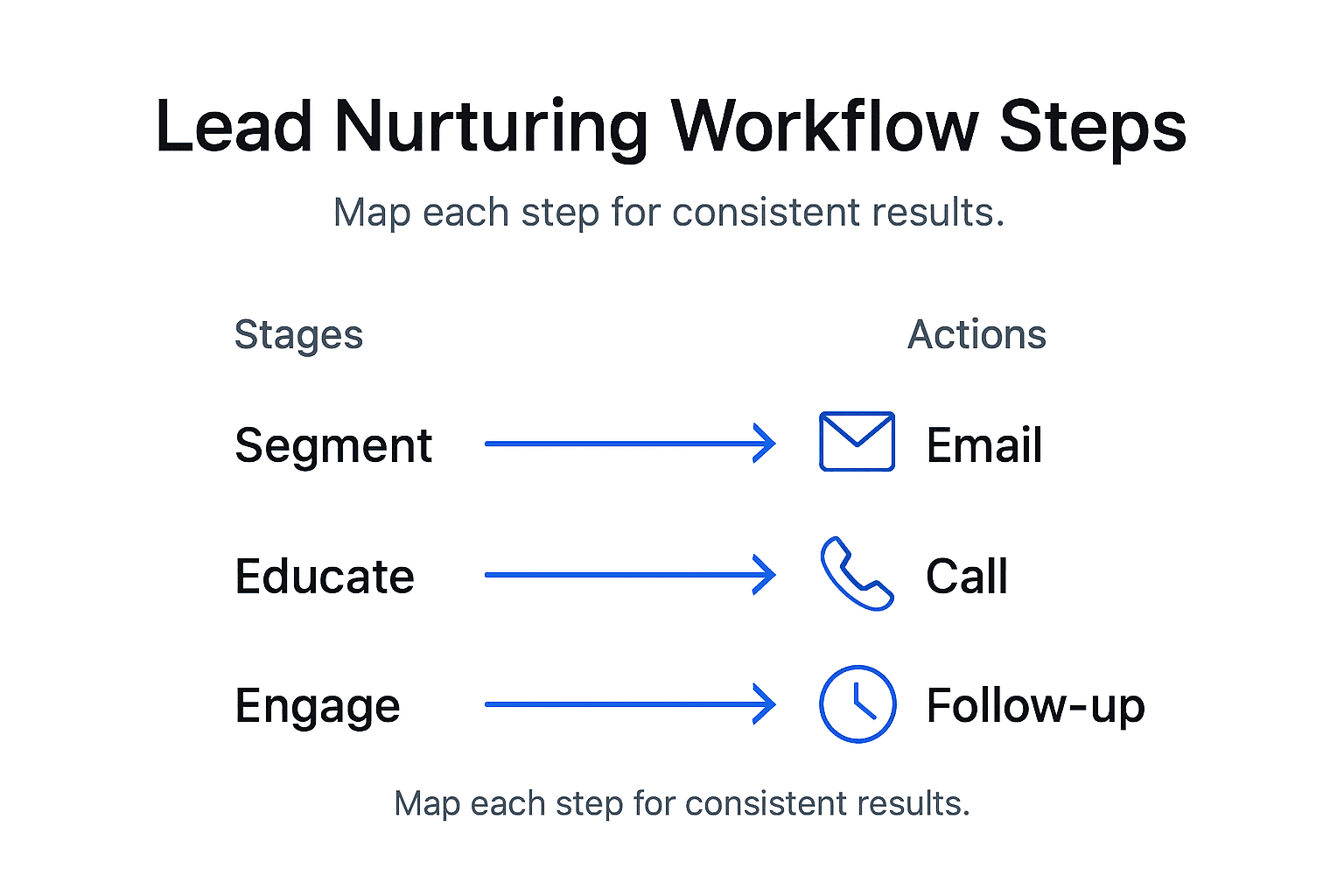
Successful workflows require careful design and continuous optimization. Small businesses should map out detailed customer journey stages, identifying key touchpoints and creating content that provides genuine value at each interaction. Lead nurturing process strategies help entrepreneurs develop multi-channel approaches that combine email, social media, targeted content, and direct communication to maintain consistent engagement. By tracking lead interactions and adjusting workflows based on performance data, businesses can incrementally improve their conversion rates and build more meaningful customer relationships.
Pro tip: Create a visual workflow diagram that maps out each lead interaction stage, ensuring your communication sequence feels natural and progressively moves prospects toward conversion.
Common Lead Management Pitfalls to Avoid
Lead management requires strategic precision, and small businesses often encounter critical mistakes that can significantly undermine their conversion potential. Systematic process implementation challenges reveal several recurring pitfalls that entrepreneurs must proactively address to maintain effective lead generation and conversion strategies.
Ineffective lead scoring represents one of the most common mistakes small businesses make. Many entrepreneurs rely on superficial or outdated criteria when evaluating potential customers, which can result in misallocating time and resources. Successful lead management demands a dynamic scoring system that considers multiple engagement signals, including website interactions, email responsiveness, demographic information, and actual purchasing potential. Businesses must continuously refine their scoring models to ensure they are targeting the most promising prospects with appropriate levels of attention and personalized communication.
Lead management fundamentals highlight another critical pitfall: inconsistent follow-up processes. Small businesses frequently struggle with maintaining consistent communication momentum, allowing potential leads to cool off or become disengaged. Effective lead management requires establishing clear protocols for timely, relevant follow-ups that provide genuine value at each interaction stage. This means developing automated yet personalized communication workflows that adapt to individual lead behaviors and preferences, ensuring no potential customer falls through the communication gaps.
Pro tip: Create a standardized lead tracking spreadsheet that documents every interaction, communication attempt, and engagement signal to help your team maintain accountability and consistency in lead management.
Transform Your Lead Management with Simplicity and Power
Managing leads effectively is a critical challenge for small businesses aiming to convert more prospects into loyal customers. If you struggle with keeping track of lead interactions, nurturing prospects at the right time, or scoring leads intelligently, you are not alone. The key pain points discussed in this article such as inconsistent follow-ups, ineffective lead scoring, and fragmented tools can hold back your growth potential.
Go Online Now-Connect offers an all-in-one solution designed specifically to help SMBs streamline their entire lead management process. Our platform combines an easy-to-use all-in-one CRM with marketing automation tools like email nurturing, SMS, and funnel management—all backed by real human support and done-for-you setups. You no longer need to juggle complicated systems or overpriced software to boost your conversions. We empower you to stay organized, automate personalized communication workflows, and gain actionable insights with minimal effort.
Take control of your lead management today and experience up to 85 percent more conversions while saving time on sales tasks. Make the smart choice and visit Ga nu online to explore how our marketingautomatiseringssoftware and digital growth services put everything you need under one roof with no hidden fees. Start growing smarter now by partnering with a platform that truly understands the unique needs of small businesses.
Veelgestelde vragen
What is lead management for small businesses?
Lead management is the strategic process of capturing, tracking, and nurturing potential customers from their initial contact to the final sale. It helps small businesses convert interested prospects into loyal customers by establishing structured pathways in their sales cycles.
Why is lead management important for small businesses?
Lead management is crucial for small businesses as it transforms random sales efforts into predictable growth mechanisms. Structured lead management processes lead to higher conversion rates and more efficient sales operations, enabling small businesses to compete effectively in crowded marketplaces.
How can CRM systems improve lead management for small businesses?
CRM systems improve lead management by centralizing contact information, tracking communication history, and providing analytics on lead engagement. They enable small businesses to personalize their outreach and follow-ups, thereby increasing the likelihood of conversion.
What are the common pitfalls in lead management that small businesses should avoid?
Common pitfalls include ineffective lead scoring and inconsistent follow-up processes. Businesses should implement dynamic scoring systems that consider various engagement signals and establish clear, timely follow-up protocols to maintain communication momentum with potential leads.
Aanbevolen
- Lead Management Fundamentals: Complete Guide for SMBs – Go Online Now
- 7 Essential Lead Generation Tips for Small Businesses – Go Online Now
- Master the Lead Generation Process for 2025 Success – Go Online Now
- 7-Step Lead Generation Checklist for Growing SMBs – Go Online Now
- Small Business Finance Made Easy