
Many small and mid-sized companies struggle to reach the right customers without spending a fortune. For marketing managers focused on real results, email marketing proves its value with a direct line to clients and measurable outcomes. In fact, studies show every dollar invested can return as much as $42, making it an appealing strategy for those looking to build stronger relationships and drive sales without large budgets.
What Email Marketing Means for SMBs
Email marketing represents a powerful, cost-effective digital strategy specifically designed for small and medium-sized businesses to connect directly with potential and existing customers. Unlike broad marketing approaches, email allows SMBs to craft personalized, targeted communications that drive meaningful engagement and growth.
Voor het MKB, e-mailmarketing provides several critical advantages:
- Direct communication channel with customers
- Low-cost marketing approach with high return potential
- Ability to segment and personalize messaging
- Trackable performance through detailed analytics
- Scalable strategy adaptable to business growth
The core strength of email marketing lies in its ability to deliver exceptional marketing ROI. Research indicates that email campaigns typically generate $42 for every dollar invested, making it an incredibly efficient channel for businesses with limited marketing budgets.

Successful email marketing for SMBs requires strategic approaches that go beyond simple promotional messages. Modern email campaigns focus on building relationships, providing value, and creating meaningful connections with subscribers. This means crafting content that educates, entertains, or solves specific problems for your target audience.
Digital communication strategies have evolved, and email remains a cornerstone of effective SMB marketing. By leveraging automation, segmentation, and personalized content, small businesses can compete effectively with larger competitors without massive marketing expenditures.
Pro tip: Create email content that provides genuine value to your subscribers, focusing on solving their problems rather than just selling products.
Types of Email Campaigns and Strategies
Email marketing offers SMBs a versatile toolkit of campaign types designed to achieve diverse business objectives. Effective email strategies leverage multiple approaches to engage customers throughout their journey, from initial awareness to long-term loyalty.
Key email campaign types include:
- Promotional Emails: Direct sales-focused messages highlighting products, discounts, or special offers
- Nieuwsbrieven: Regular communications providing valuable content, industry insights, and brand updates
- Transactional Emails: Automated messages triggered by specific customer actions like purchases or account changes
- Behavioral Trigger Campaigns: Targeted emails responding to customer interactions and preferences
- Re-engagement Campaigns: Strategically designed messages to reconnect with inactive subscribers
Successful email marketing goes beyond simple broadcast messaging. Modern strategies emphasize personalization and segmentation, allowing businesses to craft highly targeted communications that resonate with specific audience segments. By analyzing customer data and behavior, SMBs can create more meaningful and effective email experiences.
Here’s how different types of email campaigns support specific business objectives for SMBs:
| Campaign Type | Main Objective | Example Use Case |
|---|---|---|
| Promotional Email | Drive immediate sales | Announcing a flash sale |
| Nieuwsbrief | Build ongoing engagement | Monthly industry updates |
| Transactional Email | Confirm and inform | Order confirmation messages |
| Re-engagement Campaign | Win back inactive customers | Special offer to lapsed users |
| Behavioral Trigger | Nurture based on actions | Cart abandonment reminders |
Automation and personalization represent the core of contemporary email marketing strategies. These approaches enable businesses to deliver timely, relevant content that feels individualized and valuable to each recipient. Advanced email marketing platforms allow SMBs to set up sophisticated workflows that automatically respond to customer behaviors, ensuring consistent and intelligent communication.
Sophisticated email campaigns are not about sending more emails, but about sending the right message to the right person at the right time.
Pro tip: Develop a comprehensive email strategy that balances different campaign types, focusing on providing genuine value rather than constant sales pitches.
How Email Marketing Drives Engagement
E-mailmarketing transforms customer communication by creating direct, personalized connections that traditional marketing channels cannot replicate. Targeted engagement strategies enable businesses to deliver precisely crafted messages that resonate with individual customer needs and preferences.
Key engagement drivers in email marketing include:
- Personalized content matching specific customer interests
- Timely and relevant communication
- Interactive elements that encourage customer response
- Segmented messaging targeting distinct audience groups
- Automated workflows that feel individually tailored
Modern email marketing goes beyond simple communication, functioning as an intelligent relationship-building tool. By analyzing customer data and behavioral patterns, SMBs can create nuanced communication strategies that feel less like marketing and more like meaningful dialogue. This approach transforms emails from generic broadcasts into personalized experiences that customers actually look forward to receiving.
Psychological engagement plays a crucial role in email marketing success. When recipients feel that an email speaks directly to their needs, interests, and pain points, they are significantly more likely to open, read, and take action. Advanced segmentation techniques allow businesses to craft messages that feel like they were written specifically for each individual, dramatically increasing the likelihood of positive customer interactions.
Effective email engagement is about creating a conversation, not just sending a message.
Pro tip: Design email campaigns that prioritize customer value over sales pitches, focusing on solving problems and providing genuine insights.
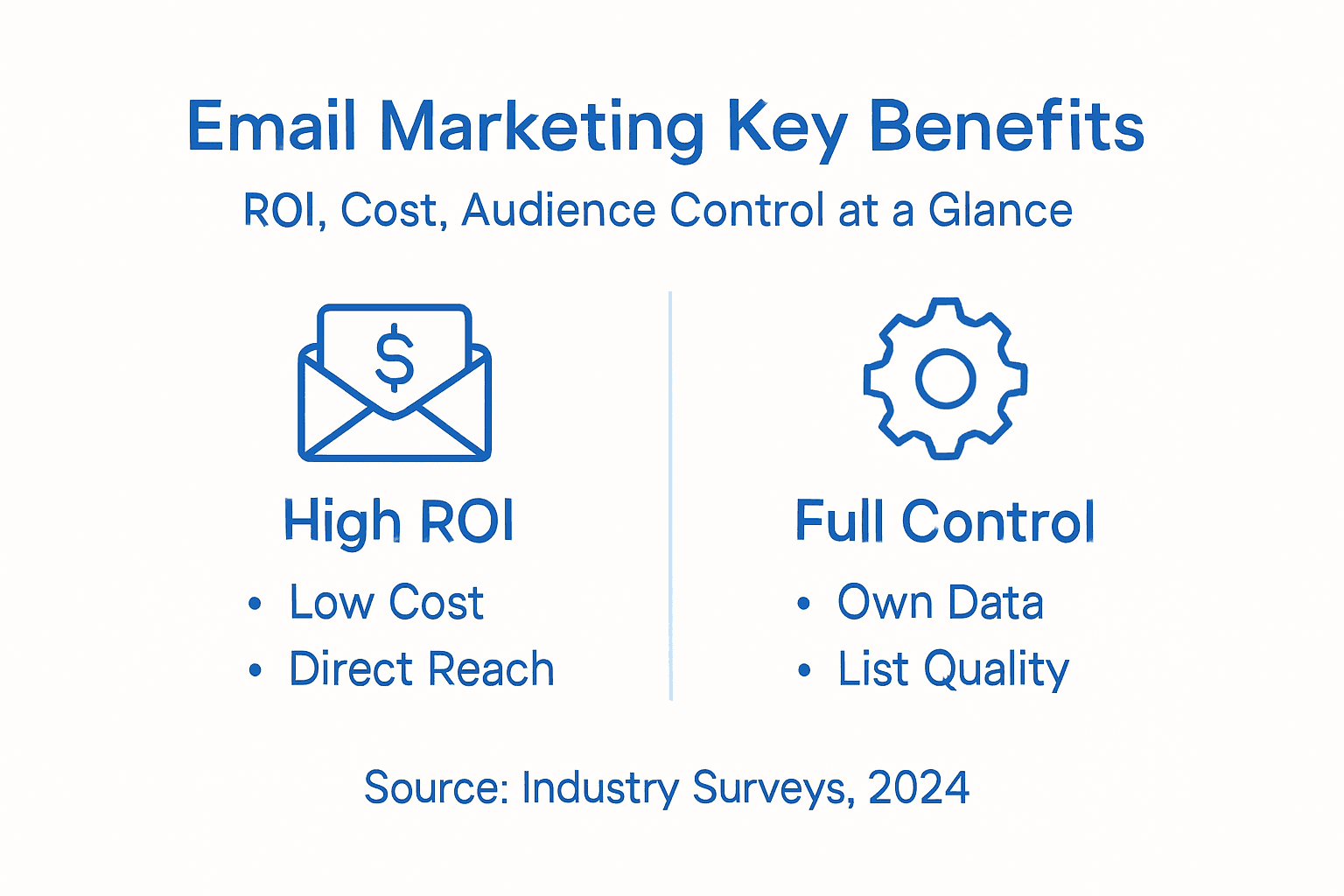
Key Benefits: ROI, Cost, and Audience Control
Email marketing stands out as a powerhouse strategy for small and medium-sized businesses, offering unparalleled advantages in terms of financial efficiency and strategic control. Marketing cost-effectiveness enables businesses to achieve remarkable results with minimal investment, making it an essential tool for growth-minded entrepreneurs.
Key financial and strategic benefits include:
- Exceptional return on investment (ROI)
- Extremely low per-message communication costs
- Precise audience targeting capabilities
- Comprehensive performance tracking
- Complete control over subscriber interactions
The financial metrics of email marketing are particularly compelling. Most businesses experience an average return of $42 for every dollar spent, which far surpasses traditional marketing channels. Unlike broad advertising approaches, email marketing allows for granular audience segmentation, ensuring that each message reaches the most relevant recipients with pinpoint accuracy.
Audience control represents another significant advantage for SMBs. By maintaining detailed subscriber lists and utilizing advanced segmentation techniques, businesses can craft highly personalized communications that speak directly to specific customer needs, preferences, and behaviors. This targeted approach dramatically increases engagement rates and helps build long-term customer relationships.
Small investments in email marketing can yield exponential returns when executed strategically.
Pro tip: Continuously refine your email list by regularly cleaning inactive subscribers and focusing on quality engagement over quantity.
Risks, Compliance, and Common Pitfalls
Email marketing, while powerful, requires careful navigation of complex legal and strategic landscapes. CAN-SPAM Act regulations create a critical framework that SMBs must understand to avoid potential legal and financial risks associated with digital communication.
Common email marketing pitfalls include:
- Neglecting explicit subscriber consent
- Failing to provide clear opt-out mechanisms
- Sending excessive or irrelevant communications
- Inadequate list management practices
- Overlooking mobile optimization
- Ignoring data privacy requirements
- Poor email content personalization
Legal compliance represents a fundamental aspect of responsible email marketing. Businesses must ensure every communication includes accurate sender information, transparent commercial disclosures, and genuine value for recipients. Penalties for non-compliance can be substantial, making it essential for SMBs to develop robust email communication protocols.
Data privacy has become increasingly complex, with regulations like CAN-SPAM and international standards demanding meticulous attention to subscriber rights. Successful email marketers treat their subscriber lists as valuable relationships, not just transactional databases. This means implementing rigorous consent mechanisms, providing clear communication preferences, and respecting individual privacy boundaries.
Effective email marketing is built on trust, transparency, and genuine value for subscribers.
Pro tip: Implement a comprehensive email compliance checklist and regularly audit your communication practices to minimize legal and reputational risks.
Comparing Email to Other Digital Channels
Digital marketing offers multiple channels for business communication, but email marketing maintains a unique position of effectiveness and control. Marketing channel strategies reveal email’s distinct advantages over alternative digital platforms.
Key comparative advantages of email marketing include:
- Direct audience access without algorithmic interference
- Higher conversion rates compared to social media
- More personalized communication options
- Complete message control and delivery
- Precise audience segmentation capabilities
- Lower per-interaction marketing costs
- Measurable and trackable performance metrics
While social media platforms rely on complex algorithms that can unpredictably limit reach, email marketing provides businesses with a guaranteed communication pathway. Marketers can ensure their messages reach intended recipients directly, without depending on third-party platform rules or sudden algorithmic changes that might reduce content visibility.
Digital communication strategies must recognize email’s unique strengths. Unlike pay-per-click advertising or social media marketing, email allows for nuanced, long-form communication that builds deeper customer relationships. The ability to craft personalized, value-driven messages creates a more intimate connection with audiences compared to broader digital marketing approaches.
This table compares email marketing with other common digital channels on essential criteria for SMBs:
| Kanaal | Direct Audience Access | Personalization Depth | Kostenefficiëntie |
|---|---|---|---|
| E-mailmarketing | Full control over list | High with segmentation | Low cost per send |
| Sociale media | Algorithm-driven reach | Limited targeting | Varies by platform |
| PPC Advertising | Pay for each interaction | Minimal personalization | High cost for exposure |
| Zoekmachineoptimalisatie | Indirect access | Beperkte personalisatie | Ongoing investment |
Email marketing bridges the gap between mass communication and personalized interaction.
Pro tip: Integrate email marketing with other digital channels to create a comprehensive, multi-dimensional marketing approach that maximizes audience engagement.
Drive Your SMB Growth with Smarter Email Marketing Solutions
The article highlights how email marketing is crucial for direct customer engagement and maximizing return on investment while avoiding common pitfalls like poor personalization and compliance risks. If you are an SMB struggling with fragmented tools, costly platforms, or ineffective email campaigns, you need a streamlined way to harness marketing automation with real human support. Unlock the power of targeted campaign automation combined with CRM features designed for small businesses aiming to grow smarter without wasteful spending.
Go Online Now-Connect simplifies email marketing, lead nurturing, and customer relationship management into one affordable system. Our platform helps you create personalized, behavior-triggered campaigns that boost engagement and revenue. Benefit from automation, segmentation, and done-for-you setup, so you focus on connecting with your audience rather than technical hassles. Integrate your growth strategy today through Automation Archives – Go Online Now, enhance your online presence via Website Services Archives – Go Online Now, and explore full solutions at Go Online Now.
Ready to transform your email marketing into a growth engine with a simple, all-in-one platform built for SMBs? Visit https://goonlinenow.co to get started and see how you can increase conversions and save time now.
Veelgestelde vragen
What are the main benefits of email marketing for small and medium-sized businesses?
Email marketing provides direct communication with customers, low-cost marketing with high return potential, the ability to segment and personalize messaging, trackable performance, and a scalable strategy that adapts to business growth.
How can email marketing improve customer engagement?
Email marketing can improve engagement by delivering personalized content, timely communications, interactive elements that encourage responses, segmented messaging for distinct audience groups, and automated workflows tailored to customer actions.
Why is it important to segment email lists in marketing campaigns?
Segmentation is crucial because it allows businesses to tailor messages to specific audience needs, resulting in higher engagement rates and improved customer interactions. This targeted approach ensures that communications resonate with recipients and build stronger relationships.
What are some common pitfalls to avoid in email marketing?
Common pitfalls include neglecting explicit subscriber consent, failing to provide clear opt-out options, sending excessive or irrelevant emails, improper list management, and not ensuring mobile optimization. Avoiding these mistakes is essential for maintaining compliance and building trust with subscribers.