
Every service-based business owner in the United States knows how crowded the inbox has become, but email marketing has not faded away. With advancements like automation tools and true audience segmentation, email campaigns now deliver timely, relevant messages while you focus on customers. As Statista confirms, the global email marketing industry maintains strong financial performance, making this channel one of the most cost-effective strategies for small and mid-sized businesses aiming for real engagement and measurable returns in 2025.
Email Marketing Defined for 2025
Email marketing in 2025 is fundamentally straightforward: it’s the practice of sending targeted messages directly to people’s inboxes to build relationships, drive sales, and keep customers engaged. But the definition has evolved significantly from the mass blast emails of the past. Modern email marketing is personalized, data-driven, and automated. Instead of sending identical messages to thousands of contacts, you now segment your audience, tailor content to their specific needs, and use automation tools to deliver the right message at precisely the right time. For service-based businesses like yours, this means your email campaigns work while you’re focused on delivering your core services. The global email marketing industry continues to show strong financial performance, with businesses seeing consistent returns on investment, making it one of the most cost-effective channels available to SMBs.
What sets 2025 email marketing apart is the convergence of technology and intent. Your email strategy now involves several interconnected elements working together seamlessly. First, content targeting ensures subscribers receive messages relevant to their stage in the customer journey. A prospect who just downloaded your free guide gets different content than a client renewal reminder. Second, email timing and frequency are optimized based on when your audience is most likely to open messages and how often they want to hear from you without feeling overwhelmed. Third, mobile adaptation is non-negotiable; over half of all emails are opened on mobile devices, so if your campaigns don’t look sharp on phones, you lose engagement instantly. Fourth, email automation systems now integrate seamlessly with CRM platforms to trigger messages based on specific actions subscribers take, eliminating manual work and increasing consistency. For a coaching business, this might mean automatically sending onboarding sequences when someone books a consultation. For a salon, it’s automatic appointment reminders and follow-up requests for reviews.

The shift from 2024 to 2025 reflects a maturation in how businesses view email. It’s no longer just a promotional channel. Email has become your direct line to customers, a channel you own (unlike social media where algorithms control visibility). Deliverability challenges like spam filters remain, but modern email platforms handle this through proper authentication protocols and compliance with regulations like CAN-SPAM and GDPR. The technical foundation matters, but what truly drives results is understanding that email marketing in 2025 is about building subscriber trust. Every message should provide value, whether that’s helpful information, exclusive offers, or genuine communication. When you treat your email list as a community rather than a distribution channel, your engagement rates climb, your unsubscribe rates stay low, and your revenue grows. This is why email consistently outperforms other digital marketing channels for SMBs—it converts.
Pro tip: Start by defining your email purpose clearly: Are you nurturing leads, welcoming new customers, driving repeat business, or sharing educational content? A single, clear purpose per email campaign keeps your messaging focused and your results measurable.
Personalization and Automation Trends
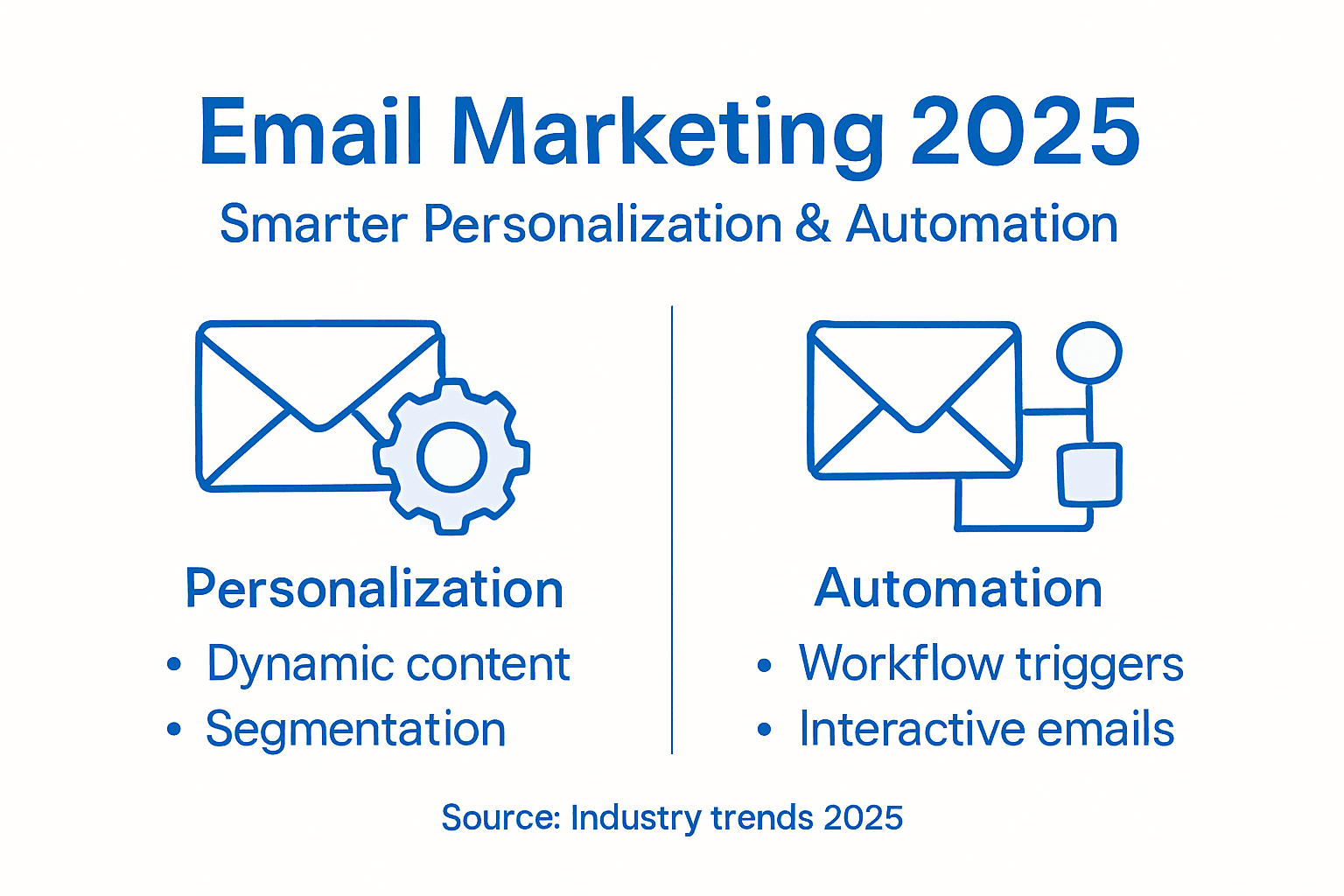
Personalization and automation have shifted from “nice to have” to absolutely essential in 2025. Here’s what’s happening: marketers are using data to understand individual subscribers better than ever before, then deploying automation to act on that understanding at scale. The combination creates a multiplier effect. A prospect who visits your pricing page gets different follow-up emails than someone who downloaded a free resource. Someone who clicked your recent offer gets reminded before the deadline expires. Someone who never opens your emails gets placed in a different sequence. None of this happens manually anymore. AI-driven content generation and analytics now power up to half of email marketing tasks, letting small business owners focus on strategy while technology handles execution. For service-based businesses, this means you can deliver the personalized experience of a large corporation without the large corporation’s budget or team size.
What makes 2025 different from previous years is the sophistication available to SMBs. Personalization now goes way beyond inserting someone’s first name in the subject line. Real personalization means segmenting your email list based on behavior, interests, purchase history, and engagement level, then tailoring the entire message to match. A real estate agent segments clients into three groups: active buyers, curious prospects, and past clients. Each group gets completely different content. Automation then takes over: when a new buyer enters your system, they automatically receive a welcome sequence. When someone requests a property showing, they get confirmation and follow-up emails. When a past client reaches their annual check-in date, they get a personalized outreach. Personalized subject lines and optimized send times increase open and click-through rates significantly, according to current research, because messages arrive when subscribers are most likely to engage and feel personally relevant.
Automation extends beyond basic email sequences. Modern platforms now support interactive elements within emails themselves—polls, surveys, and preference centers that let subscribers tell you exactly what they want. This feeds back into your data, making future personalization even sharper. A coaching business can add a quick poll asking “What’s your biggest challenge right now?” and automatically route responses into separate campaigns based on answers. A salon can let clients choose their preferred appointment reminders via email preference settings. When you combine automation capabilities with strategic investment, you see improved ROI and engagement metrics that directly impact revenue. The trend shows no signs of slowing because it works. Subscribers appreciate getting relevant messages, businesses appreciate lower unsubscribe rates and higher conversions, and everyone wins.
The 2025 reality is this: if your email strategy isn’t personalized and automated, you’re competing with one hand tied behind your back. Your competitors aren’t sending generic broadcast emails anymore. They’re using data to understand customer needs and automation to respond instantly. The good news is that modern platforms make this accessible to businesses of any size. You don’t need a dedicated marketing team or technical expertise. Most platforms handle the heavy lifting through simple, visual workflows. What you do need is a clear understanding of your customer segments and what messages they need at each stage of their journey. Get those two things right, layer in automation, and your email channel becomes a revenue-generating machine that works while you sleep.
Pro tip: Start with one simple automation workflow: a welcome sequence for new subscribers that runs for five emails over two weeks. Measure open rates, click rates, and conversions, then use those insights to improve personalization in your next workflow.
Essential Features for Small Businesses
Not all email marketing platforms are created equal, and what works for enterprise-level companies often overcomplicates life for small business owners. When you’re selecting an email marketing tool, focus on features that directly impact your bottom line without adding unnecessary complexity. The foundation starts with deliverability. If your emails land in spam folders instead of inboxes, nothing else matters. Look for platforms that handle authentication protocols like SPF, DKIM, and DMARC automatically, maintain good sender reputation management, and provide clear visibility into bounce rates and spam complaints. Next comes contact management and segmentation. You need to organize your subscriber list by behavior, interests, and purchase history without needing a data scientist. Simple drag-and-drop segmentation tools let you create groups instantly: new subscribers get one sequence, engaged customers get another, inactive contacts get a re-engagement campaign. Key email marketing features like consistent sender information and engaging subject lines directly impact open rates and subscriber retention, so your platform must make these basics foolproof.
Beyond the fundamentals, modern SMB email platforms need automation workflows that don’t require coding knowledge. When someone books an appointment with your coaching business, they should automatically receive a confirmation email, then a reminder 24 hours before, then a follow-up request for feedback after the session ends. All of this happens without you lifting a finger. Workflows should trigger based on subscriber actions: opening an email, clicking a link, visiting your website, or completing a purchase. The platform should also include pre-built templates that look professional on mobile devices (since half your subscribers open emails on phones) and can be customized in minutes, not hours. You shouldn’t need design skills to create emails that convert. Another critical feature is analytics and reporting that actually tells you something useful. Forget vanity metrics. You need to see open rates, click-through rates, unsubscribe rates, and most importantly, how email drives revenue. Can you track which email campaign led to a sale? Can you see which segments convert best? These insights guide your strategy. Personalization, interactive email content, and AI tools enhance engagement while optimization of email scheduling and layout maximize performance, making these features non-negotiable for competitive SMBs.
One feature often overlooked but essential for service-based businesses is integration with your CRM and calendar systems. When someone responds to your email, that response should automatically update their contact record in your CRM. When they book an appointment through your email link, it should sync with your calendar instantly. These integrations eliminate manual data entry and ensure your entire team has current information. Look for platforms offering integrations with tools you already use: scheduling software, payment processors, social media management tools, and customer support systems. The best platforms also include A/B testing capabilities so you can test different subject lines, send times, or email content to see what resonates with your audience. You don’t have to guess anymore; data shows you exactly what works. Finally, consider customer support quality. When you hit a roadblock at 2 p.m. on Tuesday, you need real humans who can help, not just chatbots or knowledge base articles. Responsive, knowledgeable support saves hours of frustration and keeps your campaigns running smoothly.
The features you choose should align with your specific business model. A real estate agent needs calendar integration and lead scoring. A salon needs appointment reminders and review request automation. A coach needs course delivery integration and payment tracking. While these needs vary, all SMBs share common ground: they need platforms that are affordable, don’t require technical expertise, deliver results quickly, and provide genuine support. Avoid platforms that overwhelm you with features you’ll never use or charge enterprise prices for SMB needs. The right platform feels intuitive from day one, scales with your business, and lets you focus on what you do best instead of wrestling with complicated software.
Pro tip: Request a free trial of any platform and build one complete automation workflow from start to finish before committing, so you understand the actual learning curve and can verify it integrates smoothly with your existing tools.
Here’s a comparison of key email marketing features and their business impact for small businesses:
| Functie | Beschrijving | Business Impact |
|---|---|---|
| Segmentatie | Groups contacts by behavior or traits | Delivers relevant messages |
| Automation Workflows | Triggers actions without manual effort | Saves time and boosts consistency |
| CRM Integration | Syncs contact and activity data | Keeps customer info up-to-date |
| Mobile-Responsive Design | Ensures emails look good on phones | Increases engagement rates |
| Analyse en rapportage | Provides actionable campaign metrics | Informs data-driven decisions |
| A/B-testen | Tests subject lines or content variations | Optimizes for higher performance |
Legal Compliance and Privacy Regulations
Compliance isn’t optional in 2025, and ignoring privacy laws isn’t a risk you can afford to take. One lawsuit or regulatory fine can wipe out months of profit for an SMB. The stakes are real, which is why understanding your legal obligations matters as much as understanding your audience. The primary regulations affecting email marketers globally are AVG (European Union), CCPA (California), and CAN-SPAM (United States). These laws have one fundamental principle in common: you need explicit consent before sending marketing emails to someone. GDPR is the strictest. If you have any subscribers in Europe, GDPR applies to you. It requires affirmative opt-in (the subscriber must actively check a box to receive emails), clear identification of who you are, and easy unsubscribe options. CCPA applies if you collect data from California residents and gives them the right to know what data you have, delete it, and opt out of data sales. CAN-SPAM is less stringent but still mandatory: you need a clear unsubscribe link in every email, honest subject lines, and a physical business address. Aligning email campaigns with privacy laws such as GDPR and CCPA while addressing data protection and consent management is essential for maintaining trust and avoiding legal penalties, particularly critical for SMBs operating in diverse regulatory environments.
Beyond the major regulations, the compliance landscape continues expanding. Many countries now have their own data protection laws similar to GDPR. Brazil has LGPD. Canada has PIPEDA. Australia has Privacy Act amendments. If you serve customers internationally, you potentially need to comply with multiple frameworks simultaneously. This sounds overwhelming, but here’s the practical reality: if you build your email program to GDPR standards, you’re already mostly compliant with stricter laws. GDPR is the highest bar. Start there. First, you need documented consent. When someone signs up for your email list, keep proof of that signup. If they clicked a checkbox on your website, maintain that record. If they verbally requested emails, document the date and method. Second, implement clear consent language. Your signup form should explicitly state what emails they’ll receive, how often, and what topics. Don’t bury this in tiny text. Make it obvious. Third, provide easy unsubscribe mechanisms. Every email must include a link to manage preferences or unsubscribe entirely. When someone clicks that link, honor it within 10 business days. Fourth, maintain data security. Store contact information securely, limit access to authorized personnel only, and encrypt sensitive data. If a data breach occurs, you’re required to notify affected individuals and authorities.
Your email marketing platform plays a critical role in compliance. Most reputable platforms handle technical compliance automatically: they authenticate emails, manage unsubscribe lists, and maintain compliance audit trails. When evaluating platforms, confirm they provide compliance documentation, maintain clear data retention policies, and offer data processing agreements. For subscribers who request data deletion, you must be able to remove them completely within a specified timeframe. Some platforms make this easy; others create headaches. Test this before committing. Also consider your international expansion plans. If you’re currently US-only but plan to expand into Canada or Europe, choose a platform now that can scale to those requirements. Switching platforms later creates data migration nightmares. Finally, maintain hygiene practices. Don’t buy email lists. Don’t send to addresses without consent. Don’t purchase lists from third parties claiming they’re “opted in.” These shortcuts lead to high bounce rates, spam complaints, and regulatory violations. Clean your lists regularly by removing hard bounces and unengaged subscribers. This protects your sender reputation and keeps you on the right side of regulations.
Compliance is ongoing, not a one-time setup. Regulations evolve. Your email program should evolve too. Document your compliance practices: who you’re sending to, why you have their consent, how you’re protecting their data, and how you’re managing unsubscribe requests. If you’re ever audited or investigated, this documentation protects you. When in doubt, choose the more conservative approach. If a law says you “may” collect data for a certain purpose but you’re unsure your use case qualifies, don’t do it. The cost of a compliance violation far exceeds the revenue from a few extra emails. For SMBs operating across borders, understanding privacy laws and regulations impacting your specific markets provides clarity on baseline requirements and helps you build a sustainable, trustworthy email program that protects both your subscribers and your business.
Pro tip: Create a compliance checklist specific to your business and audit it quarterly: confirm consent documentation is current, verify unsubscribe mechanisms work, test data deletion requests, and review your platform’s compliance certifications to ensure you’re meeting all applicable regulations.
Below is a summary of major email compliance regulations and who they apply to:
| Regulation | Region/Countries | Key Requirement | Applies To |
|---|---|---|---|
| AVG | Europese Unie | Explicit consent and data rights | Any business with EU users |
| CCPA | California, USA | Data access and opt-out rights | Firms with CA residents |
| CAN-SPAM | United States (federal) | Honest content, easy unsubscribe | All US commercial emails |
| LGPD | Brazil | Consent and data protection | Businesses serving Brazil |
| PIPEDA | Canada | Data privacy and transparency | Companies with Canadian data |
| Privacy Act | Australië | Data use and access obligations | Firms operating in Australia |
Common Pitfalls and How to Avoid Them
Email marketing seems simple until you actually start doing it. Then you realize there are dozens of ways to undermine your own efforts. The most dangerous pitfall is sending emails people don’t want to receive. This sounds obvious, but it’s shockingly common. You buy a list, blast promotional content to strangers, and wonder why your unsubscribe rates spike and your sender reputation tanks. Stop. Unsolicited emails destroy trust instantly. Instead, build your list organically through your website, social media, and word of mouth. Every subscriber should have actively chosen to hear from you. The second major pitfall is poor subject lines. Your subject line is the only thing determining whether someone opens your email or deletes it. Generic subject lines like “Monthly Update” or “Important News” fail. Vague subject lines confuse subscribers. Overly promotional subject lines trigger spam filters. Great subject lines are specific, honest, and create curiosity without being manipulative. Test different approaches and measure which ones get opened. The third pitfall is inconsistent sending schedules. You send one email, then silence for three weeks, then suddenly five emails in two days. Your subscribers never know when to expect communication, so they stop paying attention. Pick a schedule you can sustain and stick to it. Whether it’s weekly, biweekly, or monthly, consistency matters more than frequency. Common pitfalls such as poor subject lines, inconsistent sending schedules, and irrelevant content directly damage subscriber engagement and campaign effectiveness, making these avoidable errors critical to address for SMB success.
The fourth pitfall is sending irrelevant content to your entire list. A prospect who downloaded your pricing guide doesn’t need educational onboarding content. A long-term customer doesn’t need beginner tutorials. Yet many businesses send the same content to everyone. Segmentation solves this. Create different email sequences for different audience groups, so each person receives content actually relevant to them. The fifth pitfall is failing to track metrics that matter. Many SMBs obsess over open rates but ignore click-through rates and conversions. You can have fantastic open rates and zero sales. Focus on metrics that connect to revenue: clicks, conversions, customer lifetime value, and ROI. If an email doesn’t drive these metrics, investigate why before sending the next one. The sixth pitfall is not providing value. Every email should answer a question, solve a problem, or offer something worthwhile. If your emails are purely promotional, subscribers tune out. Mix in educational content, behind the scenes insights, exclusive offers, and genuine communication. The ratio should lean heavily toward value, with promotion as the minor element. Difficulty proving ROI, inefficiencies in personalization, and underutilization of automation represent typical challenges that SMBs must address through data-driven strategies and AI tools to maximize effectiveness in 2025.
The seventh pitfall is ignoring subscriber preferences. Some people want daily emails, others monthly. Some want product recommendations, others just want educational content. Some prefer emails on weekdays, others on weekends. Give subscribers control through preference centers where they can adjust frequency and content type. When people feel heard, they engage more. The eighth pitfall is not testing anything. You create an email, send it, and hope for the best. Better approach: test subject lines, test send times, test content formats. A/B testing reveals what actually works for your audience instead of relying on assumptions. The ninth pitfall is sending emails people can’t act on. Your email has great content but no clear call to action. Or the link is broken. Or the landing page doesn’t match the email promise. Make it dead simple for subscribers to take the next step. One clear action per email. The tenth pitfall is underestimating the importance of mobile design. Over half your subscribers check email on phones. If your emails don’t look good on mobile, they get deleted immediately. Test every email on mobile before sending. Use responsive templates that adapt to screen size.
The final pitfall worth mentioning is launching without a plan. You buy software, import a list, and start sending. Real success comes from strategy first. Define your goals. Understand your audience segments. Map out the customer journey. Plan your email sequences to support each stage. Then execute. Most SMBs that fail at email never had a strategy to begin with. They treated email like a broadcast channel instead of a relationship builder. Here’s what separates successful email marketers from the rest: they test, measure, and adjust continuously. They treat each send as a learning opportunity. They listen to subscriber feedback through engagement metrics. When unsubscribe rates spike, they investigate why instead of ignoring it. When click-through rates drop, they experiment with new approaches. Email marketing isn’t set it and forget it. It’s an ongoing conversation that improves as you learn your audience better.
Pro tip: Audit your last five emails: check subject lines for clarity, verify all links work, confirm content provides genuine value beyond promotion, and review metrics to identify which formats resonated most with your audience.
Unlock Smarter Email Marketing with Go Online Now-Connect
Struggling to keep up with the fast-evolving world of email marketing in 2025 The article highlights the challenges small businesses face like mastering personalization, automation, compliance, and delivering relevant content without wasting time or increasing costs. You want an all-in-one solution that simplifies these complexities while boosting engagement and conversions.
Go Online Now-Connect was built precisely for SMBs and SMEs seeking to grow smarter not harder. Our platform combines powerful marketingautomatiseringssoftware, a comprehensive all-in-one CRM, and expert digitale marketingdiensten to handle lead nurturing email marketing automation and reputation management seamlessly. Our done-for-you setup and real human support eliminate the frustration of technical hurdles so you can focus on your business. Explore how you can streamline your strategy and tap into proven tactics discussed in Digital Marketing Archives – Go Online Now and get step-by-step help.
Ready to stop guessing and start converting Visit https://goonlinenow.co today to see how our affordable transparent system drives up to 85 percent more conversions and saves you 75 percent of your time. Don’t let complicated software or hefty contracts hold you back Take the first step toward automated smarter email marketing with Go Online Now-Connect and experience the difference of a true growth partner.
Veelgestelde vragen
What is email marketing in 2025?
Email marketing in 2025 involves sending personalized, targeted messages to subscribers’ inboxes. It focuses on building relationships, driving sales, and engaging customers through automation and data-driven strategies.
How can small businesses improve their email content targeting?
Small businesses can enhance email content targeting by segmenting their audience based on behavior, interests, and engagement levels, ensuring that subscribers receive relevant messages tailored to their stage in the customer journey.
What are the essential features to look for in an email marketing platform for small businesses?
Key features for small businesses include deliverability, contact management, automation workflows, mobile-responsive design, analytics and reporting, CRM integration, and responsive customer support to drive effective email campaigns.
Why is compliance with email marketing regulations important?
Compliance with email marketing regulations, such as GDPR and CAN-SPAM, is crucial to avoid legal penalties and maintain subscriber trust. It involves obtaining explicit consent, providing clear unsubscribe options, and safeguarding subscriber data.
Aanbevolen
- Marketing Trends in 2025: Essential Guide for SMBs – Go Online Now
- 7 Essential Email Marketing Strategies for 2025 SMB Success – Go Online Now
- Digital Marketing Terminology 2025: What SMBs Must Know – Go Online Now
- Marketing Automation Software: Smarter Growth for SMBs – Go Online Now
- Amazon Seller Tips 2025: Essential Strategies for Success