
Most small business owners know SEO matters, yet a surprising number still feel lost about where to start or what actually works. Here’s a fact worth noting: budget tools costing $25 to $50 per month yield positive ROI within 90 days for 89% of over 1,200 businesses analyzed. That’s a powerful signal. The challenge is that SEO in 2026 looks very different from even two years ago. Search engines are smarter, user expectations are higher, and the platforms you need to show up on have multiplied. This guide cuts through the noise and gives you a clear, cost-effective path forward.
Key Takeaways
| Point | Details |
|---|---|
| Focus on user needs | Content that helps real customers and answers searcher intent wins in 2025. |
| Affordable tools pay off | Most SMBs see ROI from budget SEO tools and steady investment within 3 months. |
| Structured data matters | Using structured data and optimizing for Core Web Vitals boosts results across platforms. |
| Frameworks beat shortcuts | Follow tested, step-by-step processes instead of chasing quick wins to avoid wasted budget. |
| Integrate and automate | Combining smart SEO with automation unlocks sustainable SMB growth and conversions. |
What makes SEO different in 2025?
To find actionable solutions, it’s essential to understand the major shifts shaping SEO today. Search engines no longer just match keywords. They interpret meaning, context, and intent. That shift changes everything about how you create and structure content.
Core SEO mechanics for 2025 now emphasize user-first content, semantic optimization, Core Web Vitals, structured data, and integration with broader marketing efforts. Core Web Vitals measure how fast and stable your site feels to visitors, and Google uses these signals directly in rankings. If your site loads slowly or jumps around while loading, you lose ground regardless of how good your content is.
AI-driven search has also changed the game. Zero-click results, AI overviews, and answer boxes now intercept traffic before users even reach your site. That means you need to optimize for multiple platforms, not just Google.
Here’s what the modern SEO landscape demands from your business:
- Semantic content: Write for topics and user intent, not just individual keywords.
- Core Web Vitals: Prioritize page speed, visual stability, and interactivity.
- Structured data: Use schema markup so search engines understand your content better.
- Multi-platform presence: Optimize for Google, Bing, AI assistants, and social search.
- Marketing integration: SEO works best when connected to your email, content, and social efforts.
“The businesses winning in search today aren’t gaming algorithms. They’re genuinely serving their audience better than anyone else.”
Explore the latest SEO trends for 2025 to see how these shifts are playing out across different industries.
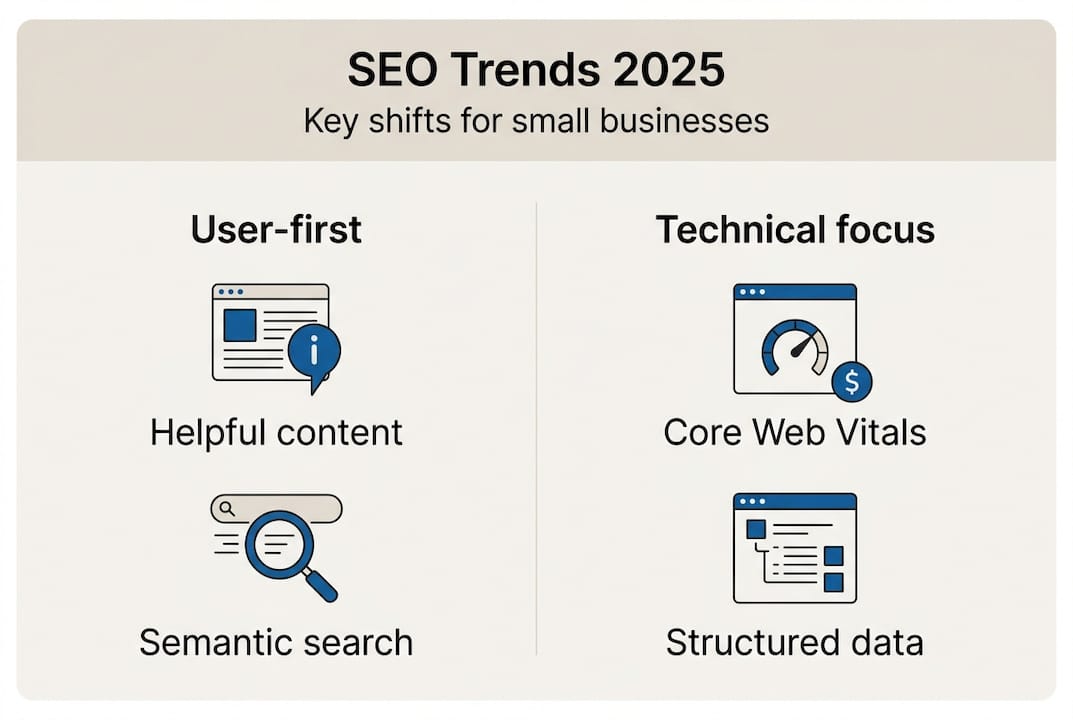
SEO priorities for small and mid-sized businesses
With these changes in mind, what actions actually deliver the most impact for your business? The answer might surprise you. More content isn’t the answer. Better content is.
Empirical testing shows that brand signals, user experience, and structured data consistently outperform scaled AI content. Flooding your site with generic, AI-generated articles doesn’t build authority. It dilutes it. What works is building topical authority through focused content clusters that cover your core service areas in depth.
Here are the top SEO priorities for SMBs right now:
- Build topical authority. Create a cluster of related content around each main service or product area. One pillar page supported by several detailed supporting articles signals expertise to search engines.
- Improve user experience. Fast load times, clear navigation, and mobile-friendly design are non-negotiable ranking factors.
- Use structured data. Free tools like Google’s Schema Markup Generator help you add rich data without a developer.
- Strengthen brand signals. Consistent mentions, reviews, and citations across the web tell search engines your business is legitimate and trusted.
- Invest in the right tools. You don’t need expensive platforms. Explore affordable marketing tools that give you keyword research, rank tracking, and site audits without breaking the budget.
Pro Tip: Before creating new content, audit what you already have. Updating and improving existing pages often delivers faster ranking gains than publishing brand-new articles.

Pairing your SEO efforts with cost-effective digital marketing tactics like email and social amplification multiplies your results without multiplying your costs.
Budgets and ROI: What can you expect?
Knowing the right focus is powerful, but what should your investment look like? The good news is that you don’t need a massive budget to see real results.
Typical SMB monthly SEO budgets range from $500 to $3,000, depending on market competition and goals. 89% of businesses analyzed using tools in the $25 to $50 per month range reported positive ROI within 90 days. That’s a strong case for starting lean and scaling as results come in.
| Budget level | Monthly spend | Expected timeline | Best for |
|---|---|---|---|
| Starter | $500 or less | 3 to 6 months | Local, low-competition markets |
| Groei | $500 to $1,500 | 2 to 4 months | Regional service businesses |
| Competitief | $1,500 to $3,000 | 1 to 3 months | Multi-location or niche authority |
ROI improves significantly when you integrate SEO with other tactics. Combining organic search with free email marketing tools and content promotion creates a compounding effect. Each channel reinforces the others.
Tracking performance is just as important as the spending itself. Use Google Search Console and Google Analytics at no cost to monitor which pages drive traffic, which keywords are gaining ground, and where visitors drop off. Adjust monthly based on what the data tells you.
For a deeper look at how to stretch your budget further, check out affordable marketing software options built specifically for SMB growth. You can also review real local SEO ROI benchmarks to set realistic expectations for your market.
Key frameworks: Step-by-step SEO strategy for 2025
Now, let’s assemble these pieces into a streamlined process for real-world application. This framework is designed for business owners who want results without needing a full-time SEO team.
Step 1: Keyword and competitor research.
Start by identifying 10 to 20 keywords your ideal customers actually search. Use free tools like Google Keyword Planner or Ubersuggest. Then look at what your top competitors rank for and find the gaps you can fill.
Step 2: Build content clusters.
Group your keywords by topic. Create one strong pillar page per topic and support it with 3 to 5 related articles. This structure signals topical authority. Learn more about content marketing for SMBs to build this system efficiently.
Step 3: Add structured data.
Use free schema tools to mark up your business information, services, reviews, and FAQs. This improves how your listings appear in search results and can earn rich snippets.
Step 4: Optimize for Core Web Vitals.
Run your site through Google PageSpeed Insights. Fix the top issues first: image compression, unused scripts, and layout shifts. User-first content and Core Web Vitals are foundational to ranking in 2026.
Step 5: Earn local links and promote content.
Reach out to local directories, industry associations, and complementary businesses for backlinks. Share content via email and social to drive initial traffic and engagement signals.
Step 6: Monitor and adjust monthly.
Set a monthly review date. Check rankings, traffic, and conversions. Double down on what’s working and cut what isn’t.
| Benadering | Old SEO (pre-2023) | New SEO (2026) |
|---|---|---|
| Content strategy | Keyword stuffing | Topical authority clusters |
| Linkbuilding | Bulk directory submissions | Earned, relevant backlinks |
| Technical focus | Meta tags only | Core Web Vitals and schema |
| Platform focus | Google only | Google, Bing, AI, social search |
Pro Tip: If you serve both local and national customers, understand the difference between local vs national SEO strategies before allocating your budget. The tactics differ significantly.
Common mistakes and how to avoid them
Even well-meaning strategies can backfire if you don’t watch out for common traps. These are the mistakes we see SMBs make most often, and they’re all avoidable.
- Chasing quick wins with spammy links. Buying links or using link farms can trigger Google penalties that take months to recover from. Focus on earning links through quality content and genuine relationships.
- Ignoring mobile experience. Over 60% of searches happen on mobile devices. If your site isn’t fast and easy to navigate on a phone, you’re losing customers before they even read a word.
- Neglecting local SEO. If you serve a specific area, your Google Business Profile is one of your most powerful assets. Keep it updated, collect reviews, and post regularly.
- Failing to measure results. Without tracking, you’re guessing. Set up Google Search Console from day one and review it monthly.
- Overlooking brand building. Brand signals and UX consistently outperform bulk content strategies. Your reputation online is a ranking factor.
Pro Tip: Don’t try to fix everything at once. Pick the two or three highest-impact issues from your site audit and address those first. Progress beats perfection every time.
For businesses that want a simpler path to getting all of this right, affordable marketing solutions can handle the technical heavy lifting while you focus on running your business. You’ll also find practical top marketing tips for SMBs that complement your SEO work across every channel.
Unlock greater growth with the right marketing automation
For SMBs ready to get more from every marketing dollar, automation is the logical next boost. SEO brings visitors to your door, but automation turns those visitors into leads and customers.
Go Online Now-Connect combines cost-effective SEO support with powerful marketing automation for SMB conversions in one simple platform. You get email sequences, lead nurturing, CRM, and reputation management working together, without the complexity or the price tag of enterprise tools. Our team handles the setup so you can focus on growth. Businesses using our platform report up to 85% more conversions within 90 days. If you want to understand the full picture, explore how marketing automation ROI stacks up and see how driving SMB growth becomes far more achievable when your tools actually work together.
Frequently asked questions
How quickly will I see SEO results if I start now?
Budget tools yield positive ROI in about 90 days for 89% of businesses analyzed. Consistency and the right focus areas are what make the difference.
What is the best SEO focus for limited budgets in 2026?
Brand signals, UX, and structured data offer the strongest ROI for SMBs with limited resources. These outperform bulk content strategies every time.
Do I need to adapt my SEO for search engines beyond Google?
Yes. Optimizing for multiple platforms including Bing, AI-driven search tools, and social platforms is essential in 2026 to capture the full range of search behavior.
Is local SEO still important for SMBs in 2026?
Absolutely. Local SEO helps service-area businesses appear in front of nearby customers who are ready to buy, making it one of the highest-ROI tactics available to SMBs.
What does “user-first content” mean for my company?
It means creating content that directly answers your customers’ real questions, written clearly and more helpfully than what your competitors currently offer.
Aanbevolen
- Cost-effective content marketing for SMBs in 2026 – Go Online Now
- Optimize local SEO 2025: step-by-step guide for SMBs – Go Online Now
- Tips for small business growth: smart strategies for 2026 – Go Online Now
- Top 7 SMB marketing strategies for growth in 2026 – Go Online Now
- Small Business Email Marketing: Growth Guide