
Most small business owners believe they need to pump out dozens of blog posts, social updates, and videos every month to compete online. That’s the biggest myth holding SMBs back in 2026. Research shows businesses publishing just 2 to 4 strategically planned, high-quality pieces monthly outperform those churning out daily content with no clear intent. The difference? Strategic focus on commercial intent, buyer journey alignment, and smart budget allocation. This guide reveals affordable, effective content marketing methods proven to drive measurable growth for SMBs without breaking the bank or overwhelming your team.
Key takeaways
| Point | Details |
|---|---|
| Quality beats quantity | Strategic content focused on commercial intent delivers better ROI than high-volume publishing |
| Budget wisely | SMBs investing $2,000 to $5,000 monthly see measurable returns within 4 to 6 months |
| Leverage automation | Affordable AI tools and repurposing maximize reach across channels for $300 to $500 monthly |
| Avoid common pitfalls | Inconsistent publishing, missing CTAs, and quitting early sabotage results that typically appear after 6 to 9 months |
| Integrate owned channels | Email marketing delivers 4x to 8x ROI, making it the highest-return owned channel for SMBs |
Why quality and strategy trump quantity in SMB content marketing
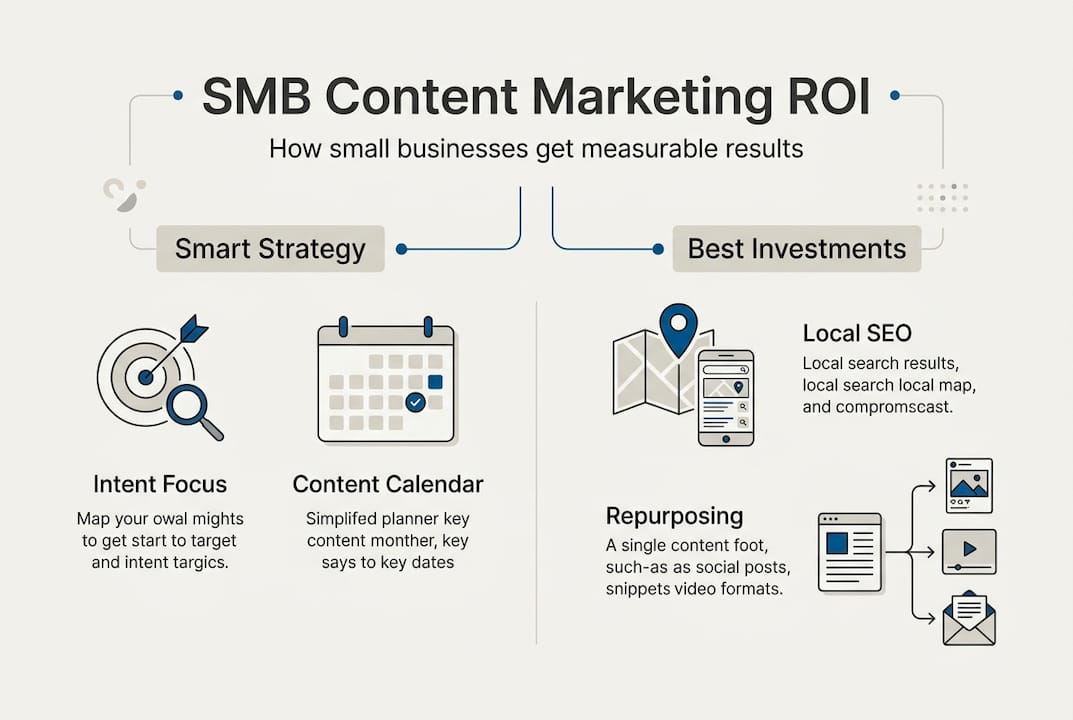
Small businesses waste thousands of dollars every year chasing content volume. They publish daily blog posts, flood social media, and create videos nobody watches. The problem isn’t effort. It’s strategy. Effective content marketing for SMBs prioritizes quality commercial-intent content over volume, using topic clusters, content calendars, and intent-mapped publishing of just 2 to 4 pieces monthly.

Commercial intent means creating content that aligns with what buyers actually search for when they’re ready to make decisions. Instead of writing generic “what is” posts, focus on comparison guides, solution-focused how-tos, and service explainers. These pieces attract visitors closer to conversion. A roofing company gets better results from “metal vs. asphalt shingle costs in 2026” than from “history of roofing materials.”
Topic clusters organize content around pillar pages that establish authority on core services. Each cluster includes a central pillar piece and 3 to 6 supporting articles that link back to it. This structure signals expertise to search engines and guides readers naturally through your offerings. A marketing agency might build a pillar page on content marketing for small businesses with supporting posts on budget allocation, automation tools, and ROI tracking.
Content calendars and intent mapping prevent random publishing. Map each piece to a specific buyer journey stage: awareness, consideration, or decision. Maintain a 70/30 ratio of commercial to non-commercial content. That means 7 out of 10 pieces should directly support service sales, while 3 can address broader industry topics that build trust and authority.
Professionele tip: Start with one topic cluster per quarter rather than trying to cover everything at once. Build depth in one service area before expanding to others.
Experts agree that focused quality wins every time. As one content strategist noted:
“SMBs that publish 2 to 4 strategically planned pieces monthly, aligned with buyer intent and organized in topic clusters, consistently outperform competitors publishing daily without clear commercial focus.”
The data backs this up. Businesses using intent-mapped content calendars see 40% higher engagement rates and 35% more qualified leads compared to those publishing on random schedules. Quality content also has a longer shelf life. A well-researched guide continues attracting traffic for years, while thin daily posts get buried within weeks.
Budgeting smartly: achieving measurable ROI with affordable content marketing
Budget determines what’s realistic for your content marketing program. SMBs achieve measurable ROI in 4 to 6 months with $2,000 to $5,000 monthly budgets, but below $1,500 monthly you should focus on service pages and local SEO first. Understanding these thresholds prevents wasted investment and frustration.
Here’s what different budget levels can realistically deliver:
| Monthly Budget | Expected Outcomes | Timeline to ROI |
|---|---|---|
| Under $1,500 | Service page optimization, basic local SEO, 1-2 blog posts | 6-9 months |
| $2,000-$3,500 | 2-3 quality posts, email campaigns, social distribution, local SEO | 4-6 months |
| $3,500-$5,000 | 3-4 posts, video content, automation setup, multi-channel distribution | 4-5 months |
| Over $5,000 | Full content program, paid promotion, advanced automation, dedicated strategy | 3-4 months |
Budgets under $1,500 monthly can’t support a full content marketing program yet. Invest that money in getting your foundation right first. Optimize your service pages with clear value propositions and strong calls to action. Claim and optimize your Google Business Profile. Build citations in local directories. Get 10 to 15 genuine customer reviews. These fundamentals deliver faster returns than blog content when resources are limited.
Once you reach the $2,000 to $5,000 range, you can run a proper content program. This budget covers professional writing, basic design, SEO optimization, and distribution across email and social channels. You’ll produce 2 to 4 substantial pieces monthly, each 1,500 to 2,500 words, with supporting graphics and optimized metadata.
Allocate your budget strategically across the buyer journey. Spend 40% on decision-stage content that converts, 35% on consideration-stage content that educates, and 25% on awareness-stage content that attracts new audiences. This distribution maximizes ROI by prioritizing content closest to conversion while still feeding your pipeline with new prospects.
Professionele tip: Track cost per lead and customer acquisition cost from day one. Knowing these numbers lets you adjust budget allocation based on what actually drives revenue, not guesswork.
Local SEO deserves special attention for service-based SMBs in competitive markets. A plumber, dentist, or salon competing in a major metro area should optimize local SEO before scaling content volume. Local pack rankings and review velocity often deliver faster, more predictable returns than blog traffic for location-dependent businesses.
The 4 to 6 month ROI timeline assumes consistent execution. Publishing 3 posts one month, then nothing for two months, then 5 posts in a rush resets your progress. Search engines and audiences both reward consistency. Better to publish 2 quality pieces every month for a year than to publish 10 pieces in three months and then go dark.
Leveraging automation and repurposing for efficiency and scale
Smart SMBs multiply content impact through strategic repurposing and affordable automation. Affordable AI tools enable content repurposing and multi-channel distribution for just $300 to $500 monthly when integrated with email and SEO stacks. This approach stretches limited budgets while maintaining consistent presence across channels.
Email remains the highest ROI owned channel for small businesses, delivering 4x to 8x returns on investment. Every piece of content you create should feed your email strategy. Turn blog posts into email series, extract key insights for newsletters, and use content upgrades as lead magnets. Email gives you direct access to interested prospects without paying for reach or fighting algorithm changes.
Short-form video adapted from written content shows the highest engagement returns in 2026. Take your blog posts and create 30 to 90 second videos highlighting key takeaways. These work perfectly for Instagram Reels, TikTok, YouTube Shorts, and LinkedIn video posts. You don’t need expensive production. Screen recordings with voiceover, simple slides, or talking head clips shot on a smartphone all perform well when the information delivers value.
Affordable automation tools that integrate well include:
- Content repurposing platforms ($50 to $100/month) that automatically convert blog posts into social media updates, email content, and video scripts
- Email marketing automation ($50 to $150/month) for nurture sequences, segmentation, and behavior-triggered campaigns
- Social scheduling tools ($30 to $80/month) that distribute content across platforms on optimal timing
- AI writing assistants ($20 to $50/month) for drafting outlines, generating variations, and optimizing copy
- SEO and analytics platforms ($100 to $200/month) for keyword research, rank tracking, and performance measurement
Total monthly investment for a solid automation stack runs $300 to $500, well within reach for most SMBs. These tools don’t replace human insight but they eliminate repetitive tasks and ensure consistent execution even when you’re busy running your business.
Here’s how to integrate AI assistance while maintaining authenticity:
- Use AI to generate content outlines and first drafts based on your topic and target keywords
- Add your unique expertise, customer stories, and specific examples that only you can provide
- Edit for brand voice, ensuring the content sounds like you, not a robot
- Verify all facts, statistics, and claims before publishing
- Have a human review every piece for accuracy, tone, and strategic alignment
De SMB content strategy guide approach emphasizes this balance between efficiency and authenticity. Automation handles the mechanical work. You provide the insight and expertise that builds trust.
Professionele tip: Always add human editorial oversight to automated content. AI tools can draft and suggest, but your expertise and authentic voice create the connection that converts readers into customers.
Repurposing extends content lifespan and reach without creating from scratch every time. A single 2,000-word blog post can become an email series, 6 social media posts, 3 short videos, an infographic, a podcast episode script, and a slide deck for presentations. This approach transforms one piece of content into 15 to 20 touchpoints across different channels and formats.
The key is planning repurposing into your content creation process from the start. When you write a blog post, identify quotable stats for social posts, sections that work as standalone emails, and concepts that translate well to video. This intentional approach makes repurposing faster and more effective than trying to retrofit content after publication.
Common pitfalls and how to avoid them for consistent results
Most SMBs sabotage their content marketing before it has a chance to work. Common failures include volume over strategy, no distribution plan, inconsistent publishing, ignoring calls to action, poor ROI tracking, and quitting prematurely when results take 6 to 9 months to materialize. Recognizing these pitfalls helps you avoid them.
The volume trap catches businesses who think more content automatically means better results. They publish daily without strategy, covering random topics that don’t align with what their buyers actually need. This creates content graveyards where dozens of posts sit unread because they weren’t created with commercial intent or distribution plans. Quality and strategy always beat quantity.
Neglecting distribution is equally damaging. Creating great content means nothing if nobody sees it. Many SMBs publish a blog post, share it once on social media, and wonder why traffic stays flat. Effective distribution means promoting each piece through email, social media, industry forums, and relevant online communities. Plan to spend as much time distributing content as creating it.
Inconsistent publishing destroys momentum and trust. Audiences and search engines both reward reliability. Publishing 4 posts in January, nothing in February and March, then 6 posts in April confuses your audience and signals unreliability to search algorithms. Set a sustainable schedule you can maintain for at least 12 months. Two quality posts monthly beats erratic bursts every time.
Missing or weak calls to action waste the attention you’ve earned. Every piece of content should guide readers toward a clear next step: schedule a consultation, download a guide, request a quote, or join your email list. Without clear CTAs, readers consume your content and leave without converting. Make the next step obvious and easy.
As one content marketing expert explains:
“The businesses that fail at content marketing share common patterns: they prioritize quantity over strategic focus, publish inconsistently, neglect distribution channels, omit clear calls to action, and abandon efforts before the typical 6 to 9 month window where results become visible.”
Poor ROI tracking means you can’t identify what works or justify continued investment. Set up proper analytics from day one. Track traffic sources, time on page, conversion rates, cost per lead, and customer acquisition cost. Use UTM parameters to identify which content pieces drive the most valuable traffic. Review these metrics monthly and adjust your strategy based on actual performance data.
Quitting too soon kills programs that would have succeeded with patience. Content marketing is a long game. Most businesses see initial traction around month 3 to 4, measurable leads by month 5 to 6, and clear ROI by month 7 to 9. Giving up at month 3 or 4 means abandoning your investment right before it pays off.
Here’s how to avoid these pitfalls and maintain consistent progress:
- Create a 90-day content calendar before you start, ensuring strategic focus and consistent publishing
- Build distribution into your workflow with checklists for promoting each piece across all relevant channels
- Set calendar reminders for publishing deadlines and treat them as seriously as client meetings
- Include at least one clear, relevant call to action in every piece of content
- Review analytics monthly and document what’s working so you can do more of it
- Commit to a 9-month minimum before evaluating whether content marketing works for your business
Understanding the content marketing strategy means accepting that this is a marathon, not a sprint. The businesses that succeed are those that maintain strategic focus, publish consistently, distribute effectively, and give the strategy time to compound.
Explore marketing automation solutions for SMB success
You’ve learned the strategies that drive content marketing success for small businesses. Now it’s time to implement them efficiently. Marketing automation software helps SMBs execute these strategies without hiring large teams or working 80-hour weeks.
The right platform integrates email marketing, social distribution, lead nurturing, and analytics in one system. It automates the repetitive tasks while letting you focus on strategy and creativity. Marketing automation software for growth enables the consistent execution that content marketing demands, turning your strategic plans into automated workflows that run reliably.
Look for solutions offering proven ROI specifically for small businesses, not enterprise platforms that cost more than your entire marketing budget. The best tools for SMBs combine power with simplicity, offering done-for-you setup and real human support when you need help.
Veelgestelde vragen
How much content should my small business publish monthly?
Aim for 2 to 4 high-quality, intent-focused pieces monthly to balance quality and consistency. This volume lets you maintain strategic focus on commercial intent while building authority through topic clusters. Publishing more than 4 pieces monthly often dilutes quality and strategic alignment unless you have dedicated content teams.
Can small businesses see ROI with content marketing on a modest budget?
Yes, SMBs investing $2,000 to $5,000 monthly in content marketing see measurable ROI within 4 to 6 months when executing strategically. Budgets under $1,500 monthly should prioritize service page optimization and local SEO before scaling content volume. The key is consistent execution and tracking the right metrics from day one.
What are common mistakes SMBs make in content marketing?
The biggest mistakes include focusing on volume over strategic intent and neglecting content distribution across owned channels. Many businesses also ignore calls to action in their content and quit before the typical 6 to 9 month window when results become visible. Inconsistent publishing and poor ROI tracking compound these problems.
How can automation improve my SMB’s content marketing?
Automation enables efficient repurposing of content across multiple channels and boosts distribution without manual effort for each piece. Affordable AI tools combined with human oversight ensure authentic content delivery while eliminating repetitive tasks. A solid automation stack costs just $300 to $500 monthly and multiplies your content impact significantly.
Aanbevolen
- Content marketing for small businesses: a 2026 guide – Go Online Now
- Content Marketing Basics: Everything You Need to Know – Go Online Now
- Content Strategy Guide for SMBs: Complete Approach – Go Online Now
- Affordable marketing software for SMB growth in 2026 – Go Online Now
- Car Rental Marketing ROI: Best Ad Platforms & Strategy Guide 2026 | Nomora