
Many small businesses struggle with content marketing because they lack a clear strategy or the resources to execute consistently. The good news is that 2026 brings affordable automation tools and proven frameworks that make strategic content marketing accessible to every entrepreneur. This guide will show you exactly how to build a content marketing system that drives real growth, generates quality leads, and fits your budget without requiring a dedicated marketing team.
Key takeaways
| Point | Details |
|---|---|
| Strategy first | A documented content plan with audience mapping and intent focus is essential for ROI |
| Commercial focus wins | Allocating 70% of effort to commercial content generates 3x more leads than purely informational posts |
| Automation levels the field | Affordable tools enable solo entrepreneurs to compete by automating creation, SEO, and distribution |
| Quality over quantity | Publishing 2-4 optimized pieces monthly outperforms high-volume, low-quality content |
| Track what matters | Measuring leads and revenue attribution beats vanity metrics like pageviews for true ROI |
Understanding content marketing essentials for small businesses
Content marketing for small businesses means creating valuable content that attracts, educates, and converts your ideal customers into paying clients. Unlike large corporations with massive budgets, you need every piece of content to work harder and deliver measurable results. The core mechanics involve building a documented strategy first, including audience definition, customer journey mapping, content pillars, and intent-mapped calendars.
Start by defining your audience with precision. Who are they? What problems keep them awake at night? What solutions are they actively searching for online? Map their journey through three stages: top of funnel (awareness), middle of funnel (consideration), and bottom of funnel (decision). Each stage requires different content types. Awareness content educates broadly, consideration content compares options, and decision content showcases your specific offerings and builds trust.

Content pillars are the three to five main themes your business will own. For a salon, pillars might include hair care tips, styling trends, and booking convenience. For a coaching business, pillars could cover mindset strategies, business growth tactics, and client success stories. These pillars shape everything you publish and help search engines recognize your authority.
Intent mapping means planning content based on what your audience is searching for and where they are in the buying journey. Commercial intent keywords like “best CRM for real estate agents” or “affordable marketing automation software” signal buyers ready to purchase. Informational keywords like “what is content marketing” attract earlier-stage readers. Smart small businesses prioritize commercial topics because they convert faster.
A solid content strategy guide helps you organize these elements into an actionable calendar. Typical publishing frequency for effective small business content marketing is 2-4 high-quality pieces per month. This pace balances resource constraints with the consistency search engines reward. Publishing more frequently with thin content hurts more than it helps.
Key elements to document in your strategy:
- Target audience personas with specific pain points and search behaviors
- Customer journey stages mapped to content types and topics
- Content pillars that align with your core services and expertise
- Editorial calendar prioritizing commercial intent topics for faster ROI
- Distribution channels where your audience actively spends time
Maximizing ROI with strategic content and automation
The biggest ROI breakthrough for small businesses is focusing 70% of content effort on commercial and service pages rather than purely educational blog posts. Research shows that commercial-focused content drives 3x more leads per dollar spent compared to traditional advertising, and email marketing integrated with content delivers a stunning $36 return for every $1 invested. When you prioritize content directly tied to your offerings, you accelerate results from 12 months down to 4-6 months.
Consistent quality publishing matters more than volume. Two deeply researched, SEO-optimized articles that answer real buyer questions will outperform ten shallow posts every time. Quality means thorough research, clear structure, actionable advice, and optimization for search intent. Each piece should solve a specific problem your ideal customer faces right now.
Email marketing amplifies your content’s reach and ROI. When you publish a new piece, email it to your list with a compelling subject line and clear value proposition. Segment your list by interest and journey stage to send the most relevant content to each subscriber. This approach transforms content from a passive asset into an active lead generation engine.
Affordable automation tools have revolutionized what small businesses can accomplish with limited time and budgets. Marketing automation platforms now range from free plans to about $1,500 per month, with most small businesses finding everything they need between $50-$500 monthly. These tools automate content creation drafts, SEO keyword research, publishing workflows, social media distribution, and email campaigns.
| Platform | Starting Price | Belangrijkste kenmerken | Best For |
|---|---|---|---|
| HubSpot | Free-$800/mo | CRM, email, blogging, social scheduling | Growing teams needing CRM integration |
| HoopAI | $29-$299/mo | AI content creation, SEO research, multi-channel publishing | Solo entrepreneurs and small teams |
| ContentBeast | $99-$499/mo | Content calendar, collaboration, analytics | Service businesses with content teams |
| Ga nu online | $97-$497/mo | All-in-one automation, CRM, done-for-you setup | SMBs wanting complete marketing system |
Pro Tip: Use AI tools for draft generation and research, but always apply human editing for authenticity, brand voice, and E-E-A-T compliance. Search engines reward content demonstrating experience, expertise, authority, and trustworthiness, which only humans can truly provide.
The right automation stack for your business depends on your specific needs and budget. Look for platforms offering:
- Content creation assistance with SEO optimization built in
- Editorial calendar and workflow management for consistency
- Multi-channel publishing to blog, social media, and email from one dashboard
- Analytics tracking leads and conversions, not just traffic
- Integration with your existing CRM and tools
Begrip why small businesses need marketing automation helps you evaluate which features matter most. The goal is spending less time on repetitive tasks and more time on strategy and customer relationships. When marketing automation supports small teams effectively, one person can accomplish what previously required three or four.
Avoiding common pitfalls: strategy, distribution, and measurement
Most small business content marketing failures stem from predictable mistakes that are easy to avoid once you know what to watch for. The data is sobering: 70% of SMBs fail to get ROI from content marketing due to poor strategy, overly promotional content, inadequate distribution, and tracking vanity metrics instead of leads and revenue. Let’s break down each pitfall and how to sidestep it.
Lack of strategy is the number one killer. Businesses that publish randomly without a documented plan waste time and money creating content nobody searches for or needs. Every piece should map to a specific audience segment, journey stage, and business goal. If you cannot explain why you are creating a particular piece and what action you want readers to take, do not publish it.
Poor distribution is almost as damaging as no strategy. Creating great content means nothing if nobody sees it. Many small businesses publish a blog post, share it once on social media, then wonder why traffic stays flat. Effective distribution means promoting each piece across multiple channels: email your list, post on relevant social platforms, repurpose into video or infographics, and engage in communities where your audience gathers.
Vanity metrics like pageviews, social shares, and time on page feel good but tell you nothing about revenue impact. A post with 10,000 views that generates zero leads is worthless compared to a post with 200 views that brings in five qualified prospects. Track metrics that matter: leads generated, email signups, consultation bookings, and revenue attributed to specific content pieces.
“Without clear strategy, consistent distribution, and lead-focused measurement, 70% of small businesses see no ROI from content marketing despite significant time and resource investment.”
Content repurposing multiplies your reach without multiplying your workload. Turn a comprehensive blog post into a video script, an infographic, a series of social posts, an email newsletter, and a podcast episode. Each format reaches different audience segments and learning preferences. This approach gives you 5-10 content assets from one core piece of research and writing.
Common mistakes to avoid:
- Publishing without a documented strategy and editorial calendar
- Creating only promotional content that talks about your business instead of solving customer problems
- Failing to distribute content beyond your blog through email, social, and partnerships
- Tracking pageviews and engagement instead of leads and revenue attribution
- Inconsistent publishing that confuses search engines and loses audience trust
Pro Tip: Set quarterly content goals tied directly to business outcomes like “generate 50 qualified leads” or “book 20 consultations” rather than “publish 12 blog posts.” Review performance monthly and adjust your topics, formats, and distribution based on what actually drives benefits from marketing automation software and conversions.
Practical steps to implement affordable automation and content growth in 2026
Transforming content marketing from overwhelming to manageable requires a clear implementation framework. Here is your step-by-step roadmap to launch or upgrade your content marketing system using affordable automation tools and proven tactics that work in 2026.
-
Document your content strategy foundation. Define your target audience personas with specific demographics, pain points, and search behaviors. Map their customer journey from awareness to decision. Identify 3-5 content pillars aligned with your core services. This foundation takes 2-3 focused hours but guides every future decision.
-
Conduct keyword and topic research. Use free tools like Google Keyword Planner, AnswerThePublic, or affordable paid tools like Ahrefs or SEMrush to identify what your audience actively searches for. Prioritize commercial intent keywords that signal buying readiness. Build a list of 20-30 topics mixing commercial and informational content weighted 70/30.
-
Choose your automation platform. Evaluate tools based on your budget, technical comfort, and feature needs. Affordable platforms enable solo entrepreneurs to compete by automating research, drafting, SEO optimization, and multi-channel distribution. Most small businesses thrive with all-in-one solutions that integrate content, email, CRM, and analytics rather than juggling five separate tools.
-
Set up your publishing infrastructure. Create templates for blog posts, emails, and social media that maintain brand consistency. Configure your automation tool to handle scheduling, SEO optimization, and distribution. Establish a realistic publishing calendar of 2-4 quality pieces monthly that you can sustain long term.
-
Create and optimize your first content batch. Write or draft 4-6 pieces covering different journey stages and pillar topics. Optimize each for target keywords, readability, and clear calls to action. Schedule them for consistent publication over 6-8 weeks.
-
Build distribution and repurposing workflows. Set up email sequences to notify subscribers of new content. Create social media templates to promote each piece 3-5 times over several weeks. Plan how you will repurpose each article into videos, graphics, or other formats.
-
Implement tracking and measurement. Configure Google Analytics goals for newsletter signups, contact form submissions, and consultation bookings. Use UTM parameters to track which content pieces drive conversions. Set up monthly reporting to review leads and revenue by content source.
| Automation Benefit | Without Automation | With Automation | Time Saved |
|---|---|---|---|
| Content research and outlining | 3-4 hours per piece | 30-45 minutes | 75% |
| SEO optimization and keyword targeting | 1-2 hours per piece | 15-20 minutes | 80% |
| Multi-channel distribution | 2-3 hours per piece | 10-15 minutes | 90% |
| Email campaign creation | 1-2 hours per campaign | 20-30 minutes | 70% |
| Performance tracking and reporting | 3-4 hours monthly | 30-45 minutes | 80% |
The cost of implementing this system ranges from free (using basic tools and manual processes) to $500 monthly for comprehensive automation that handles most tactical work. Most small businesses find their sweet spot between $100-$300 monthly, which delivers professional results without enterprise complexity or pricing.
Exploring small business automation strategies helps you identify which processes to automate first based on your biggest time drains. Start with the tasks you do most frequently, like social media posting or email sends. Then expand automation to content creation, SEO research, and analytics as you gain confidence.
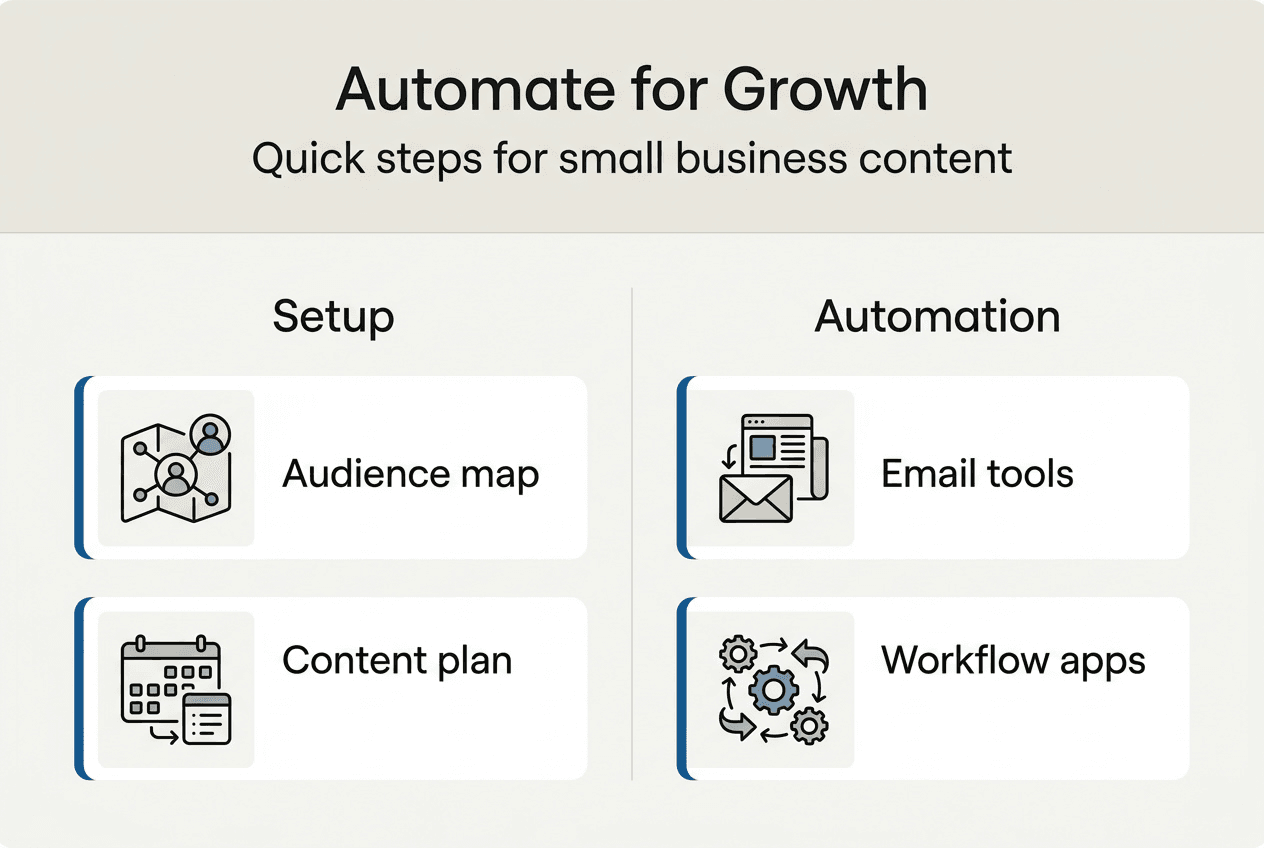
Building effective marketing automation workflows means connecting your content to your sales process. When someone downloads a guide, they enter a nurture sequence. When they visit your pricing page, they receive targeted follow-up. When they book a consultation, they get preparation materials. These workflows turn content from isolated pieces into a cohesive system that guides prospects toward becoming customers.
Explore marketing automation solutions for small business growth
Now that you understand how strategic content marketing combined with affordable automation drives real growth, it is time to put these insights into action. Go Online Now offers marketing automation software designed specifically for SMB conversions, bringing together content creation, email campaigns, CRM, and analytics in one simple platform.
Our clients achieve measurable results: up to 85% more conversions and 75% time saved within 90 days. Unlike overpriced enterprise platforms, we provide done-for-you setup, real human support, and transparent pricing with no contracts or hidden fees. Whether you need help automating your content workflow, tracking marketing automation software ROI, or scaling your marketing automation software for growth, we have built our platform around what small businesses actually need, not what tech companies think you should want.
Frequently asked questions
How often should small businesses publish content for best results?
Publishing 2-4 high-quality pieces per month balances resource constraints with the consistency search engines reward. This frequency allows time for proper research, optimization, and promotion of each piece. Consistent monthly publishing builds authority faster than sporadic high-volume bursts that cannot be sustained long term.
What types of content should small businesses focus on?
Prioritize commercial content directly tied to your services and offerings because allocating 70% of effort to commercial content yields better ROI than purely informational posts. Service pages, product comparisons, case studies, and buyer guides convert visitors into leads more effectively. Use the remaining 30% for educational content that builds trust and attracts top-of-funnel traffic.
Can small businesses afford marketing automation in 2026?
Yes, automation tools for SMBs range from free plans to about $1,500 per month, with most businesses finding complete solutions between $100-$500 monthly. These platforms automate time-consuming tasks like content distribution, email campaigns, and SEO research, enabling solo entrepreneurs to compete with larger teams. The time saved and leads generated typically deliver ROI within 60-90 days.
How do you measure content marketing ROI accurately?
Track leads generated, consultation bookings, email signups, and revenue attributed to specific content pieces rather than vanity metrics like pageviews or social shares. Set up conversion tracking in Google Analytics, use UTM parameters to identify which content drives action, and review monthly reports showing leads and revenue by content source. This approach reveals which topics and formats deliver real business results.
Aanbevolen
- 8 Digital Marketing Tips for Small Businesses in 2025 – Go Online Now
- Content Marketing Basics: Everything You Need to Know – Go Online Now
- Content Strategy Guide for SMBs: Complete Approach – Go Online Now
- Tips for small business growth: smart strategies for 2026 – Go Online Now
- Best Law Firm Marketing Strategies for 2026