Most American coaching and service-based businesses waste over 30 percent of their time jumping between unconnected tools and software. This struggle to keep client data organized can stall growth and drain resources fast. A truly unified CRM solution promises freedom from chaos, helping entrepreneurs and marketing managers in North America build stronger relationships while reducing costs. Discover what makes these all-in-one systems the better choice for efficient client management and long-term business success.
Defining All-in-One CRM Solutions
An all-in-one CRM solution represents a comprehensive business management platform designed to centralize critical operations and customer interactions across multiple departments. These unified systems combine sales, marketing, customer service, and analytics into a single integrated interface, eliminating traditional organizational silos and providing businesses with a holistic approach to customer relationship management.
Unlike traditional CRM platforms that focus on isolated tasks, modern all-in-one solutions are engineered to streamline complex business processes. They serve as a central hub for managing information and interactions across every organizational function, ensuring seamless communication and data accessibility. This approach enables small and mid-sized businesses to track customer journeys more effectively, understand comprehensive engagement metrics, and make data-driven decisions with unprecedented clarity.

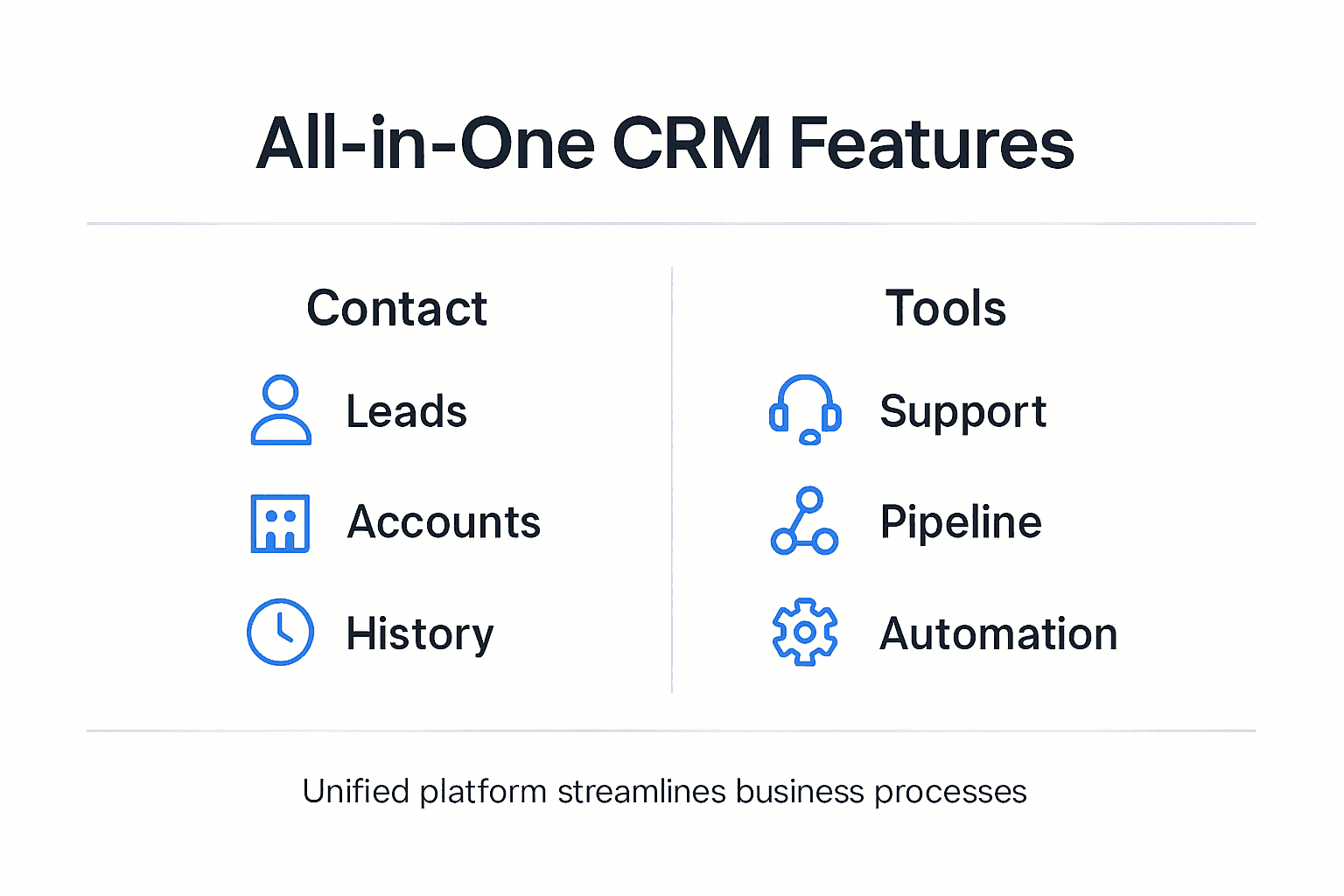
The key components of an all-in-one CRM typically include robust contact management, lead tracking, sales pipeline visualization, marketing automation capabilities, customer support tools, and advanced reporting features. By consolidating these functions into a single platform, businesses can reduce technological complexity, minimize software subscription costs, and create a more integrated workflow that enhances overall operational efficiency.
Pro tip: When evaluating all-in-one CRM solutions, prioritize platforms that offer seamless integration, user-friendly interfaces, and scalable features that can grow alongside your business needs.
Core Features and Unified Tools Explained
All-in-one CRM solutions offer a comprehensive suite of integrated tools designed to transform how small and mid-sized businesses manage customer relationships. These platforms consolidate multiple critical business functions into a single, streamlined system that eliminates fragmented workflows and data silos. These sophisticated platforms typically encompass a range of interconnected capabilities that support every stage of customer interaction.
The core features of an all-in-one CRM can be categorized into several essential functional domains. Contact Management serves as the foundation, providing a centralized database where businesses can track detailed customer information, communication history, and interaction preferences. Sales Pipeline Tracking enables real-time visualization of potential opportunities, helping teams understand exactly where prospects are in the conversion process. Marketingautomatisering tools allow for targeted email campaigns, lead scoring, and automated communication workflows that nurture potential customers without requiring constant manual intervention.
Additional unified tools typically include comprehensive Customer Support Modules that enable ticket tracking, issue resolution management, and customer communication logging. Advanced Reporting and Analytics features transform raw data into actionable insights, allowing businesses to understand performance metrics, customer behavior patterns, and potential growth opportunities. By integrating these diverse tools into a single platform, organizations can create a more cohesive, efficient approach to managing customer relationships and driving business growth.
Pro tip: When selecting an all-in-one CRM, prioritize solutions that offer seamless integration between different modules and provide intuitive, user-friendly interfaces that minimize employee training time.
Types of Businesses That Benefit Most
Certain industries and business types experience dramatically enhanced performance when implementing all-in-one CRM solutions. Small and medium-sized businesses across multiple sectors stand to gain significant operational advantages by adopting these comprehensive platforms. The most successful implementations typically occur in industries that rely on complex customer interactions, multi-stage engagement processes, and require seamless communication across different departments.
Key industries that derive exceptional value from all-in-one CRM platforms include Professionele diensten, Vastgoed, Gezondheidszorg, Onderwijs, En Coaching Businesses. These sectors share common characteristics that make them ideal candidates: frequent customer touchpoints, need for detailed client tracking, complex sales cycles, and requirements for personalized communication. For instance, coaching businesses benefit from centralized client management that tracks consultation histories, progress notes, and communication preferences, while real estate professionals can leverage integrated tools to manage leads, property portfolios, and client relationships simultaneously.
Marketing and Sales-Driven Organizations represent another critical segment that thrives with all-in-one CRM solutions. Companies across various industries leverage these platforms to consolidate customer data, automate marketing workflows, and create more streamlined sales processes. Technology startups, consulting firms, and service-based businesses find particular value in platforms that eliminate data silos, provide comprehensive analytics, and enable more intelligent customer engagement strategies. The ability to track a customer’s entire journey from initial contact through conversion and ongoing support represents a transformative capability for growth-oriented businesses.
Pro tip: Conduct a comprehensive internal audit of your current customer management processes before selecting a CRM, identifying specific pain points and communication gaps that an integrated solution could potentially resolve.
Comparing All-in-One vs. Multiple Platforms
The fundamental differences between all-in-one CRM solutions and multiple standalone platforms can significantly impact a small business’s operational efficiency and growth potential. While standalone tools might offer specialized features, they often create complex technological ecosystems that drain resources and fragment critical business data. Small and mid-sized businesses must carefully evaluate the trade-offs between specialized functionality and integrated performance when selecting their customer relationship management approach.
Multiple platform approaches typically involve using separate software for different business functions like sales tracking, email marketing, customer support, and analytics. This strategy can initially seem appealing due to the perception of getting best-of-breed solutions for each specific need. However, the hidden costs become apparent through increased Integration Complexity, higher Training Expenses, and reduced Cross-Department Collaboration. Each additional platform requires individual subscriptions, unique login credentials, separate data synchronization efforts, and distinct user interfaces that can overwhelm smaller teams with limited technological resources.
All-in-one CRM platforms, by contrast, offer a unified approach that consolidates multiple business functions into a single, interconnected system. These comprehensive solutions eliminate data silos, reduce technological friction, and provide a holistic view of customer interactions across different stages of engagement. Small businesses gain significant advantages through simplified workflows, reduced software costs, streamlined reporting, and the ability to track complete customer journeys without navigating multiple disconnected systems. The seamless integration allows teams to focus on strategic growth activities rather than managing complex technological infrastructures.
Here’s a comparison of all-in-one CRM platforms and multiple standalone tools to summarize their practical impact:
| Factor | All-in-One CRM | Multiple Platforms |
|---|---|---|
| Data Management | Centralized database | Scattered information |
| Workflow Efficiency | Seamless processes | Frequent context switching |
| Cost Structure | Single subscription | Multiple licenses |
| Team Collaboration | Real-time visibility | Department silos |
| Training Requirement | Unified learning curve | Multiple user interfaces |
| Integration Needs | Built-in connections | Complex setup |
Pro tip: Calculate your total technology cost of ownership by adding up not just software subscriptions, but also integration expenses, training time, and potential productivity losses when evaluating multiple platform versus all-in-one CRM solutions.
Cost, Time, and Implementation Factors
Implementing an all-in-one CRM platform involves carefully evaluating the total cost of ownership, which extends far beyond simple software subscription prices. Small and mid-sized businesses must consider not just upfront expenses, but the long-term financial and operational implications of their customer relationship management strategy. The true investment includes software costs, implementation time, staff training, and potential productivity gains that can significantly impact overall business performance.
The financial landscape of CRM implementation reveals several critical considerations. Pricing structures vary widely based on the number of users, required features, and complexity of integration needs. Productivity Costs represent a hidden but substantial factor, with businesses potentially losing up to 40% efficiency when managing multiple disconnected platforms. All-in-one solutions dramatically reduce these hidden expenses by providing a unified system that minimizes context switching, reduces training time, and eliminates the need for complex data synchronization between different software tools.
Implementation factors go beyond simple monetary calculations. Small businesses must assess the total Time to Productivity, which includes initial setup, staff training, data migration, and the learning curve associated with new technology. All-in-one CRM platforms typically offer more streamlined implementation processes, with many providers now offering done-for-you setup services that dramatically reduce the technical burden on internal teams. The goal is not just to purchase a software solution, but to create a seamless technological ecosystem that supports business growth with minimal disruption to existing workflows.
Below is a quick summary of implementation and total cost factors to consider for small businesses:
| Consideration | Beschrijving | Business Impact |
|---|---|---|
| Upfront Costs | Initial software purchase or subscription | Requires immediate investment |
| Training Time | Learning curve for the team | Affects productivity ramp-up |
| Data Migration | Moving information to a new platform | May cause temporary disruption |
| Ongoing Support | Access to vendor assistance | Reduces technical challenges |
| Productivity Gains | Efficiency from unified system | Improves long-term ROI |
Pro tip: Request a detailed implementation timeline and total cost of ownership breakdown from potential CRM providers, including hidden expenses like training, data migration, and potential productivity losses during the transition period.
Simplify Your SMB Growth with One Powerful CRM Solution
Are you struggling with scattered tools and complex workflows that slow down your small or medium-sized business? The article highlights how all-in-one CRM solutions solve these exact challenges by unifying sales, marketing automation, and customer management into a seamless system. Pain points like integration complexity, wasted time switching between apps, and unclear customer data stop your team from growing smarter and faster.
Ga nu online - Maak verbinding was built specifically for SMBs and SMEs facing these hurdles. Our platform combines a robust all-in-one CRM with marketing automation software and digital marketing services in one affordable, easy-to-use system. Unlike bloated platforms, we deliver essential features like lead nurturing, appointment scheduling, and pipeline tracking without the overwhelming price or complexity. Plus, real human support and done-for-you setup mean you can start improving conversions and cutting down wasted time immediately.
Explore how our automation tools can streamline your processes in the Automation Archives – Go Online Now and discover tailored growth strategies on our Digital Marketing Archives – Go Online Now page.
Ready to stop juggling multiple disconnected tools and experience proven results? Visit Ga nu online and take the first step toward smarter SMB growth with our all-in-one CRM and marketing automation platform. Don’t wait to simplify your business and boost your revenue today.
Veelgestelde vragen
What are all-in-one CRM solutions?
All-in-one CRM solutions are comprehensive platforms that centralize business operations and customer interactions across departments, integrating sales, marketing, customer service, and analytics into a single interface.
How do all-in-one CRMs enhance SMB efficiency?
All-in-one CRMs streamline complex business processes, eliminate data silos, and improve communication, leading to enhanced operational efficiency and better tracking of customer journeys.
What key features should I look for in an all-in-one CRM?
When evaluating an all-in-one CRM, prioritize features like contact management, sales pipeline tracking, marketing automation, customer support tools, and advanced reporting capabilities to ensure a well-rounded solution.
What industries benefit most from all-in-one CRM solutions?
Industries such as professional services, real estate, healthcare, education, and coaching businesses often see significant advantages from all-in-one CRM platforms due to their need for detailed client tracking and automated communications.