

TL;DR:
- Brand reputation management involves proactively monitoring and shaping public perception to protect your business. For SMEs, reputation can represent up to 40% of enterprise value and heavily influences customer trust and referrals. Implementing continuous, targeted strategies and using tools like Goonlinenow enhances reputation control and business growth.
Brand reputation management is defined as the proactive process of monitoring, influencing, and protecting how your business is perceived by customers, partners, and the public. For SMEs, this is not a luxury. Intangible assets like brand reputation can represent up to 40% of a business’s enterprise value. That number alone reframes reputation from a soft marketing concern into a hard financial asset. Add the fact that negative reviews deter 94% of potential customers, and the cost of neglect becomes impossible to ignore.
What is brand reputation management and why does it matter for SMEs?
Brand reputation management, also called corporate reputation management in larger organizations, covers every effort you make to shape public perception of your business. It includes monitoring online reviews, responding to feedback, publishing owned content, and aligning your messaging across every channel your customers use. The goal is not to control what people think. The goal is to give them accurate, positive information so their natural conclusions favor your brand.
The distinction between brand and reputation is worth understanding clearly. Brand is what you say about yourself; reputation is what others say. You own your brand narrative through your website, social media, and marketing. You earn your reputation through every customer interaction, every review, and every public mention. A values-led brand is the strongest defense against misinformation because it gives your audience a clear reference point when conflicting narratives appear.
For SMEs specifically, the stakes are higher than most owners realize. A single viral complaint or a cluster of negative Google reviews can redirect purchasing decisions at scale. 90% of consumers trust peer recommendations over brand advertising. That means your customers are your most powerful marketing channel, and their trust is the asset you are managing.
What are the key components of an effective brand reputation strategy?
A strong reputation management framework rests on five core pillars: purpose, consistency, emotion, flexibility, and social proof. Each one plays a specific role in how your brand is perceived over time.
- Doel defines why your business exists beyond profit. Customers connect with brands that stand for something clear and credible. A coaching business that publicly commits to client outcomes, for example, builds a reputation that survives individual negative reviews.
- Consistency means your messaging, tone, and values appear the same across your website, social media, email, and in-person interactions. Inconsistency creates doubt. Doubt erodes trust faster than a bad review.
- Emotion refers to the feeling your brand creates. Customers remember how you made them feel far longer than what you said. Every touchpoint, from your invoice design to your customer service response time, contributes to that emotional record.
- Flexibility is your ability to adapt messaging when circumstances change, such as during a public controversy or a product issue, without abandoning your core values.
- Social proof includes reviews, testimonials, case studies, and user-generated content. These are the most credible signals in your reputation toolkit because they come from real customers, not your marketing team.
Professionele tip: Align your reputation efforts with your brand values from day one. When your public actions consistently match your stated values, you create a reputation that is genuinely hard to damage.
Consistent messaging across channels is not just a branding best practice. It is a reputation defense mechanism. When your owned channels all tell the same story, misinformation has less room to take hold. The importance of reputation management grows directly with the number of channels your customers use to research you.

How can SMEs measure and track brand reputation effectively?
Measuring reputation turns an abstract concept into a manageable business metric. Without measurement, you are reacting to crises rather than preventing them. The right key performance indicators (KPIs) give you early warning signals and a clear picture of where you stand.
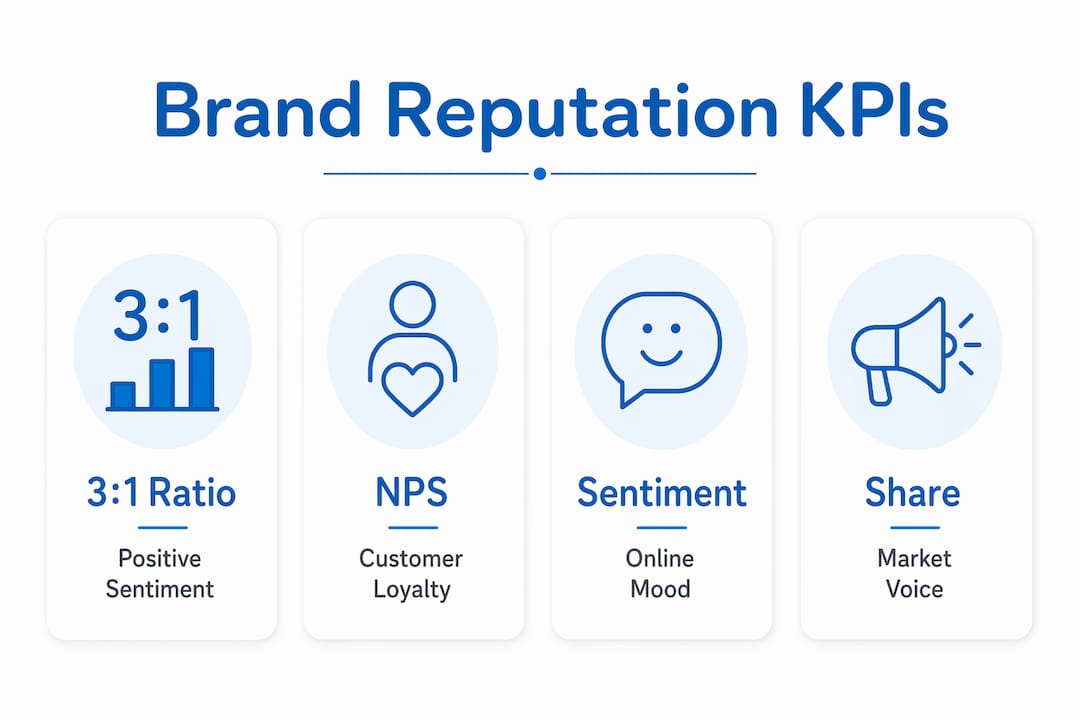
The three most important KPIs for SME reputation tracking are:
- Netto Promoter Score (NPS): NPS measures how likely your customers are to recommend you to others. A high NPS signals strong trust and organic word-of-mouth growth. A declining NPS is an early warning that something in the customer experience needs attention.
- Sentiment analysis: Sentiment analysis categorizes online mentions of your brand as positive, negative, or neutral. Tracking sentiment analysis alongside share of voice gives you a real-time pulse on public perception. The emotion behind a mention matters as much as the mention itself.
- Share of voice: This measures how much of the online conversation in your category your brand owns compared to others. A growing share of voice in positive contexts signals that your reputation-building efforts are working.
A practical target to work toward is a 3:1 ratio of positive to negative online sentiment. That ratio provides enough positive signal to absorb occasional negative mentions without lasting damage to your overall perception.
| KPI | What it measures | Why it matters for SMEs |
|---|---|---|
| Net Promoter Score | Customer likelihood to recommend | Predicts organic growth and loyalty |
| Sentiment analysis | Tone of online brand mentions | Catches reputation shifts early |
| Share of voice | Brand presence in category conversations | Shows competitive standing |
| Review volume and rating | Quantity and quality of public reviews | Directly influences purchase decisions |
Social listening tools help you monitor these metrics without manual effort. Set up alerts for your business name, your key staff members, and common misspellings of your brand. Negative sentiment often hides in forums and discussions that do not mention your brand name directly. Broad monitoring catches what narrow monitoring misses.
What are proven strategies for managing and improving brand reputation?
The single most important shift in how to manage brand reputation is moving from reactive to proactive. Most SMEs only think about reputation when something goes wrong. By then, the damage is already spreading. Effective reputation management is an ongoing discipline, not a crisis response plan.
The foundation of a proactive approach is building a high-quality buffer of owned digital content. Blog posts, case studies, video testimonials, and press releases that consistently appear in search results make it much harder for negative content to rank prominently. Waiting until a crisis hits makes it extremely difficult to push negative news down in search results. You need that content buffer in place before you need it.
Here are the core practices that consistently produce results:
- Create a central source of truth. Consistently updating your owned digital channels makes misinformation harder to spread and gives journalists and customers an accurate reference point. Your website, Google Business Profile, and social media bios should all tell the same, current story.
- Respond selectively. Engage only with constructive feedback and factual misinformation. Responding to trolls or malicious comments often amplifies the negative content by feeding the algorithms that promote it.
- Monitor broadly. Track your business name, key personnel names, product names, and common misspellings. Hidden negative sentiment in niche forums can surface unexpectedly if left unaddressed.
- Build review generation into your process. Ask satisfied customers for reviews immediately after a positive interaction. Timing matters. A customer who just had a great experience is far more likely to leave a review than one you contact weeks later.
- Assign ownership. Reputation management requires dedicated resources and leadership attention. Treating it as an accidental byproduct of good service is how reputations erode quietly.
Professionele tip: Set up Google Alerts for your business name, your own name, and two or three common misspellings. This takes five minutes and catches mentions that your primary monitoring might miss entirely.
Common pitfalls to avoid include deleting negative reviews without responding, making public promises your operations cannot consistently deliver, and ignoring reputation signals until they become a crisis. Each of these mistakes compounds the original problem.
How does brand reputation impact customer trust and business success?
The business case for reputation management is direct and measurable. Reputation risk is now recognized as a cash-flow, valuation, and leadership risk. That means your board, your bank, and your potential acquirers are all paying attention to how your brand is perceived, not just your revenue figures.
“Brand reputation should be integrated into core business planning as a value-protection engine, similar to finance or operations.” — Brand Equity / Economic Times
Customer acquisition costs drop significantly when your reputation does the selling for you. A business with a strong review profile and consistent positive sentiment attracts referrals organically. That reduces your paid advertising dependency and improves margin. Conversely, a business with a weak or damaged reputation pays more to acquire each customer because it has to overcome doubt at every stage of the buying process.
Loyalty is the other major financial benefit. Customers who trust your brand spend more, complain less, and refer others. The reputation management for SMEs framework that prioritizes trust-building over short-term promotional wins consistently produces better long-term customer lifetime value.
The compounding effect is real. A business that actively manages its reputation builds a positive digital footprint that grows over time. That footprint becomes a competitive advantage that is genuinely difficult for a new entrant to replicate quickly. For SMEs competing against larger, better-funded rivals, a strong reputation is one of the few assets that levels the playing field.
Why most SMEs are managing reputation the wrong way
After working with SMEs across multiple industries, one pattern stands out clearly. Most business owners treat reputation management as damage control. They check reviews when a complaint comes in, respond defensively, and then go back to running the business. That approach guarantees you are always behind.
The businesses that build genuinely strong reputations treat it the way they treat cash flow: with regular attention, clear metrics, and a plan. They publish content consistently. They ask for reviews systematically. They monitor broadly, including staff names and product-specific searches. And they respond to feedback with the same professionalism they bring to a client meeting.
The other misconception I see constantly is that reputation management is a marketing function. It is not. It is a leadership function. The decisions that shape your reputation, how you handle a difficult client, whether you deliver on a promise, how you respond publicly to criticism, are made at the top. Marketing can amplify a good reputation, but it cannot manufacture one.
The practical opportunity for SMEs is significant. Most of your direct competitors are not doing this well. A consistent, proactive approach to building brand trust puts you ahead of the majority of businesses in your category without requiring a large budget. It requires discipline, not dollars.
— Go
How Goonlinenow helps SMEs take control of their reputation
Managing your brand reputation manually across reviews, social media, email, and your website is time-consuming. Goonlinenow brings the tools you need into one place, so nothing falls through the cracks.
Goonlinenow’s platform combines reputation monitoring, automated review requests, and a unified inbox so you can track and respond to customer feedback without switching between five different tools. The built-in CRM connects every customer interaction to a single contact record, giving you the context you need to respond with accuracy and speed. For SMEs that want to build a positive digital footprint without adding headcount, marketing automation for SMBs handles the repetitive tasks while your team focuses on delivering great work. Real human support and done-for-you setup are included from day one.
Veelgestelde vragen
What is brand reputation management in simple terms?
Brand reputation management is the ongoing process of monitoring, shaping, and protecting how your business is perceived by customers and the public. It combines review management, content creation, social listening, and crisis response into a single discipline.
Why does brand reputation matter for small businesses?
Brand reputation can account for up to 40% of a business’s total enterprise value. For small businesses, a strong reputation directly reduces customer acquisition costs and increases referral-driven growth.
What are the most important KPIs for tracking brand reputation?
Net Promoter Score, sentiment analysis, and share of voice are the three core KPIs. A 3:1 positive to negative sentiment ratio is the practical target for a healthy reputation profile.
How should SMEs respond to negative reviews?
Respond only to constructive feedback and factual misinformation. Engaging with malicious or troll comments amplifies negative content through platform algorithms and increases its visibility.
How often should you monitor your brand reputation?
Reputation monitoring should be continuous, not periodic. Set up automated alerts for your business name, key staff names, and common misspellings to catch negative sentiment before it compounds.