

TL;DR:
- Small businesses should plan Facebook marketing using a combination of organic posts and paid ads to maximize visibility and leads. They need proper setup, including a Business Page, Meta Business Manager, and Facebook Pixel, before launching campaigns. Consistent, simple content and immediate lead follow-up significantly improve Facebook ad performance.
A Facebook marketing strategy for small business is defined as a structured plan that uses Facebook’s organic posts, paid ads, and audience tools to build brand visibility, generate leads, and convert customers. With organic reach below 2% for most business pages, relying on free posts alone no longer works. You need a combination of content planning, audience targeting, and paid campaigns to compete. The good news is that Facebook’s full suite of tools gives small businesses access to the same targeting power as large brands, at a fraction of the cost, when used correctly.
What does a small business need to start Facebook marketing?
The foundation of any effective Facebook campaign is a properly configured Business Page and a Meta Business Manager account. Your Business Page is your public presence. Meta Business Manager is the back-end hub where you manage ads, audiences, and permissions. Without Business Manager, you cannot run ads at scale or share access with a team or agency.
The next critical setup step is installing the Facebook Pixel on your website. The Pixel tracks visitor behavior, records conversions, and feeds data back to Meta’s algorithm so it can find more people like your best customers. Pair it with the Conversions API for more accurate tracking, especially as browser privacy restrictions limit cookie-based data. Together, these two tools form the data layer your campaigns depend on.
Your campaign objective determines how Meta charges you and who it shows your ads to. Choose Verkoop for e-commerce, Leads for service businesses collecting inquiries, and Traffic for content or event promotion. Picking the wrong objective wastes budget from day one.
| Tool | Doel | Setup priority |
|---|---|---|
| Facebook Business Page | Public brand presence and content hub | Day 1 |
| Meta Business Manager | Ad account, audience, and team management | Day 1 |
| Facebook Pixel | Website visitor tracking and conversion data | Day 1 |
| Conversions API | Server-side tracking for accuracy | Week 1 |
| Meta Business Suite | Organic post scheduling and analytics | Week 1 |
| Facebook Instant Forms | Lead capture without a website | Week 1 |
Professionele tip: Start with one ad account, one pixel, and one campaign objective. Adding complexity before you have data is the fastest way to burn budget and learn nothing.
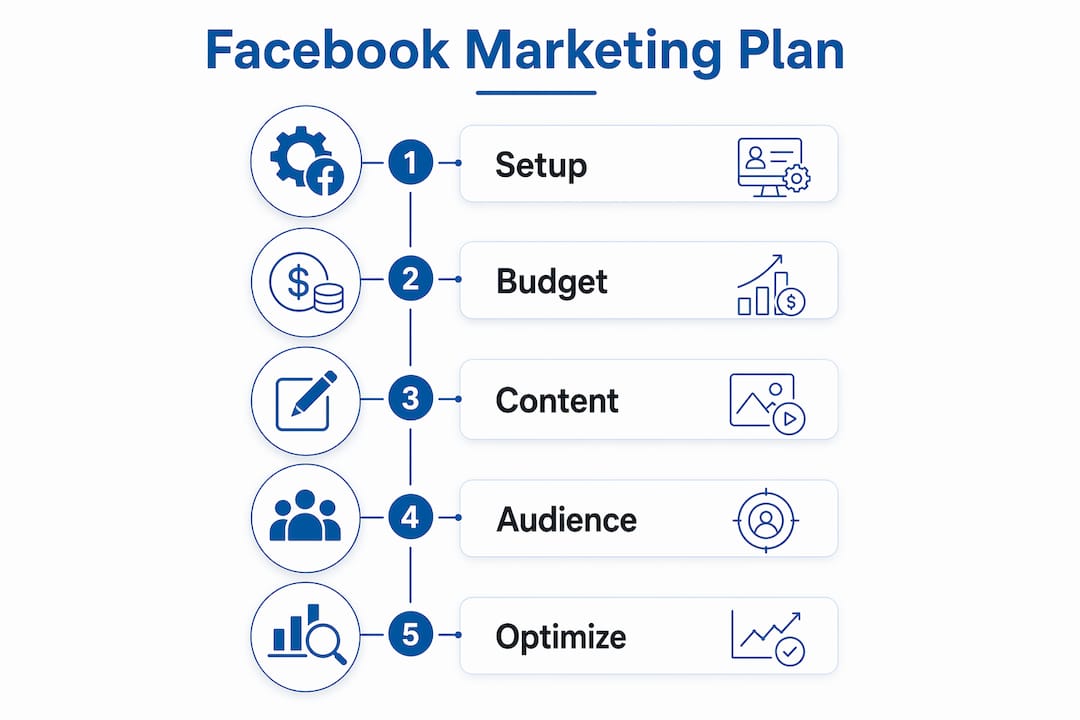
How much should small businesses budget for Facebook ads?
Small businesses typically need a minimum monthly ad spend of $300–$500 to exit Meta’s learning phase and reach stable cost-per-lead results. For local service businesses running both Google and Meta ads, a combined budget of $800–$1,200 per month is the recommended starting point. That range gives the algorithm enough data to optimize without overextending your cash flow.
Meta’s learning phase is the period after a campaign launches when the algorithm tests different audiences, placements, and creatives to find what works. Meta recommends at least 7 days of stable spend before drawing conclusions. Changing your budget, audience, or creative during this window resets the process and wastes the data already collected.
Budget planning by business type:
- Local service business (salon, plumber, coach): Start at $300–$500 per month on a single Lead Generation campaign. Run it for 4 weeks without changes.
- E-commerce store: Allocate $500+ per month on a Sales campaign with a catalog or single product. Allow 2 weeks minimum before adjusting bids.
- B2B lead generation: Budget $500–$800 per month on a Leads campaign using Instant Forms or a landing page. B2B audiences are smaller, so CPLs run higher.
- New business or startup: Validate your offer with a $10–$15 per day test budget for 2 weeks before scaling. Proof of concept before scaling is non-negotiable.
- Scaling phase: Once your cost per acquisition (CPA) is stable, increase budget by no more than 20% every 5–7 days to avoid triggering a new learning phase.
Professionele tip: Allow campaigns to run 2–4 weeks without major changes. Patience here is not passive. It is the active choice that produces reliable performance data.
What content strategy works best alongside Facebook ads?
Facebook organic reach averages below 2% for business pages, so organic content alone will not grow your audience. But organic posts still matter because they build credibility for anyone who clicks through from your ads. A visitor who sees a dead or inconsistent page loses trust immediately.

Video ads that hook viewers in the first 3 seconds with a problem-solution or before-and-after format convert best for service businesses. User-generated content style videos consistently outperform polished brand videos in engagement. That means a phone-recorded testimonial from a real customer often beats a studio-produced ad. Authenticity signals trust, and trust drives clicks.
Integrating customer testimonials into your Facebook content builds social proof that directly supports your paid campaigns. 75% of consumers read online reviews before choosing a local provider. Featuring those reviews as posts or Stories turns your organic feed into a conversion asset.
Effective content formats for small business Facebook pages:
- Short-form video (Reels and Stories): Hook viewers fast with a problem statement in the first 3 seconds. Best for awareness and reach.
- Customer testimonials and case studies: Screenshot reviews, before-and-after photos, or short video testimonials. Best for trust and conversion.
- Behind-the-scenes posts: Show your process, team, or workspace. Best for brand personality and engagement.
- Facebook Live sessions: Q&A, product demos, or tutorials. Best for community building and algorithm reach.
- Facebook Groups: Create or join groups relevant to your niche. Best for organic community growth and repeat engagement.
- Educational posts: Tips, checklists, or how-to content. Best for positioning your authority and driving saves and shares.
Schedule organic posts through Meta Business Suite to maintain consistency without daily manual effort. Aim for 3–5 posts per week as a baseline. Check your social media strategy for 2026 to align your content calendar with your paid campaign themes.
How can small businesses build and refine Facebook audiences?
Audience targeting is where most small businesses either win or waste money. The best starting point is uploading your existing customer list to Meta as a Custom Audience. Meta matches your contacts to Facebook profiles and uses that data to find similar users. This approach outperforms cold interest targeting because it is grounded in real purchase behavior, not assumptions.
Advantage+ automated targeting outperforms manual interest stacks for budgets under $50 per day. Manual interest targeting requires you to guess which interests your customers share. Advantage+ lets Meta’s algorithm find the best audience using your pixel data and customer list as seeds. The result is faster optimization with less manual work.
| Audience type | Best use case | Budget threshold |
|---|---|---|
| Custom Audience (customer list) | Retargeting, upsells, loyalty campaigns | Any budget |
| Lookalike Audience (1–3%) | New customer acquisition from proven data | $300+ per month |
| Advantage+ automated | Cold traffic campaigns, new accounts | Under $50 per day |
| Manual interest targeting | Niche markets with clear interest signals | $500+ per month |
| Geographic radius targeting | Local service businesses (5–25 mile radius) | Any budget |
Local service businesses should set a geographic radius of 5–25 miles around their location. Running ads nationally when you only serve one city burns budget on people who will never become customers. Combine geographic targeting with Advantage+ to let Meta find the best local prospects within your radius.
Voor fresh lead generation ideas that go beyond basic targeting, refine your offer and landing page before scaling your audience size. More reach with a weak offer produces more wasted spend, not more customers.
What mistakes should small businesses avoid in Facebook campaigns?
The most costly mistake is changing your campaign during the learning phase. Changing targeting or budget resets the learning phase, forcing Meta to start data collection over. Every reset wastes the spend already invested. Set your campaign, then leave it alone for at least 7–14 days.
Running ads to a weak offer or an unoptimized landing page is the second most common error. Facebook ads are accelerators. They amplify what is already there. A poor offer with ads behind it fails faster and costs more. Validate your offer with organic posts or a small test budget before committing to a full campaign.
Lead follow-up speed is a critical and often ignored factor. Leads contacted within 5 minutes of submission convert at 9 times higher rates than leads followed up after one hour. That gap is enormous. Set up instant WhatsApp or email alerts so your team responds the moment a lead comes in.
Troubleshooting checklist for underperforming campaigns:
- High CPL, low volume: Audience is too narrow or budget is too low. Broaden targeting or increase daily spend.
- High impressions, low clicks: Creative is not compelling. Test a new hook or video format.
- Clicks but no conversions: Landing page or offer needs work. Check load speed, headline clarity, and call to action.
- Good CPL but no sales: Lead quality issue. Tighten audience targeting or add a qualifying question to your Instant Form.
- Ads not spending: Audience is too small or bid is too low. Expand geographic radius or switch to Advantage+ targeting.
Professionele tip: Track cost per lead (CPL) and cost per acquisition (CPA) weekly, not daily. Daily fluctuations are normal. Weekly trends reveal whether your campaign is actually working.
What I have learned from watching small businesses run Facebook ads
Working with small business owners on their Facebook campaigns, the pattern I see most often is impatience. A business owner launches a campaign on monday, sees no sales by wednesday, and starts changing everything. That behavior is the single biggest reason campaigns fail. The algorithm needs time. Interrupting it is expensive.
The second thing I have noticed is that the businesses getting the best results are not running the most sophisticated campaigns. They are running simple campaigns with a clear offer, a short video testimonial, and a fast follow-up process. Complexity does not win on Facebook. Clarity does.
Organic and paid content work best when they reinforce each other. Your ads bring people to your page. Your organic posts convince them to trust you. If your page looks inactive or generic, your ad spend is doing half the job it should. Treat your Facebook page as a living portfolio, not a billboard.
The data also tells a story most small business owners ignore. Your pixel, your CPL, your CPA, these numbers tell you exactly what is working. Gut instinct has a role in creative decisions. It has no role in budget allocation. Let the numbers lead.
— Go
How Goonlinenow helps small businesses convert Facebook leads faster
Running Facebook ads generates leads. What happens next determines whether those leads become customers. Most small businesses lose leads because follow-up is slow, manual, or inconsistent.
Goonlinenow is built to close that gap. The platform combines marketingautomatiseringssoftware with an all-in-one CRM, so every Facebook lead flows directly into a pipeline with automated email and SMS follow-up triggered within minutes. No manual data entry. No leads falling through the cracks. Goonlinenow clients report up to 85% more conversions and 75% time saved within 90 days. If you want your Facebook campaigns to produce real revenue, not just clicks, explore the full platform and see what automated lead management looks like in practice.
Ready to Turn Facebook Leads Into Real Business Opportunities?
Let’s look at your current Facebook marketing, lead flow, and follow-up process to identify opportunities to generate better leads and convert more of them into customers.
Veelgestelde vragen
What is a Facebook marketing strategy for small business?
A Facebook marketing strategy for small business is a structured plan combining a Business Page, organic content, and paid ads to build brand awareness, generate leads, and acquire customers. It requires defined campaign objectives, a content calendar, audience targeting, and a consistent budget.
How much should a small business spend on Facebook ads per month?
Small businesses need a minimum of $300–$500 per month to exit Meta’s learning phase and achieve stable results. Local service businesses running both Google and Meta ads perform best with a combined budget of $800–$1,200 per month.
What is Meta’s learning phase and why does it matter?
Meta’s learning phase is the period when the algorithm tests audiences and creatives to find the best-performing combinations. Changing your campaign during this phase resets the process and wastes budget, so campaigns should run unchanged for at least 7–14 days.
How do I capture leads on Facebook without a website?
Facebook Instant Forms allow you to collect name, email, and phone number directly inside Facebook without sending users to an external site. These forms can be connected to Google Sheets or WhatsApp for instant lead notification and follow-up.
How fast should I follow up with Facebook leads?
Leads contacted within 5 minutes convert at 9 times higher rates than leads followed up after one hour. Use automated alerts or a CRM with instant notifications to respond the moment a lead submits their information.