

TL;DR:
- A content marketing position involves full ownership of content strategy, creation, distribution, and performance measurement aligned with business outcomes. It requires skills in SEO, data analytics, multi-channel execution, and cross-functional collaboration to drive pipeline growth. Effective SMB content teams are structured with clear ownership of the entire content lifecycle to prevent fragmentation and achieve measurable results.
A content marketing position is defined as end-to-end ownership of content strategy, creation, distribution, and performance measurement tied directly to business outcomes. This role has moved far beyond writing blog posts. Today’s content marketer operates at the intersection of SEO, data analytics, multi-channel execution, and sales alignment. For SMB marketing professionals and business owners, understanding what this role actually covers in 2026 is the difference between hiring someone who fills a calendar and hiring someone who drives pipeline growth.
What does a content marketing position actually own?
The modern content marketing position covers the full content lifecycle: editorial planning, content creation, distribution, and performance measurement linked to business outcomes. That scope is broader than most SMB job descriptions reflect, which is exactly why so many small companies end up with fragmented content efforts and no clear owner.
Here is what the core responsibilities look like in practice:
- Editorial planning: Building a content calendar aligned to buyer journey stages, product launches, and seasonal demand. This is not just scheduling. It means deciding which topics serve awareness, which serve consideration, and which close deals.
- Multi-format content creation: Writing requirements fell 28% in recent job listings while broader content creation demands grew by 209%. That means your content marketer needs to produce blogs, social posts, email sequences, video scripts, and webinar content, not just articles.
- Distribution and repurposing: Publishing a blog post and hoping Google finds it is not a strategy. A strong content marketing role includes owned distribution (email, social), earned distribution (PR, backlinks), and paid amplification when the budget supports it.
- Performance measurement: High-performing content marketers track pipeline influence and assisted conversions rather than just page views. Attribution is imperfect, but content-influenced pipeline metrics give leadership a credible picture of content’s commercial contribution.
- Cross-functional collaboration: Senior content marketers work directly with sales and demand generation teams, turning brand narratives into sales enablement assets and campaign content.
Professionele tip: When writing a content marketing job description for your SMB, list the specific channels and formats you need covered. Vague descriptions attract generalists who may lack depth in the areas that matter most to your growth goals.
How do content marketing roles vary across SMBs?

Content strategy jobs carry different titles depending on the company’s size, maturity, and priorities. Understanding those differences helps you hire the right person or structure the right role from the start.
| Title | Primary Focus | Execution vs. Strategy | SEO Requirement |
|---|---|---|---|
| Content Marketing Manager | Full lifecycle ownership, team coordination | Balanced | Moderate to high |
| Content SEO Manager | Organic search growth, keyword strategy | Execution-heavy | High |
| Content Producer | Asset creation across formats | Execution-heavy | Low to moderate |
| Head of Content | Team leadership, editorial direction, brand voice | Strategy-heavy | Moderate |
| Content Marketing Strategist | Planning, audience research, funnel mapping | Strategy-heavy | Moderate |
The Content SEO Manager title is emerging as a distinct senior role, appearing in roughly 20% of content marketing listings as SEO becomes a baseline expectation rather than a specialty. This matters for SMBs because it signals that organic search competency is no longer optional in any content role.
For small to mid-sized companies, the most common mistake is hiring a Content Producer when they actually need a Content Marketing Manager. Producers create assets. Managers own outcomes. If your business needs someone to build a content engine from scratch, you need a role with strategic authority, not just execution capacity.
The clearest way to avoid this gap is to define scope before you write the job description. Map out who owns editorial planning, who owns SEO, who owns distribution, and who owns reporting. If one person needs to cover all four, that is a Content Marketing Manager role, and the compensation and seniority level should reflect it.
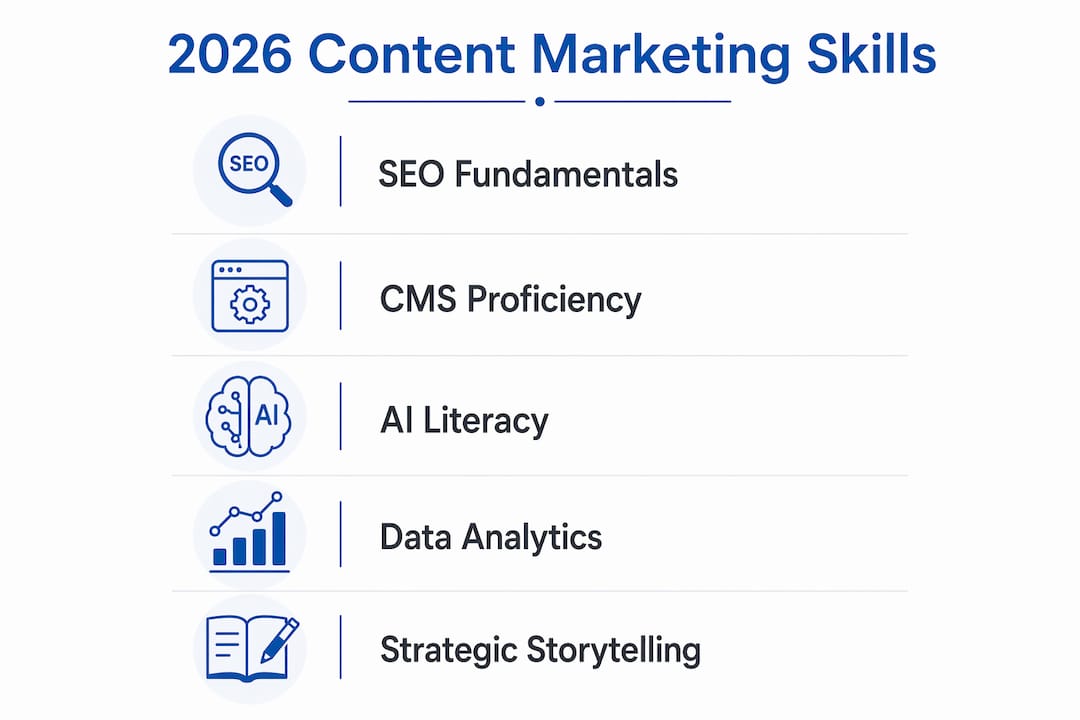
What skills does a content marketing role require in 2026?
The competencies that define high-performing digital marketing positions have shifted significantly. Content jobs now blend creative storytelling with data literacy for measurable business impact. Here is what that looks like across skill categories:
- SEO fundamentals: Keyword research, on-page optimization, internal linking strategy, and understanding of search intent. Tools like Ahrefs, Semrush, and Google Search Console are standard. Content marketers who cannot read organic performance data are operating blind.
- CMS proficiency: Platforms like HubSpot CMS, WordPress, and Webflow are common environments. Your hire should be able to publish, format, and optimize content without relying on a developer for every update.
- AI literacy: AI proficiency appears in 34% of senior content listings and 19% of execution-level roles. This does not mean replacing writers with AI. It means using tools like ChatGPT, Jasper, or Surfer SEO to accelerate research, drafting, and optimization while maintaining quality and brand voice.
- Analytics and attribution: Reading Google Analytics 4, understanding conversion paths, and connecting content activity to pipeline metrics. The ability to present content ROI to a non-marketing audience is increasingly valuable.
- Project management: Coordinating freelancers, designers, and subject matter experts requires organizational discipline. Tools like Asana, Notion, or Trello are common in content team workflows.
- Strategic storytelling: The ability to translate product features and customer pain points into narratives that resonate at each funnel stage. This is the creative core that no tool replaces.
Professionele tip: When evaluating candidates for content marketing roles, ask them to walk you through a piece of content they created from brief to performance review. The depth of their answer reveals whether they think strategically or just execute tasks.
The combination of strategic mindset and hands-on execution is what separates a strong content marketer from a capable writer. For SMBs especially, you often need one person who can do both. Prioritize candidates who have owned results, not just produced deliverables. You can find more on in-demand content competencies for SMB-focused roles to sharpen your evaluation criteria.
How can SMBs get the most from a content marketing position?
Filling the role is only the first step. Getting measurable results from your content marketing investment requires a clear operating model. Here is a practical framework for SMBs:
- Map content to the buyer journey. Every piece of content should serve a defined stage: awareness, consideration, or decision. Aligning content with funnel stages and multi-channel approaches is what separates content that generates leads from content that just generates traffic.
- Build a sustainable publishing cadence. Consistency beats volume. A coherent end-to-end content strategy that covers research, creation, and iteration outperforms sporadic bursts of high-output publishing. For most SMBs, two to four quality pieces per month with strong distribution beats ten thin posts with no promotion.
- Distribute across owned, earned, and paid channels. Email newsletters, LinkedIn, YouTube, and industry publications each reach different segments of your audience. Your content marketer should have a distribution plan for every asset, not just a publishing date.
- Use AI tools to improve workflow efficiency. Tools like Surfer SEO for optimization, Otter.ai for transcription, and Canva for visual content reduce production time without sacrificing quality. This matters for SMBs where one person often covers multiple content functions.
- Iterate based on commercial metrics. Page views are a vanity metric. Track content-influenced pipeline, email click-through rates, and conversion rates by content type. Use that data to double down on what works and cut what does not.
| Metric | What it measures | Why it matters for SMBs |
|---|---|---|
| Content-influenced pipeline | Revenue opportunities touched by content | Connects content to sales outcomes |
| Organic traffic growth | Search visibility over time | Measures SEO effectiveness |
| Email click-through rate | Audience engagement with distributed content | Indicates content relevance |
| Conversion rate by content type | Which formats drive action | Guides format investment decisions |
| Time on page | Content depth and engagement | Signals content quality |
Adopting a publisher mindset focused on quality, narrative, and multi-channel experience is what separates SMBs that build lasting brand authority from those that chase short-term traffic spikes. For a deeper look at cost-effective content approaches built for smaller teams, the principles above translate directly into budget-conscious execution.
What I have learned about content marketing positions in SMBs
Working with SMBs across coaching, real estate, professional services, and education has shown me one consistent pattern: the companies that struggle most with content marketing do not have a strategy problem. They have an ownership problem.
When no single person owns the full content lifecycle, execution fragments. The blog gets written but never distributed. The email list sits unused. The analytics dashboard gets checked once a quarter. Hiring a content marketer without giving them clear ownership of outcomes is the most common and most expensive mistake I see.
AI is changing the speed of content production, but it is not changing the need for strategic judgment. The best content marketers I have seen use AI to handle the repetitive parts of their workflow, then spend their real energy on audience insight, narrative development, and performance analysis. That combination is what drives pipeline, not just publishing volume.
My honest advice: before you post a content marketing job description, write down exactly what success looks like in 12 months. Define the metrics. Define the channels. Define who this person collaborates with. If you cannot answer those questions, you are not ready to hire. You are ready to build a content strategy first. That clarity is what attracts the right candidate and sets them up to actually deliver results.
— Go
Scale your content marketing with the right tools
Building a strong content marketing function takes more than the right hire. It takes the right infrastructure to manage your calendar, automate distribution, track performance, and connect content activity to your CRM pipeline.
Goonlinenow gives SMBs everything they need to run content marketing at scale without the complexity or cost of enterprise platforms. From automated multi-channel distribution to pipeline tracking and lead nurturing, the platform connects your content efforts directly to revenue outcomes. If you are ready to turn your content marketing position into a measurable growth engine, Goonlinenow is built for exactly that.
Veelgestelde vragen
What is a content marketing position?
A content marketing position is a role that owns the full lifecycle of content: strategy, creation, distribution, and performance measurement tied to business goals. It goes beyond writing to include SEO, analytics, and cross-functional collaboration with sales and demand generation teams.
What titles fall under content marketing roles?
Common content marketing roles include Content Marketing Manager, Content SEO Manager, Content Producer, Head of Content, and Content Marketing Strategist. Each title reflects a different balance of execution versus strategic ownership, with senior titles carrying broader accountability for business outcomes.
What skills are required for content strategy jobs in 2026?
Content strategy jobs in 2026 require SEO fundamentals, CMS proficiency, AI literacy, data analytics, and strategic storytelling. AI proficiency now appears in 34% of senior content listings, making it a baseline expectation alongside traditional creative and technical skills.
How do SMBs structure a content marketing team effectively?
SMBs get the best results by assigning a single owner to the full content lifecycle rather than splitting responsibilities across multiple people without clear accountability. Defining which channels, formats, and metrics the role owns before hiring prevents execution gaps and misaligned expectations.
How is content marketing performance measured?
Content marketing performance is measured through content-influenced pipeline, assisted conversions, organic traffic growth, email engagement rates, and conversion rates by content type. Direct revenue attribution is rarely precise, so pipeline influence metrics provide the most credible view of content’s commercial impact.