

TL;DR:
- Small business SEO marketing focuses on optimizing websites and local online presence to improve visibility over competitors. It relies on four pillars: on-page, local, technical, and off-page SEO, with technical health prioritized first, followed by content and local signals. Consistently optimizing Google Business Profile and managing reviews significantly enhance local search rankings and customer engagement.
Small business SEO marketing is the practice of optimizing your website and local online presence so customers searching for your services can find you before they find your competitors. Unlike paid advertising, which stops the moment your budget runs out, SEO builds lasting visibility that compounds over time. Tools like Google Business Profile, Google Search Console, and review platforms such as Yelp and Facebook are the core instruments of this strategy. The US Chamber of Commerce confirms that SEO emphasizes content fundamentals over paid keyword bidding, making it one of the most cost-effective channels available to small business owners.
What are the core pillars of small business SEO marketing?
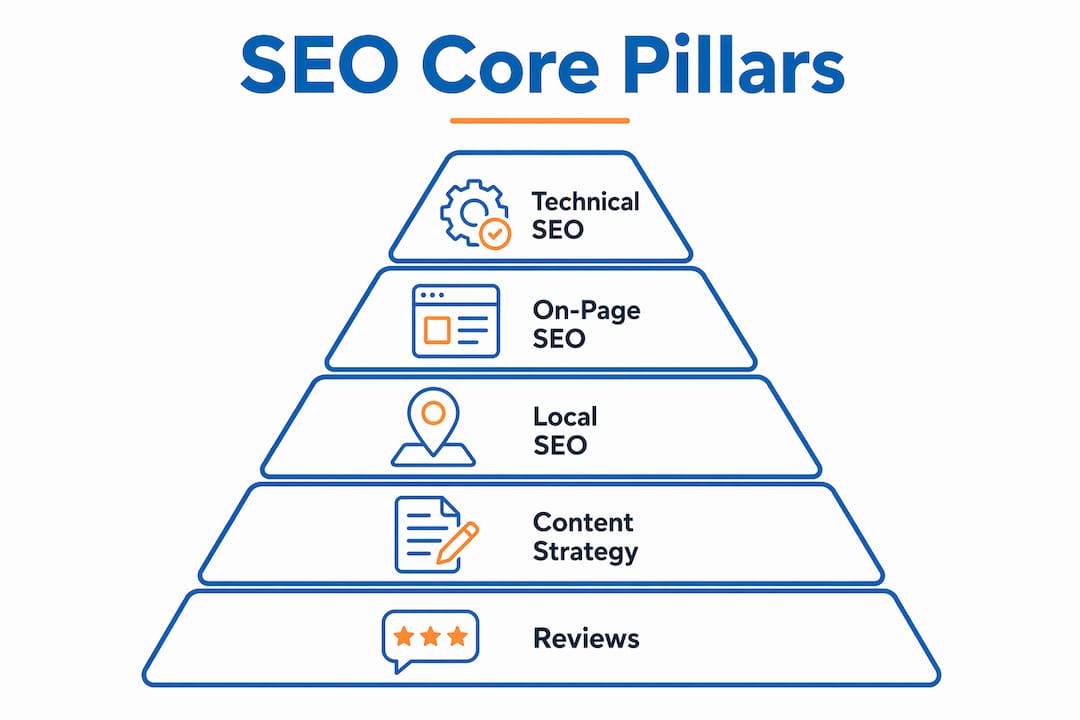
Search engine optimization for small businesses rests on four interconnected pillars. Each one addresses a different dimension of how Google evaluates and ranks your business. Neglect any single pillar and the others underperform.
On-page SEO covers everything on your website itself. This includes keyword research, title tags, meta descriptions, header structure, and the quality of your written content. Your service pages need to answer the specific questions your customers type into Google, not just describe what you do in general terms.
Lokale SEO is where most small businesses win or lose. According to Network Solutions, GBP optimization drives local SEO more than any other single factor. This pillar includes your Google Business Profile, local citations across directories, and location-specific content on your website.
Technische SEO is the foundation that makes everything else work. If Google cannot crawl and index your pages efficiently, your content and local signals will not matter. Mobile usability, page speed, and clean site architecture all fall under this category.
Off-page SEO is your reputation in the broader web. Backlinks from local news sites, industry directories, and partner businesses signal authority to Google. Customer reviews are also a major off-page signal, particularly for local search rankings.
- Conduct keyword research using Google Keyword Planner or Ahrefs before writing any page
- Write unique title tags and meta descriptions for every service page
- Claim and fully complete your Google Business Profile
- Build citations on directories like Yelp, Bing Places, and Apple Maps
- Run a technical audit using Google Search Console or Screaming Frog
- Earn backlinks by contributing to local publications or sponsoring community events
Professionele tip: Fix technical SEO issues before investing in content. A website Google cannot crawl properly will not rank no matter how good the writing is. The priority-sequenced action plan from The SEO Engine Blog recommends resolving crawlability first, then local surface readiness, then content.
How to optimize your Google Business Profile and leverage customer reviews
Your Google Business Profile is not simply a directory listing. Network Solutions describes it as the core local search surface that verifies your business information for Google’s local ranking algorithm. A half-completed profile is a missed opportunity every single day.
Follow these steps to get your GBP working at full capacity:
- Claim and verify your profile at business.google.com using the postcard, phone, or video verification method Google provides.
- Complete every field including business category, service areas, hours, website URL, and a keyword-rich business description.
- Add photos consistently. Profiles with photos receive significantly more direction requests and website clicks than those without.
- Post updates weekly. Google Posts keep your profile active and signal to the algorithm that your business is current and engaged.
- Match your NAP exactly. Your name, address, and phone number on your GBP must be identical to what appears on your website and every other directory listing. Even minor inconsistencies can hurt your local ranking.
Reviews deserve their own strategy. 97% of consumers read reviews when searching for local businesses in 2026, and 85% are more likely to use a business after reading positive reviews. That is not a soft preference. It is a direct conversion driver. Ask every satisfied customer for a review via a follow-up text or email, and respond to every review you receive, positive or negative. BrightLocal’s research confirms that AI-assisted review responses improve engagement efficiency without sacrificing authenticity. Expand your review presence beyond Google to Facebook, Yelp, and industry-specific platforms to build a multi-channel trust signal.
Professionele tip: Get a free GBP and SEO report to see exactly where your profile is losing visibility before you spend time fixing the wrong things.

Crafting local content that captures your customers’ searches
Local content is the mechanism that connects your business to the specific searches your customers make. A plumber in Austin who writes a page titled “Emergency Pipe Repair in Austin, TX” will outperform a generic “Plumbing Services” page every time. Hyper-local content enables small businesses to outrank national chains by demonstrating stronger community ties and location-specific relevance.
Start with keyword research. Google Keyword Planner is free and shows you exactly what people in your area are searching for. Look for long-tail phrases that combine your service with your city, neighborhood, or region. “Affordable dog grooming in Brooklyn” converts better than “dog grooming” because the searcher is already close to a buying decision.
- Create a dedicated service page for each core offering, not one generic “Services” page
- Add location modifiers to page titles, headers, and the first paragraph of each page
- Write blog posts that answer common local questions, such as “What permits do I need for a home addition in [city]?”
- Build a FAQ section on each service page using the exact language your customers use
- Align your website content with the categories and services listed on your Google Business Profile
Consistency between your website and your GBP matters more than most business owners realize. If your GBP lists “HVAC Repair” as a service but your website only mentions “Heating and Cooling,” Google sees a mismatch. That mismatch reduces your local ranking confidence. Keep your terminology consistent across both platforms.
Professionele tip: Use Google’s “People Also Ask” boxes and autocomplete suggestions as a free content research tool. Type your main service into Google and write content that directly answers every question that appears.
Technical and performance essentials for small business SEO success
Technical SEO is the part most small business owners skip because it feels invisible. You cannot see a crawl error the way you can see a poorly written headline. But Google can, and it affects your rankings directly.
One of the most overlooked technical constraints in 2026 is Google’s crawl limit. Googlebot fetches up to 2MB of HTML per page. Any content beyond that limit is ignored for indexing. This means bloated pages with excessive inline scripts, large HTML tables, or redundant code may have their most important content cut off before Google even reads it. Place your meta tags, structured data, and primary content as early in the HTML document as possible.
| Technical factor | Why it matters | Recommended tool |
|---|---|---|
| Mobile usability | Google uses mobile-first indexing for all sites | Google Search Console |
| Page speed | Slow pages rank lower and lose visitors faster | Google PageSpeed Insights |
| Structured data | Local business schema helps Google display rich results | Schema.org, Merkle Schema Markup Generator |
| Crawlability | Blocked pages cannot rank regardless of content quality | Screaming Frog, Ahrefs Site Audit |
| Core Web Vitals | Google’s user experience signals directly influence ranking | Google Search Console, Lighthouse |
Mobile performance is non-negotiable. Google indexes the mobile version of your site first, so a desktop-only optimization strategy is working against the algorithm. Run your site through Google PageSpeed Insights and address the issues flagged under the mobile tab before anything else. Structured data, specifically local business schema, helps Google display your address, hours, and reviews directly in search results, which increases click-through rates without requiring a higher ranking position.
What are realistic timelines and budgets for small business SEO?
Setting accurate expectations is one of the most valuable things you can do before starting an SEO program. Most small businesses see measurable local ranking improvements within 3 to 6 months. Competitive markets, such as personal injury law or real estate in major cities, typically require 6 to 12 months before significant movement appears.
| Benadering | Monthly cost | Best for | Key trade-off |
|---|---|---|---|
| DIY with free tools | $0 to $50 | Startups with time but limited budget | High time investment, slower results |
| DIY with paid tools | $50 to $130 | Owners comfortable with technology | Requires learning curve for tools like Ahrefs or SEMrush |
| Freelance SEO specialist | $300 to $800 | Businesses needing targeted help | Variable quality, limited strategic oversight |
| SEO-bureau | $500 to $3,000 | Businesses ready to scale | Higher cost, but faster and more consistent results |
Budget allocation should follow the same priority sequence as your technical work. Fix crawl and indexability issues first because they are often free to resolve and unlock the value of everything else. Then invest in local optimization, followed by content creation, and finally link building. Tracking performance costs nothing if you use Google Search Console and Google Analytics 4, both of which are free.
Paid advertising through Google Ads can complement your organic SEO during the early months when rankings are still building. Running a modest local service ad campaign while your organic presence matures keeps your business visible without abandoning the long-term investment. For cost-effective SEO strategies tailored to SMB budgets, the sequencing of spend matters as much as the total amount.
Professionele tip: Track your Google Business Profile insights monthly alongside Search Console data. GBP shows you how many people called, requested directions, or visited your website directly from your profile. That data tells you whether your local SEO is converting, not just ranking.
What I’ve learned from working with small business SEO every day
Most small business owners I work with underestimate two things: the power of their Google Business Profile and the patience SEO requires. They spend weeks on blog content before their GBP is even fully verified. That is working in the wrong order.
The businesses that see the fastest results are the ones that treat SEO as a system, not a checklist. They fix technical issues first, then build out their local presence, then create content that reinforces both. Every layer compounds the one before it. A well-optimized GBP with 50 recent reviews and a fast, mobile-friendly website will outperform a competitor with better content but weaker local signals almost every time.
Reviews are the most underused asset in local SEO. 41% of consumers always read reviews before choosing a local business, yet most small business owners ask for reviews inconsistently or not at all. A simple automated follow-up message after a completed job or appointment can generate a steady stream of new reviews with almost no ongoing effort.
The other lesson I keep returning to is that generative AI search features still reward the same foundational practices. Structured data, clear content, strong local signals, and a trustworthy review profile are exactly what AI-driven search surfaces pull from. The fundamentals are not going away. They are becoming more important.
If you are a service business in a mid-sized city, you have a real opportunity to outrank national brands by going deeper on local relevance than they ever will. That is not a theory. It is what the data from local search consistently shows.
— Go
How Goonlinenow helps you turn SEO traffic into paying customers
Attracting visitors through SEO is only half the equation. Converting those visitors into booked appointments, signed contracts, or paying customers requires a system that works while you focus on running your business. Goonlinenow combines marketing automation for SMB conversions with an all-in-one CRM that captures every lead your SEO efforts generate. Automated follow-up sequences, reputation management tools, and a unified inbox mean no lead goes cold and no review request gets forgotten. For small business owners who want their SEO investment to produce real revenue, not just traffic, Goonlinenow is built exactly for that. Explore affordable marketing tools for SMBs and see how the platform connects your online visibility to measurable growth.
Veelgestelde vragen
What is small business SEO marketing?
Small business SEO marketing is the process of optimizing your website, Google Business Profile, and online content so local customers can find your business in search results without paid advertising. It covers on-page content, local listings, technical performance, and review management.
How long does SEO take to show results for a small business?
Most small businesses see measurable local ranking improvements within 3 to 6 months, with competitive markets requiring 6 to 12 months. Consistency and correct prioritization of technical fixes accelerate the timeline.
How much does small business SEO cost?
SEO agency services for small businesses typically cost between $500 and $3,000 per month, while DIY approaches using tools like Google Search Console and Google Keyword Planner cost little to nothing beyond your time.
Why are customer reviews important for local SEO?
97% of consumers read reviews when searching for local businesses, and positive reviews directly increase the likelihood of a customer choosing your business. Review recency and volume are also confirmed local ranking signals in Google’s algorithm.
Do I need a Google Business Profile for local SEO?
A fully completed Google Business Profile is the single most important local SEO asset for small businesses. Network Solutions confirms it is the core local search surface Google uses to verify your business information and determine local ranking eligibility.