

TL;DR:
- Most small business owners struggle with creating effective content marketing strategies that connect to business goals and drive results. Developing clear goals, detailed audience personas, and auditing existing content are essential starting points before building a structured plan. Consistent execution, proper measurement, and ongoing optimization are crucial for content marketing success in SMBs.
Most small business owners know they need content marketing. The problem is that few know how to create a content marketing strategy that actually drives results rather than just filling a blog with posts nobody reads. You spend hours writing, posting, and hoping. Traffic stays flat. Leads don’t come. The real issue is almost never effort. It’s the absence of a documented plan that connects your content to real business goals. This guide walks you through every stage of building that plan, from goal-setting to measurement, in a way that works for real businesses with real resource constraints.
What you need before creating your content marketing strategy
Before you write a single word, you need three things in place: clear goals, a deep understanding of your audience, and an honest look at what content you already have. Skipping these steps is the most common reason content marketing plans fail before they start.
Define goals that actually guide decisions
Your goals must be specific enough to shape what content you create. “Get more traffic” tells you nothing. “Increase organic website visitors by 30% within six months through educational blog content targeting service-based keywords” tells you exactly what to do. A documented content strategy should outline what content to create, who it is for, how it will be distributed, and how you will measure impact against business goals.
Use the SMART framework: Specific, Measurable, Achievable, Relevant, and Time-bound. For a local service business, a SMART goal might look like increasing email list signups by 50 new subscribers per month through downloadable guides. For an e-commerce SMB, it might mean improving time-on-site by 20% through product education videos.
Build audience personas with real specificity
A persona is not “women aged 25 to 45 who like wellness.” That describes half the internet. A useful persona includes what problems your customer is trying to solve, where they go to find answers, what format they prefer when consuming information, and what objections they hold before buying. Talk to five real customers and you will learn more than any survey template.
Knowing your audience determines everything downstream: which topics you cover, which platforms you prioritize, and what tone you use. If your audience is time-strapped salon owners, long-form whitepapers are the wrong format. Short videos and quick-read guides work better.
Audit your existing content before building more
If you have been creating content for more than six months, you likely have assets that can be updated, consolidated, or removed. Content audits should assign actions such as update, consolidate, or remove to optimize resources and improve performance continuously. A post ranking on page two of Google for a relevant keyword might only need a few updates to reach page one. That is faster and more efficient than writing something from scratch.
- Update: High-quality posts with declining traffic due to outdated information.
- Consolidate: Multiple thin posts covering the same topic.
- Remove: Content with no traffic, no links, and no strategic value.
Professionele tip: Before your audit, export your Google Search Console data. Filter for pages with impressions but low click-through rates. These are your fastest wins and should go to the top of your update list.
Building the core of your content marketing strategy
Once your foundation is set, you can start building the strategy itself. This is where you define what you will talk about, in what format, and where you will share it.
Choose your content pillars
Content pillars are the three to five broad topics your brand will consistently own. Choosing 3 to 5 content pillars based on what your brand can credibly cover focuses strategy and scales content efficiently. For a real estate agency, pillars might be home buying tips, local market insights, mortgage basics, and investment properties. Everything you create maps back to one of these pillars.
The key is that pillars must intersect three things: what your audience wants to know, what you have genuine expertise in, and what ultimately connects to your services. If none of your pillars point toward a buying decision, you are building an audience you cannot convert.
Map topics to the buyer journey
Here is how to organize your content by funnel stage:
- Top of funnel (awareness): Educational content that answers broad questions. Blog posts, short videos, social media content. Example: “How much does it cost to renovate a kitchen?”
- Middle of funnel (consideration): Content that helps prospects compare options and evaluate solutions. Case studies, comparison guides, webinars. Example: “What to look for in a licensed contractor.”
- Bottom of funnel (decision): Content that removes the final objection and prompts action. Testimonials, service pages, free consultations. Example: “Why [Your Business] vs. a general handyman.”
- Retention content: Often overlooked by SMBs. Email newsletters, how-to guides, and customer success stories keep existing clients engaged and generate referrals.
Select formats and plan your distribution
Choosing the right format is not about what you enjoy creating. It is about what your audience actually consumes. If they are on YouTube, text blogs are insufficient as your only format. Distribution planning for each content piece across owned, earned, and paid channels is non-negotiable for getting results.
Professionele tip: Repurpose before you create. One well-researched blog post can become a LinkedIn carousel, an email newsletter, three social media captions, and a short video script. This multiplies your output without multiplying your workload.
For most SMBs, a practical starting point is one anchor piece per week (a blog or video) supported by three to four social posts that remix the same content for different platforms.
Building your content calendar and workflow
A strategy without an operational structure collapses within weeks. The content calendar and workflow are what keep publishing consistent when business gets busy.

What a working content calendar looks like
Plan at least 4 to 6 weeks of content in advance with fields like title, funnel stage, target keyword, assigned author, status, and distribution channels. A simple spreadsheet works. So does a project management tool. The format matters less than the discipline of actually maintaining it.
| Calendar Field | Doel |
|---|---|
| Content title | Keeps the team aligned on what is being created |
| Target keyword | Connects creation to SEO goals |
| Funnel stage | Ensures you cover all buyer journey phases |
| Assigned owner | Prevents tasks from falling through cracks |
| Due date | Maintains publishing cadence |
| Distribution channels | Confirms where each piece will be shared |
| Status | Tracks progress from brief to published |
Governance and workflows: the unsexy part that matters most
Without defined governance and workflows, content marketing becomes reactive publishing with inconsistent results. Define the steps each piece of content goes through: brief, research, draft, edit, design, review, approval, and publishing. Assign a single owner to each stage. If two people are responsible, effectively no one is responsible.
- Brief: Who assigns it and what information must it include?
- Draft: Who writes it and what is the deadline?
- Review: Who checks it for accuracy and brand voice?
- Design: Who creates visuals and how many revisions are allowed?
- Approval: Who gives final sign-off?
- Publishing: Who schedules it and confirms distribution?
This may feel like over-engineering for a small team. It is not. Even a two-person operation benefits from having these steps written down so nothing slips between the cracks during a busy week.
Measuring and optimizing your content marketing plan
Creating content without measuring it is like running ads with no conversion tracking. You feel busy, but you cannot tell whether you are growing.
Set KPIs that connect to business outcomes
Measuring content marketing performance requires tracking KPIs across funnel stages and linking content engagement to revenue and pipeline influence. Vanity metrics like page views feel good. But a blog post with 50 readers that generated three consultation requests is more valuable than a post with 5,000 readers and zero conversions.
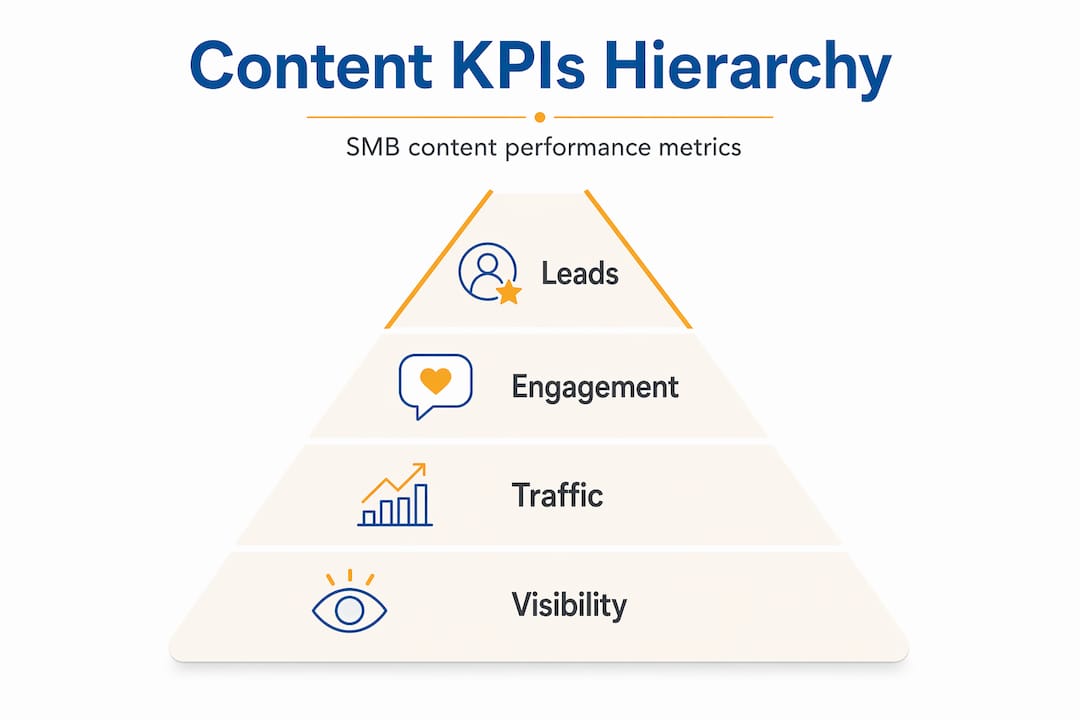
| Metric | What it tells you |
|---|---|
| Organic traffic | Whether SEO content is gaining visibility |
| Time on page | Whether content is holding reader attention |
| Email sign-ups | Whether content converts readers to subscribers |
| Lead form submissions | Whether content drives pipeline |
| Revenue attributed | Whether content influences closed deals |
Use Google Analytics for behavior data. Connect it to your CRM to track which content pieces appear in the journeys of customers who actually bought. That linkage is where the real insight lives.
Professionele tip: Schedule a content review meeting once a month. Spend 30 minutes looking at what content drove the most engagement, which pieces underperformed, and whether your publishing cadence held. Adjust next month’s calendar based on what you find, not what you assumed would work.
Content marketing best practices evolve slowly, so focus on fundamentals: audience identification, KPI setting, and content auditing. Those three habits, done consistently, outperform any trend.
Common pitfalls to avoid when building your strategy
Even well-intentioned content programs fall into patterns that erode results over time. Here is what to watch for.
- Publishing without purpose: Every piece of content should trace back to a specific business goal. “We needed something to post” is not a goal.
- Spreading too thin: Three platforms done well beats eight platforms done poorly. Pick channels where your audience is active and commit to those first.
- Reactive content cycles: If your editorial calendar is blank until the week you need to publish, you are reacting instead of planning. Content plans are critical for team alignment and consistent output.
- Prioritizing quantity over quality: Publishing four weak posts per week generates less authority than one well-researched, genuinely useful post. Search engines and audiences agree on this.
- Skipping QA: Objective QA checks covering brief completeness, SEO requirements, and call-to-action placement stabilize content quality and ensure execution predictability. Build a simple checklist and use it every time.
- Ignoring your existing content library: Most businesses have underperforming content that is two edits away from ranking. Repurposing and updating is one of the most cost-effective moves in any content marketing plan.
My take: what actually works in SMB content marketing
I have seen a lot of content programs built from scratch. The ones that succeed share one trait: they are treated as a system, not a series of individual tasks. When you write a blog post as a standalone act, it lives and dies on its own. When you write it as part of a documented strategy tied to keywords, personas, and a distribution plan, it compounds over time.
The biggest mistake I see small business owners make is setting publishing goals they cannot sustain. Two high-quality posts per month, published consistently and distributed properly, will outperform ten rushed posts in terms of both search rankings and reader trust. Start slow. Build the habit. Then scale.
What I have also found is that most businesses do not measure their content deeply enough. They check page views and call it done. But connecting content behavior to actual pipeline, even loosely, transforms how leadership perceives content marketing. When you can say “this blog post was in the journey of 12 of our last 30 customers,” budget conversations change. That is the reporting shift I encourage every SMB owner to prioritize. You can explore the content strategy fundamentals to understand this measurement layer better.
Success in content marketing is not about being everywhere or producing the most. It is about being consistent, relevant, and willing to optimize based on data. Every business that commits to that process eventually gets traction.
— Go
Take your content strategy further with Goonlinenow
You now have a clear picture of what it takes to build a content marketing strategy that drives real results. Putting it into practice is where most SMBs need support, and that is exactly what Goonlinenow is built for.
Goonlinenow gives you the tools to manage your content calendar, automate email and social distribution, track leads from first click to closed deal, and maintain a consistent publishing workflow without needing a large team. Our marketing automation software for SMBs is designed to handle the operational side of content marketing so you can focus on creating content your audience actually wants. From automated lead nurturing to CRM-connected performance tracking, everything lives in one place. No scattered tools. No complex setup. Just results you can measure.
Veelgestelde vragen
What are the core elements of a content marketing strategy?
A content marketing strategy should include defined business goals, audience personas, content pillars, a distribution plan, and a measurement framework. Core elements also include brand positioning, a value proposition, and a clear plan for measuring ROI.
How many content pillars should a small business have?
Most small businesses perform best with three to five content pillars. More than five tends to spread resources too thin and dilutes topical authority in search results.
How far in advance should I plan my content calendar?
Plan at least four to six weeks of content in advance. This gives you enough lead time to maintain quality, accommodate approvals, and avoid reactive publishing.
How do I know if my content marketing is working?
Track metrics at every funnel stage: organic traffic, time on page, email sign-ups, and lead form submissions. Connect these to CRM data to link content behavior to revenue and get a full picture of your content’s business impact.
What is the biggest mistake SMBs make with content marketing?
The most common mistake is publishing without a documented plan. Without a content plan, content tends to be reactive, inconsistent, and impossible to measure against business goals.