

TL;DR:
- Most small business owners jump into marketing without a clear strategy, leading to wasted budgets and poor results. Building a strong foundation by defining target audiences, specific actions, and measurable goals is essential before investing in paid or free tactics. Combining consistent free channels, smart paid advertising, and automated lead follow-up creates sustainable growth and maximizes return on investment.
Most small business owners jump straight into marketing and advertising for small business by boosting posts and buying ads before they have a clear strategy. The result is predictable: wasted budget, disappointing returns, and a growing frustration that “marketing doesn’t work.” It does work. You just need the right sequence. This guide walks you through the foundational steps, free tactics, paid channels, and lead management practices that turn marketing spend into real revenue. Every recommendation here is grounded in data and built specifically for businesses with limited budgets and big growth goals.
Start with a strong marketing foundation
Before you spend a single dollar on ads or a single hour on social media, you need to answer two questions: Who are you trying to reach? And what action do you want them to take? Most business owners skip this step entirely, and it’s exactly why their ads underperform. As one marketing framework puts it, defining your target audience and desired action must come before any media spend.
Here’s how to build that foundation correctly:
- Identify your ideal customer. Go beyond age and location. What problem are they trying to solve? What language do they use to describe that problem? A salon owner targeting working mothers needs to speak differently than one targeting teenagers, even if they’re in the same zip code.
- Define the one action you want them to take. Not three. One. Book an appointment, fill out a form, call your number. When your goal is vague, your ad creative will be vague too, and vague ads don’t convert.
- Set measurable goals. “Get more customers” is not a goal. “Generate 20 qualified leads per month at under $30 each” is a goal. Having a number gives you something to optimize toward.
- Resist the urge to advertise too early. Running ads before you know your audience is like driving with no destination. You’ll move fast, spend fuel, and end up nowhere useful.
Pro Tip: Use your digital marketing checklist to audit whether your foundation is genuinely solid before committing ad spend. Most businesses find at least two or three foundational gaps when they do this honestly.
With a solid foundation in place, you can select marketing tactics that truly connect.

Effective free marketing tactics every small business should use
Paid ads get the attention, but free tactics often deliver the most durable results. The best strategies for small businesses consistently start with free-channel optimization before scaling to paid. Here’s where to focus:
- Google Business Profile. This is non-negotiable for local marketing for small biz. A fully optimized profile with photos, hours, services, and regular posts can put you in front of local buyers who are actively searching. It costs nothing and the visibility impact is significant for SEO for small businesses.
- Customer reviews. Reviews are social proof, and social proof is currency. Ask every satisfied customer to leave a Google review. A business with 80 reviews averaging 4.7 stars will consistently outperform a competitor with 10 reviews averaging 5.0. Volume signals credibility.
- Email marketing. Your existing customer list is your most valuable marketing asset. A monthly email with useful tips, a special offer, or a behind-the-scenes update costs nothing beyond your time and keeps your brand top of mind. Email consistently delivers one of the highest returns of any digital channel.
- Strategic social media. The goal is not follower count. The goal is genuine engagement with people who could become customers or refer others. Answering questions, responding to comments, and sharing real stories about your business builds community. That community converts far better than a passive audience of thousands.
Ontdekken cost-effective SEO strategies En digitale marketingstrategieën that complement these free tactics and build long-term visibility without ongoing ad spend.
Pro Tip: Set up a simple review request automation. After a completed service or purchase, send a text or email asking for a Google review. The timing makes a big difference. Asking within 24 hours of a positive experience can triple your response rate compared to asking a week later.
Once free tactics are optimized, it’s time to consider paid channels to accelerate growth.
Paid marketing channels: choosing and optimizing your budget
Paid digital advertising is where many small businesses either find real traction or burn through budget quickly. The difference usually comes down to channel selection, targeting, and how you structure your campaigns.
Here’s what to know before spending:
- Clarify your objective first. Are you trying to generate leads, drive website traffic, or get direct purchases? Your objective determines which campaign type and platform you should use.
- Start with Meta Ads (Facebook and Instagram). For most service-based SMBs, Meta offers the best combination of targeting depth and cost efficiency. The average cost per lead on Meta is around $27.66 with conversion rates near 7.72%, though costs vary significantly by industry. A real estate agent and a restaurant will see very different numbers.
- Use Lead Form Ads over landing pages early on. Facebook Lead Form Ads can reduce cost per lead by 20 to 30% compared to sending traffic to an external page, and often convert 2 to 5 times better because the form is pre-filled with the user’s information. Less friction means more leads.
- Start small to learn fast. A $50 to $100 test campaign with tight geographic and interest targeting teaches you far more than assumptions. Let the data guide your next spend decision.
- Refresh your creative regularly. Ad fatigue is real. When the same image and copy run for more than two to three weeks, click-through rates drop and cost per lead rises. Rotate creative before performance falls, not after.
| Kanaal | Best for | Avg. cost per lead | Key advantage |
|---|---|---|---|
| Meta Lead Form Ads | Service businesses, local leads | $15 to $35 | Pre-filled forms, lower friction |
| Google Search Ads | High-intent buyers | $40 to $80 | Captures active demand |
| Instagram Story Ads | Brand awareness, younger audiences | $10 to $25 | Visual storytelling, wide reach |
| Email campaigns | Existing customers | Minimal (list-based) | Highest ROI channel overall |
Pro Tip: Use cold audience campaigns to build awareness first, then retarget those engaged users with Lead Form Ads. This two-step approach warms your audience and significantly improves lead quality compared to hitting cold traffic with a direct conversion ad. Pair this with your sociale media strategie for maximum impact.
Knowing where and how to spend helps you maximize returns, but capturing leads isn’t enough. You need to manage and nurture them.
Smart lead management and follow-up for better conversion
Here’s a truth most marketing guides skip: your ad performance is inseparable from your follow-up speed. Research consistently shows that treating your marketing as a lead pipeline with capture, routing, follow-up, and measurement tied to timing is what separates businesses that profit from ads and those that waste budget on them.
Build your lead pipeline around these practices:
- Capture leads directly into your CRM. When a form submission lands in your email inbox instead of a CRM, it gets lost or delayed. Connect your lead forms to a system that automatically creates a contact, tags the source, and triggers a follow-up.
- Respond within minutes. Not hours. Not the next business day. The faster you respond, the higher your conversion rate. This is not an opinion. It is a measurable, repeatable pattern across industries.
- Segment and tag leads from the start. A lead from a Facebook ad for your salon’s hair color service is different from one who clicked on your balayage promotion. Tagging them correctly lets you follow up with relevant messages, not generic ones.
- Track lead sources. Knowing which channel, which ad, and even which creative drives your best leads lets you double down on what works and cut what doesn’t. Without this data, you’re guessing.
- Build nurture sequences for leads who don’t convert immediately. Most people don’t buy or book on the first contact. A simple email or SMS sequence over five to seven days keeps you top of mind until they’re ready.
Use our lead management guide and explore CRM for SMB marketing to set up these systems without the complexity of enterprise tools.
Pro Tip: If you can only automate one thing this month, automate your lead response. A text sent within two minutes of a form submission telling the prospect you’ll call shortly can double your contact rate on its own.
With strong lead management, your marketing investment delivers real sales growth. But knowing how to balance your channel mix is the next step.
Building an integrated marketing mix for sustainable growth
No single channel is enough. The small businesses that grow most consistently are the ones that combine free, paid, and brand-building channels in a mix that fits their current budget and scales as revenue grows.
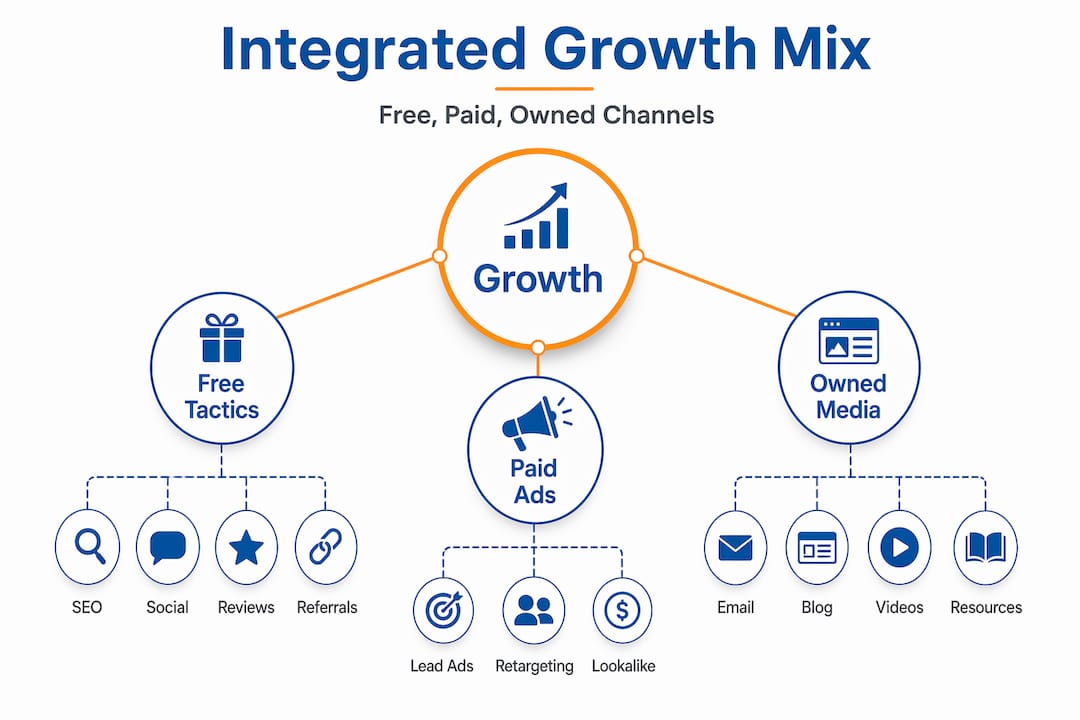
Here’s a practical way to think about it by budget tier:
| Monthly budget | Recommended channel mix |
|---|---|
| $0 to $100 | Google Business Profile, email list, organic social, review collection |
| $100 to $500 | Add one paid channel (Meta or Google Search), based on where your customers actually spend time online |
| $500 to $1,000 | Run paid social and search together, add retargeting, begin testing streaming TV or local display ads |
| $1,000 and above | Multi-channel with dedicated tracking, A/B testing, and content marketing for small firms |
A few things worth noting about this mix:
- Owned channels first. Starting paid budgets at $50 to $100 with hyper-local targeting lets you gather real data before committing larger amounts. This is not timidity. It’s smart resource management.
- Streaming TV is no longer just for big brands. Affordable streaming TV ad platforms now let small businesses run professional-level video ads starting at around $50. This kind of brand awareness complements digital campaigns and builds the trust and recognition that makes your paid ads perform better over time.
- Consistent messaging is non-negotiable. If your Google ad says “fast, friendly service” but your Facebook page hasn’t been updated in six months, you’re sending mixed signals. Your message needs to feel cohesive wherever a customer encounters you.
Explore more on this topic through our SMB marketing strategies resource, which maps out channel combinations for service businesses across different industries.
Understanding how to combine channels sets the stage for a fresh perspective on winning marketing approaches.
Why mastering fundamentals beats chasing trends in small business marketing
Here’s the uncomfortable truth about small business marketing: the businesses that fail at it are almost never failing because they chose the wrong platform. They fail because they skip the fundamentals and jump straight to tactics like boosting posts or buying ads without aligning those tactics with a defined audience and a clear desired action.
The marketing world rewards shiny new things. A new ad format, a new social platform, a new automation trick. Every month there’s something claiming to be the future. And every month, business owners abandon strategies that were starting to work to chase the next thing. This is how budgets evaporate.
Marketing is a conversation, not a broadcast. When you truly understand your customer, what they want, what they fear, what language they use, your message lands differently. It doesn’t feel like advertising. It feels like someone finally gets them. That’s what drives conversions. Not the platform. The understanding.
The businesses we see grow most consistently share three traits. They know their numbers. They respond to their leads fast. And they keep showing up with the same clear message long enough for it to compound. Patience is not passive. Consistency is a competitive advantage that most of your competitors are too distracted to maintain.
Use the insights from this guide alongside your digital marketing strategies to build a marketing system that compounds over time, not one that chases results month to month.
Streamline your marketing and CRM with automation software
The framework in this guide works. But executing it manually across email, ads, CRM, follow-up, and reporting is genuinely difficult without the right tools. That’s exactly where marketing automation software for SMBs changes the equation.
Go Online Now-Connect is built specifically for small and growing businesses that want the full marketing and sales system in one place, without the enterprise price tag. The platform combines email and SMS automation, lead capture forms, CRM pipeline tracking, and reputation management into a single system configured for you from day one.
When your leads flow automatically into your CRM, trigger an instant follow-up, get tagged by source, and enter a nurture sequence, all without manual input, your conversion rate goes up and your workload goes down. That’s what marketing automation driving SMB growth actually looks like in practice. Pair it with our all-in-one CRM for SMB marketing automation and your entire marketing and sales pipeline runs on autopilot.
Frequently asked questions
What is the ideal budget for marketing a small business?
Most small businesses should allocate 5 to 10% of revenue to marketing, prioritizing channels that generate measurable returns and scaling spend as those returns are confirmed. Higher investment during growth phases is often necessary.
How can I lower my Facebook Lead Ads cost per lead?
Use Lead Form Ads instead of external landing pages, since they reduce CPL by 20 to 30%, and follow up with leads within minutes. Also refresh your ad creative regularly to prevent fatigue, and layer retargeting on top of cold awareness campaigns.
Is TV advertising viable for small businesses?
Yes. Streaming TV ad platforms now let small businesses run targeted video ads starting at around $50, providing brand awareness and credibility that complement digital marketing campaigns effectively.
Should small businesses use multiple marketing channels?
An integrated approach combining free owned channels and targeted paid spend delivers the most sustainable growth. Start small and scale multi-channel as you confirm which channels generate the best leads for your specific business type.
How important is follow-up timing for leads from ads?
Extremely important. Leads contacted within 5 minutes are up to nine times more likely to convert than those reached after 30 minutes. Fast follow-up is one of the highest-leverage improvements any small business can make to their marketing ROI.