

TL;DR:
- Many small businesses mistakenly believe that regular online posting alone drives growth, but strategic content creation is essential. (1) Creating purposeful, goal-oriented content across owned, earned, and paid channels maximizes business results and audience engagement. (2) Implementing a structured, stage-mapped process and simple metrics ensures sustainable digital marketing success for SMBs.
Many small business owners believe that posting regularly online is enough to grow their digital presence. It isn’t. Content creation in digital marketing is far more than scheduling a few social posts or writing a blog when inspiration strikes. It’s a structured, goal-driven practice that connects your business to the right audience at the right moment. This guide breaks down exactly what content creation means, how to build a repeatable process, which content types actually deliver results for SMBs, and how to measure what’s working without needing a data science degree.
Key Takeaways
| Point | Details |
|---|---|
| Content is strategic | Digital marketing content must support specific business goals, not just fill space online. |
| Process matters | A repeatable workflow from research to publishing boosts content quality and results. |
| Focus beats quantity | Impactful content is mapped to the customer journey and prioritized for business value. |
| Simple measurement wins | Track engagement and assisted sales with basic tools to prove content ROI. |
| SMB-friendly solutions | Affordable software and service options help SMBs scale their content and measure success efficiently. |
The true meaning of content creation in digital marketing
Many businesses spend months churning out posts, articles, and videos without seeing meaningful results. The reason is almost always the same: there’s no strategy behind the content. Random posting feels productive, but it rarely moves the needle.
True content creation in digital marketing means producing planned, purposeful material designed to achieve specific business outcomes. Think of it this way: every piece of content should have a job to do. That job might be generating leads, building trust, or converting a warm prospect into a paying customer.
As one strategic content framework puts it, “Content creation is not just ‘posting’; it’s intentional creation with measurable objectives and distribution across owned, earned, and paid channels to drive business outcomes across the funnel.”
Understanding the difference between channels is also critical for SMBs. Here’s a quick breakdown of the three main types:
- Owned channels: These are platforms you control completely, such as your website, blog, email list, and social media profiles. You set the rules and own the relationship with your audience.
- Earned channels: This is third-party coverage you earn through credibility, including press mentions, customer reviews, shares, and organic backlinks. You can’t buy it, but you can create content worth sharing.
- Paid channels: These include sponsored posts, paid ads, and promoted content. They amplify your reach quickly, but stop the moment you stop paying.
For most SMBs, the smart path is to build strong owned channels first, supplement with earned reach through quality content, and selectively invest in paid distribution. A deeper look at understanding content creation process helps clarify how these channels work together in practice.
A simple framework: The content creation process explained
Now that you know what content creation is, let’s break down how it actually happens in a business-friendly, repeatable way. The biggest mistake SMBs make isn’t producing bad content. It’s skipping the planning phase entirely and jumping straight into writing or filming.
A well-established content methodology starts with a pre-write phase, moves into drafting, and ends with deliberate editing. Each phase has a purpose. Rushing any of them weakens the final result and, more importantly, weakens your return on investment.
Here’s how the process works step by step:
- Pre-write research: Before writing a single word, define the purpose of the piece. Who is the target audience? What do they already know? What do they need to understand to take action? Gather evidence, data, or customer questions to support your angle.
- Create a creative brief: This is a one-page document that summarizes the content goal, the audience, the key message, and the distribution channel. It sounds formal, but even a simple brief saves hours of revision later.
- Draft the content: Write clearly and directly. Focus on being useful, not impressive. A real estate agent reading your blog doesn’t need literary flair. They need answers that help them solve a problem today.
- Edit for quality and intent: Read the draft with fresh eyes. Does it deliver on the creative brief? Is it credible? Does it move the reader toward the next step? Cut anything that doesn’t serve those goals.
- Distribute and track: Publish on the right channels and set up a simple way to track performance. More on this in a later section.
Pro Tip: Tie every single piece of content to one primary business goal before you begin writing. Is this content meant to generate leads, educate prospects, or retain customers? Clarity at this stage prevents wasted effort at every stage that follows.
Skipping planning doesn’t save time. It costs you time, money, and momentum. SMBs that follow a structured process consistently outperform those that publish on impulse. For a deeper walkthrough, both the content marketing management guide En step-by-step content marketing guides are worth bookmarking.
A repeatable system transforms content from a time drain into a reliable growth engine. The businesses that treat content like a process, not a creative whim, are the ones that build sustainable pipelines.
What works: Content types, funnel stages, and SMB best practices
Once the process is clear, it’s essential to know where to focus your energy and resources for the best return. Not all content types are equal, and what works for a large e-commerce company may not be practical for a coaching business or a local salon.
Volgens industry benchmarks, social content often drives more measurable impact than long-form blogs, especially for SMBs with limited publishing frequency. Blogs remain valuable for SEO and long-term discovery, but social posts frequently outperform them for immediate engagement. Only 33% of marketing teams use formal attribution models, which means most businesses are making content decisions based on incomplete data.
Here’s a look at average content outputs by SMB type based on observable benchmark patterns:
| Content type | Coaching/services | Salons/local business | Real estate/professional services |
|---|---|---|---|
| Blog posts per quarter | 11 to 15 | 4 to 8 | 10 to 20 |
| Social posts per quarter | 51 to 75 | 75 to 100 | 50 to 80 |
| Email campaigns per quarter | 6 to 12 | 4 to 8 | 8 to 15 |
| Webinars or video content | 1 to 3 | Rare | 2 to 4 |
These numbers are benchmarks, not targets. They help you set realistic expectations rather than chasing content volume you can’t sustain.
Understanding the customer funnel is equally important. Your content should support buyers at every stage of their journey:
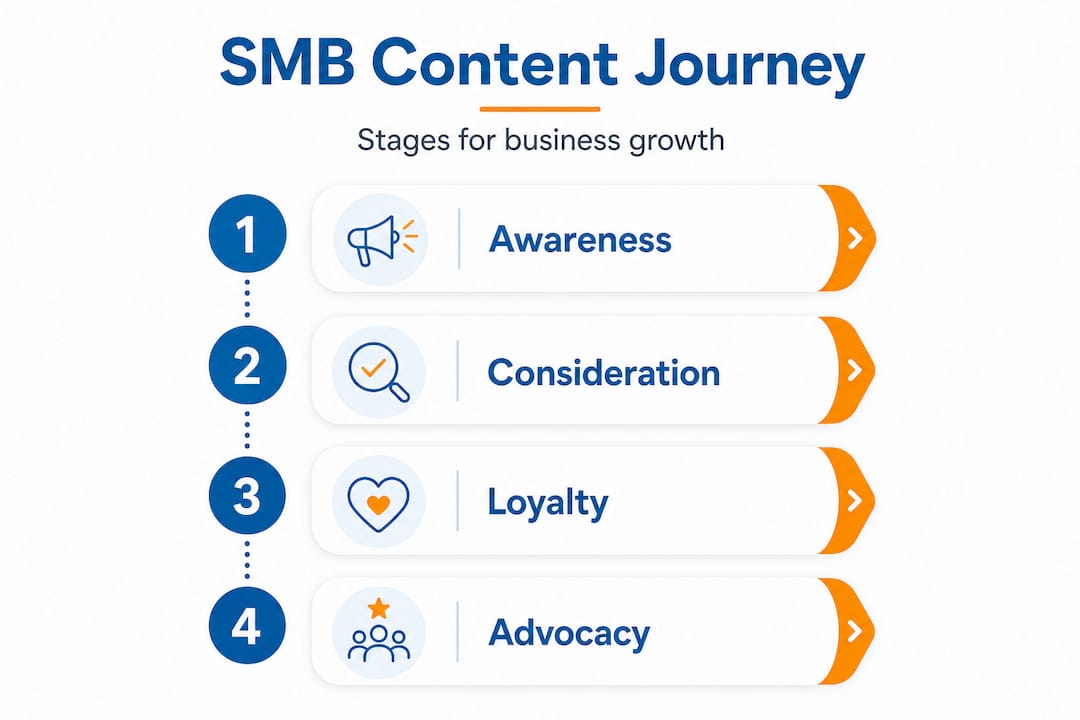
- Awareness: Blog posts, social media, short videos, and guides that introduce your business and build trust with people who don’t know you yet.
- Consideration: Case studies, how-to content, comparison articles, and email sequences that help prospects evaluate whether you’re the right fit.
- Decision: Testimonials, service pages, free consultations, and strong calls to action that push a warm lead to commit.
- Loyalty: Newsletters, exclusive tips, check-in emails, and community content that keep existing customers engaged and encourage referrals.
Most SMBs over-invest in awareness content and under-invest in consideration and loyalty stages. That’s a missed opportunity. A prospect who already trusts you needs much less convincing than a cold visitor, and retaining an existing customer is significantly less expensive than acquiring a new one.
For practical guidance on making the most of a limited content budget, explore affordable SMB content marketing and sharpen your approach with a solid content strategy for SMBs.

How to measure content success without complex tools
Understanding outputs and priorities leads to the next crucial piece: how to measure whether your efforts are paying off in real business terms. This doesn’t need to be complicated.
One of the most common mistakes SMBs make is relying on last-click attribution, which gives all the credit to the final piece of content a customer saw before converting. This model sounds logical, but it ignores all the content that educated, warmed up, and built trust with that customer over time. Formal attribution tracking is uncommon even among established marketing teams, which tells you that chasing a perfect measurement system is not where SMBs should invest their energy.
Instead, use a simple, practical framework. Here’s a comparison of two measurement approaches:
| Measurement approach | Complexity | Useful for SMBs? | Best metrics to track |
|---|---|---|---|
| Last-click attribution | Low | Partially | Final conversion source only |
| Engagement plus assisted conversions | Medium | Yes | Likes, shares, email opens, form fills |
| Full multi-touch attribution | High | Rarely | Complete customer journey mapping |
| Lightweight content audit | Low | Absolutely | Traffic, leads, content-influenced revenue |
Pro Tip: Pick 2 to 3 core metrics and track them consistently every month. Good starting points are the number of leads generated from content, average engagement rate on social posts, and total customer pipeline influenced by content in the last 30 days.
Here are practical steps to set up a lightweight measurement routine:
- Use your website’s free analytics tool to track which pages attract the most visitors and where people drop off.
- Tag your email links so you can see which campaigns drive website visits and contact form submissions.
- Ask new customers or leads how they first heard about you. This simple question reveals content influence that analytics tools often miss.
- Review your numbers monthly, not daily. Consistency over time tells a better story than short-term spikes.
The goal isn’t perfection. Some tracking is always better than none. If you know which content types are generating leads and which are ignored, you can double down on what works and stop wasting time on what doesn’t. Start there. Resources like the content marketing basics guide and content marketing for small businesses offer practical frameworks to build your measurement habit.
What most SMBs miss: Why mapping content to business goals matters most
Here’s our honest perspective, and it might not be what you expect to hear.
Most SMBs don’t have a content problem. They have a mapping problem. They produce decent content, sometimes even great content, but none of it connects to a clear picture of where a customer is in their journey. The result is a collection of disconnected assets that feel busy but don’t compound into real growth.
More content does not equal more results. A business that publishes 20 blog posts a year with zero journey alignment will consistently lose to a competitor publishing 8 posts mapped precisely to where buyers are and what questions they’re asking at each stage. Volume without direction is just noise.
Effective content strategy explicitly maps content to audience journey stages and aligns goals and objectives to each asset. That’s not an advanced concept. It’s the foundational discipline that separates businesses that grow steadily from those that spin their wheels.
Think about two hypothetical SMBs in the same industry. Business A publishes whenever they feel inspired, mixing motivational posts, product announcements, and occasional blog articles with no connecting logic. Business B maps three pieces of content to each funnel stage before publishing anything. Business B isn’t working harder. They’re working with intention. Over 12 months, Business B builds a content library that attracts, nurtures, and converts customers systematically, while Business A wonders why their effort isn’t translating.
The fix is simpler than most people think. Start with one journey map. Draw out three to four stages your customers move through before buying from you. Assign one or two content types to each stage. Then, before publishing anything, ask: “Which stage does this serve?” If you can’t answer that question, the content isn’t ready.
This approach works for every industry, every budget, and every team size. The digital marketing checklist for SMBs is a practical tool for getting this mapping process started today without overcomplicating it.
Take your digital content further with SMB-focused solutions
With a clear understanding of content creation, a repeatable process, and a practical measurement approach, the next step is putting it all into action consistently. That’s where many SMBs stall: the knowledge is there, but the time, tools, and execution capacity aren’t.
Go Online Now-Connect is built specifically for businesses like yours. Whether you need automation software for SMB conversions that nurtures leads while you focus on running your business, or a team to handle digitale marketingdiensten including content strategy, creation, and distribution, we bring everything under one roof. No overpriced subscriptions, no scattered tools, and no complex setups. Just a straightforward system designed to help your business grow smarter, with real human support every step of the way.
Frequently asked questions
What does content creation mean for my small business?
Content creation means intentionally developing and sharing digital material that helps attract customers and achieve your business goals. As one framework clarifies, it’s not just posting online but rather purposeful content with measurable objectives and planned distribution.
Which types of content have the most impact for SMBs?
Industry benchmark data shows social posts often have more measurable impact than blogs for SMBs, but the best type always depends on your specific audience, industry, and goals.
Do I need expensive tools to measure my content’s performance?
Most SMBs get strong results using simple metrics like engagement rates and influenced sales. Formal attribution tools are useful but optional, and consistent lightweight tracking often delivers more actionable insight than complex systems.
How often should I publish new digital marketing content?
Benchmark patterns suggest roughly 11 to 20 blog posts and 51 to 100 social posts per quarter for SMBs, but quality and goal alignment always matter more than raw publishing frequency.