
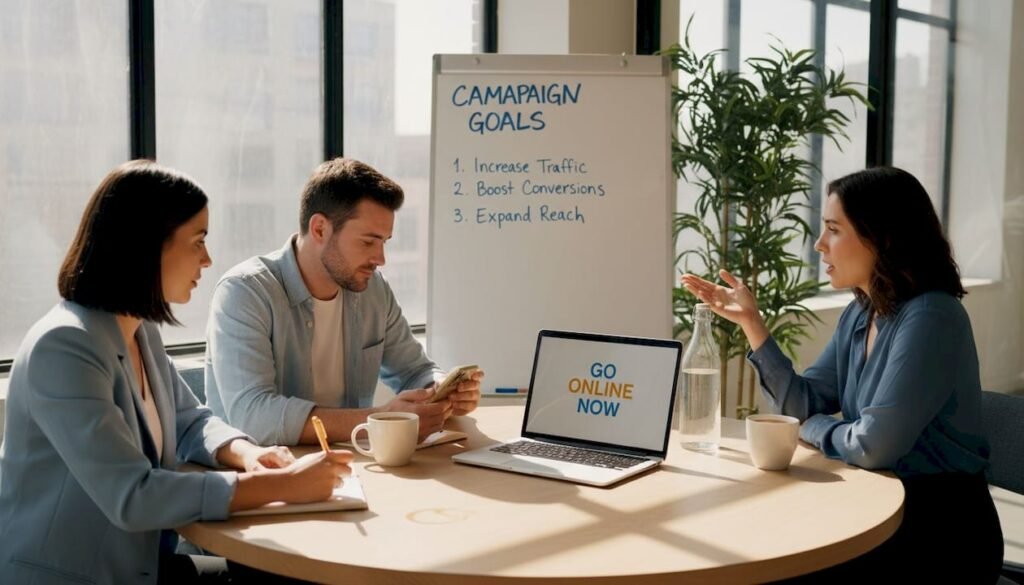
TL;DR:
- Effective digital campaigns are goal-oriented, integrated, and trackable across multiple channels.
- Automation and owned data are essential for sustainable growth and adapting to privacy changes.
- A balanced omnichannel strategy combining performance and brand tactics yields the best results for SMBs.
Most small business owners believe a digital marketing campaign means posting regularly on social media, sending a few emails, or running occasional paid ads. That assumption is costing them real money and real growth. In 2026, privacy changes and AI are reshaping how audiences are reached, shifting emphasis toward first-party data, owned channels like email, and original content over generic SEO tactics. A true digital marketing campaign is a coordinated, measurable, and goal-driven system. This guide will show you exactly what that means, how to build one, and how automation makes it achievable even with a small team and a tight budget.
Key Takeaways
| Point | Details |
|---|---|
| Integrated strategy matters | Scattered digital efforts fall flat; a coordinated campaign ensures results. |
| Automation boosts efficiency | Modern tools let SMBs manage, measure, and optimize campaigns without hiring large teams. |
| Choose the right approach | Decide if you need fast ROI, brand growth, or an omnichannel mix—and build campaigns accordingly. |
| First-party data is critical | With privacy changes, owning your audience through email and original content safeguards your reach. |
| Measuring drives results | Track and tweak campaign metrics to turn actions into tangible SMB growth. |
Defining a digital marketing campaign for today’s SMBs
Now that we’ve highlighted the stakes, let’s clarify exactly what a digital marketing campaign means for a modern SMB. The short answer: it is not a collection of random marketing tasks. It is an integrated set of coordinated digital actions all pointing toward one defined goal, executed across the right channels, within a set timeframe, and measured by clear performance indicators.
Think about the difference between a business that occasionally posts on Instagram when they feel like it versus one that runs a 30-day lead generation campaign combining SEO content, targeted Facebook ads, a lead magnet, and an automated email follow-up sequence. The first is activity. The second is a campaign.
A well-structured SMB digital strategy connects these moving parts so each piece reinforces the others. Every channel serves the campaign goal, every message is consistent, and every result is trackable.
Here are the key elements that define a proper digital marketing campaign:
- Goal: A single, specific objective (generate 50 leads, increase online sales by 20%, grow email subscribers by 500)
- Target audience: A defined segment of customers you are trying to reach
- Channels: The platforms and methods used to deliver the message (search, email, social media, paid ads)
- Messaging: Consistent copy and creative that speaks to your audience’s specific needs
- Timeline: A defined start and end date with scheduled touchpoints
- KPIs (Key Performance Indicators): Metrics that tell you whether the campaign is working
“A digital marketing campaign without a defined goal is just noise. The goal is what turns scattered effort into strategic momentum.”
As you build your digital growth strategies, keep in mind that performance-first and brand-first approaches represent two distinct campaign philosophies. Performance-first relies on quick ROI through paid channels like PPC, while brand-first focuses on long-term compounding through SEO and content. Omnichannel coordination combines both and outperforms either one alone.
Core components of a successful digital marketing campaign
Understanding what a digital marketing campaign is sets the stage for breaking down what makes up an effective campaign for your business. Let’s look at the specific building blocks you need to get right.

Campaign objectives are your starting point. Every campaign should fall into one of these four categories: lead generation, direct sales, brand awareness, or customer retention. Each objective requires a different channel mix, message style, and measurement approach. Running a retention campaign looks completely different from a lead generation campaign, even for the same business.
Channel selection is where many SMB owners make mistakes. They try to be everywhere at once and end up being effective nowhere. Choose channels based on where your ideal customer actually spends time and where you can realistically execute well.
Common campaign channels include:
- Search (SEO and PPC): Captures people actively looking for your solution
- Social media: Builds awareness and drives engagement, especially useful for visual industries like salons or coaching
- Email marketing: Highly personal, low cost, and delivers strong ROI, especially with an owned list
- Content marketing: Blog posts, videos, and guides that build trust and improve search rankings over time
- Paid advertising: Facebook Ads, Google Ads, and display ads that drive faster results with a budget
Your tech stack matters more than most people realize. Affordable automation tools allow you to manage all of these channels from one place. According to research on digital marketing for small businesses, affordable automation enables campaign management including auto-emails, lead scoring, and segmentation, boosting efficiency without requiring large teams. This is a real shift in what’s possible for SMBs.
Measurement is the final component. Use your digital marketing checklist to establish KPIs before you launch. Track leads generated, cost per lead, email open rates, conversion rates, and overall ROI. Quick wins like click-through rates tell you about daily performance. Long-term metrics like customer lifetime value tell you about the health of your business.
Pro Tip: Before you choose a single channel or write a single piece of copy, write your campaign goal in one sentence. If you cannot state it clearly, your campaign will drift. Clarity at the start saves you weeks of wasted effort.
Performance-first vs. brand-first: Choosing your campaign strategy
Once the core pieces are in place, the next key is choosing the campaign strategy that fits your business goals and resources. This is a decision most SMBs either skip entirely or get wrong.
The two dominant approaches are performance-first and brand-first. Neither is universally superior. The right choice depends on your timeline, your budget, and where you are in your business lifecycle.
Performance-first campaigns focus on immediate, measurable returns. You run Google Ads or Facebook Ads, drive traffic to a landing page, and measure leads or sales directly. Results come fast, sometimes within days. The tradeoff is that the moment you stop spending, the results stop too. It is rented attention, not owned.
Brand-first campaigns invest in SEO, original content, and organic social media to build trust and authority over time. Results take longer, often months before you see meaningful traction. But once they gain momentum, they compound. Your blog post from six months ago keeps generating traffic today without additional spend.
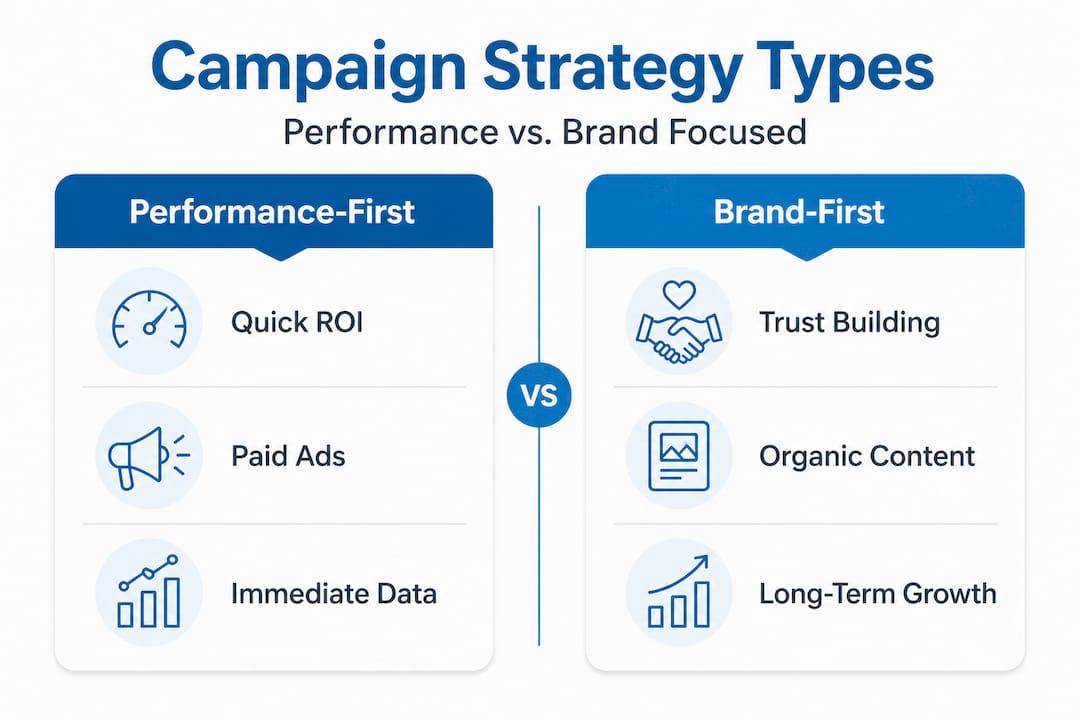
Here is a practical comparison to help you decide:
| Factor | Performance-first | Brand-first |
|---|---|---|
| Speed of results | Fast (days to weeks) | Slow (months) |
| Cost structure | Pay per click or impression | Upfront content investment |
| Sustainability | Stops when spend stops | Compounds over time |
| Best for | New launches, seasonal offers | Long-term authority and trust |
| Measurement | Direct attribution (clicks, leads) | Traffic, rankings, share of voice |
| Risk level | Higher spend without ROI clarity | Slower returns, lower risk |
In 2026, omnichannel coordination is becoming the standard best practice because integrated campaigns consistently outperform single-channel efforts. A customer might discover you through a Google search (brand-first), get retargeted by a Facebook ad (performance-first), and convert after receiving an email (automation). That is an omnichannel campaign, and it is far more powerful than any one channel alone.
Jouw SMB marketing strategies should balance both approaches wherever budget allows. If you are a new business, lean toward performance-first to generate early revenue. If you are established, invest in brand-first to reduce your dependence on paid traffic over time.
Pro Tip: Review your digital marketing essentials to identify which channels you already have a presence on. Start with those before expanding into new ones. Consistency on two channels beats inconsistency across five.
Automation, AI, and data: The new backbone of digital marketing campaigns
After exploring campaign strategies, it’s crucial to see how technology enables success even with small teams and budgets. Automation is no longer a “nice to have” for SMBs. It is a competitive necessity.
Here is what modern automation does for your campaigns:
| Automation feature | What it does | Impact |
|---|---|---|
| Auto-email sequences | Sends targeted emails based on user behavior | Nurtures leads without manual follow-up |
| Lead scoring | Ranks leads by engagement and readiness to buy | Helps you prioritize the right prospects |
| Audience segmentation | Groups contacts by behavior, demographics, or stage | Makes messaging more relevant and effective |
| SMS marketing | Delivers time-sensitive offers directly to phones | High open rates, fast conversions |
| CRM pipeline tracking | Visualizes where every lead is in the sales process | Reduces deals falling through the cracks |
The shift toward first-party data and owned audiences is one of the most important changes happening in 2026. As third-party cookies disappear and privacy regulations tighten, businesses that built their marketing on rented platforms and third-party targeting are becoming more vulnerable. Your email list, your CRM contacts, and your SMS subscribers are assets you own and control.
Affordable automation gives you HubSpot-level capabilities without the HubSpot price tag. You can run lead scoring, segment your audience, and trigger personalized email sequences based on specific actions, all without hiring a dedicated marketing operations team.
Here is a simple step-by-step process to get started with automation for your campaigns:
- Choose a platform that combines CRM, email automation, and analytics in one system
- Import your existing contacts and tag them by source, industry, or stage in the buying journey
- Set up a welcome email sequence for every new lead, at minimum a 3-email series introducing your business and offering value
- Define a lead scoring model based on actions like opening emails, visiting pricing pages, or filling out forms
- Create one automated follow-up workflow for leads that go cold, a simple 2-step re-engagement sequence
- Review automation performance monthly and adjust based on open rates, click rates, and conversions
“The businesses winning in 2026 are not the ones with the biggest budgets. They are the ones with the best systems. Automation is how small teams produce big results.”
Gebruik digital growth tips to identify which automation workflows will have the biggest immediate impact on your revenue.
From action to results: Measuring and optimizing your campaigns
Powerful campaigns depend on more than setup. You need ways to track, test, and optimize performance efficiently. Many SMBs launch campaigns and then forget to measure them properly. That is a fast track to wasted budget.
Here is a practical process for measuring your campaigns:
- Define your metrics before launch. Decide which KPIs matter most for your campaign goal. For lead gen, track leads and cost per lead. For sales campaigns, track conversion rate and revenue.
- Set up a simple dashboard. Use your CRM or analytics tool to display your top 5 metrics in one view. You should be able to assess campaign health in under five minutes.
- Review weekly, not daily. Daily fluctuations create noise. Weekly reviews show actual trends.
- Identify your weakest link. If traffic is strong but conversions are low, the problem is your landing page or offer, not your ads.
- Test one variable at a time. Change one element (subject line, headline, call to action) and measure the result before changing anything else.
Key metrics to monitor for every campaign:
- Click-through rate (CTR): Measures how compelling your ad or email is
- Conversion rate: Percentage of visitors or leads who take the desired action
- Cost per lead (CPL): How much you spend to acquire one lead
- Email open rate: Indicates how relevant your subject lines and sender name are
- Return on ad spend (ROAS): Revenue earned for every dollar spent on paid ads
- Customer acquisition cost (CAC): Total marketing spend divided by new customers acquired
Affordable automation with built-in reporting makes this measurable and manageable, even without a dedicated analyst. Review your marketing strategies for 2026 to see how leading SMBs are structuring their measurement systems for maximum clarity and efficiency.
Why the old playbook for digital marketing campaigns no longer works
With the fundamentals covered, let’s discuss the shifting reality and what most guides miss for SMBs in 2026.
Here is the honest truth: most digital marketing advice circulating online was written for a different era. The “post consistently and use hashtags” approach that worked in 2019 is producing diminishing returns. Generic SEO content churned out at scale is being filtered out by AI-driven search updates. “Spray and pray” social media strategies are generating impressions without engagement or revenue.
Privacy changes and the rise of AI have fundamentally changed the rules. Third-party tracking is becoming less reliable. Paid platforms are charging more for diminishing reach. And audiences are more skeptical of generic, low-effort marketing than ever before.
What actually works now? Three things: owning your audience, investing in original content, and using automation to stay consistent without burning out.
Owning your audience means building an email list and an SMS subscriber base that you control, not one rented from a social media platform that can change its algorithm tomorrow. Original content means producing content that reflects real expertise, addresses specific questions your customers ask, and demonstrates genuine value rather than recycling what everyone else says.
Automation is what makes both of those sustainable. Without it, even the best strategy collapses under the weight of execution. Small teams simply cannot maintain the consistency required for modern campaigns without technology handling the repetitive tasks.
The SMBs we see winning are not chasing every new trend or platform. They are mastering the fundamentals: a strong offer, a clear audience, a quality email list, and an automated follow-up system. Understanding why digital marketing matters for your specific business model is the first step toward building campaigns that actually move the needle.
Don’t let the platforms own your audience. Build your own, protect it, and serve it well. That is the strategy that compounds.
Take your campaigns further: Affordable automation for SMB growth
Everything you’ve read in this guide is entirely achievable for your SMB, without enterprise budgets or a team of ten. The right tools make the difference.
Go Online Now-Connect is built specifically for businesses like yours. Our platform combines automation software for conversions with a full CRM, email and SMS marketing, and done-for-you setup, so you can start running real campaigns without a steep learning curve. Whether you are launching your first coordinated campaign or optimizing an existing strategy, explore how automation software for growth can help you generate more leads, close more sales, and save hours every week. Get started by reading our digital marketing explained guide to understand how each piece of your campaign fits into the bigger picture.
Frequently asked questions
What is the first step in planning a digital marketing campaign?
Clearly define your campaign goal, such as increasing leads or sales, before choosing channels and creating your message. A defined goal is what transforms scattered effort into coordinated, measurable action.
How can small businesses afford marketing automation?
SMBs now have access to affordable automation software that handles emails, lead scoring, and campaign reporting, making advanced marketing achievable without a large staff or enterprise budget.
Is email still a key channel in 2026 digital campaigns?
Yes. With privacy changes shifting priorities toward owned audiences, building and nurturing an email list is more strategically important in 2026 than it has ever been.
How should SMBs choose between a performance or brand campaign?
Performance campaigns deliver faster ROI through paid ads, while brand campaigns build long-term trust through content and SEO. A balanced, omnichannel approach that uses both works best for most SMBs.
What’s the most common mistake in SMB digital marketing campaigns?
Launching campaigns without a clear measurement plan is the top pitfall. Automation with lead scoring and built-in reporting makes it far easier to track performance and optimize based on real data rather than guesswork.
Aanbevolen
- Role of Digital Marketing for SMBs: Complete Guide – Go Online Now
- Understanding Why Digital Marketing for SMBs Matters – Go Online Now
- Digital marketing checklist: optimize SMB strategies now – Go Online Now
- What Is SMB Digital Strategy and Why It Matters – Go Online Now
- Optimize local campaigns with targeted advertising route planning
- Step by Step Video Ads: Easy E-Commerce Growth Guide | QuickAdVideo Blog