

Hiring the right people used to mean posting a flyer, sifting through paper resumes, and hoping the best candidate lived nearby. That world is gone. Today, digital tools enable SMBs to efficiently source, vet, and onboard talent from across the world, without a massive HR department or a Fortune 500 budget. Whether you are an HR manager juggling five roles or a business owner trying to scale your team, this guide walks you through the tools, strategies, pros and cons, and practical steps to make digital recruitment work for your SMB.
Key Takeaways
| Point | Details |
|---|---|
| SMBs gain global reach | Digital recruitment lets small businesses access top talent beyond local limits efficiently. |
| Efficiency and lower costs | Automation of screening and assessment slashes manual hiring time and expenses. |
| AI needs human oversight | Blending AI with human review prevents bias and ensures cultural fit in hiring. |
| Belangrijke statistieken bijhouden | Success comes from monitoring quality-of-hire and time-to-hire, and adjusting strategies regularly. |
What is digital recruitment and why does it matter for SMBs?
Having previewed digital recruitment’s growing impact on SMBs, let’s break down what it actually is and why it matters to your business.
Digital recruitment is the process of finding, attracting, screening, and hiring candidates using online platforms and technology. It replaces or supplements traditional methods like newspaper ads and manual resume reviews with faster, smarter systems. For SMBs, this shift is not just convenient. It is a genuine competitive advantage.
Here is what digital recruitment typically includes:
- Applicant Tracking Systems (ATS): Software that collects, organizes, and ranks job applications automatically
- AI-powered screening: Algorithms that match candidate profiles to job requirements in seconds
- Video interviewing platforms: Tools like structured video calls that remove geographic barriers
- Social media sourcing: Finding passive candidates on LinkedIn, Facebook, and niche job boards
- Integrated CRM workflows: Keeping candidate communication organized and consistent
The real power here is reach and efficiency. Digital tools automate resume filtering and candidate matching, giving you access to global talent pools that were once only available to large enterprises. And according to Gartner’s HR recruiting research, digital recruitment levels the playing field for SMB HR managers, enabling data-driven decisions at lower costs.
“The best digital recruitment setups do not replace human judgment. They free up your time so your human judgment can focus on what actually matters: finding the right cultural fit.”
Pro Tip: Start with a digital recruitment guide that maps your current hiring steps, then identify which ones can be automated first. Repetitive tasks like resume sorting and interview scheduling are the easiest wins.
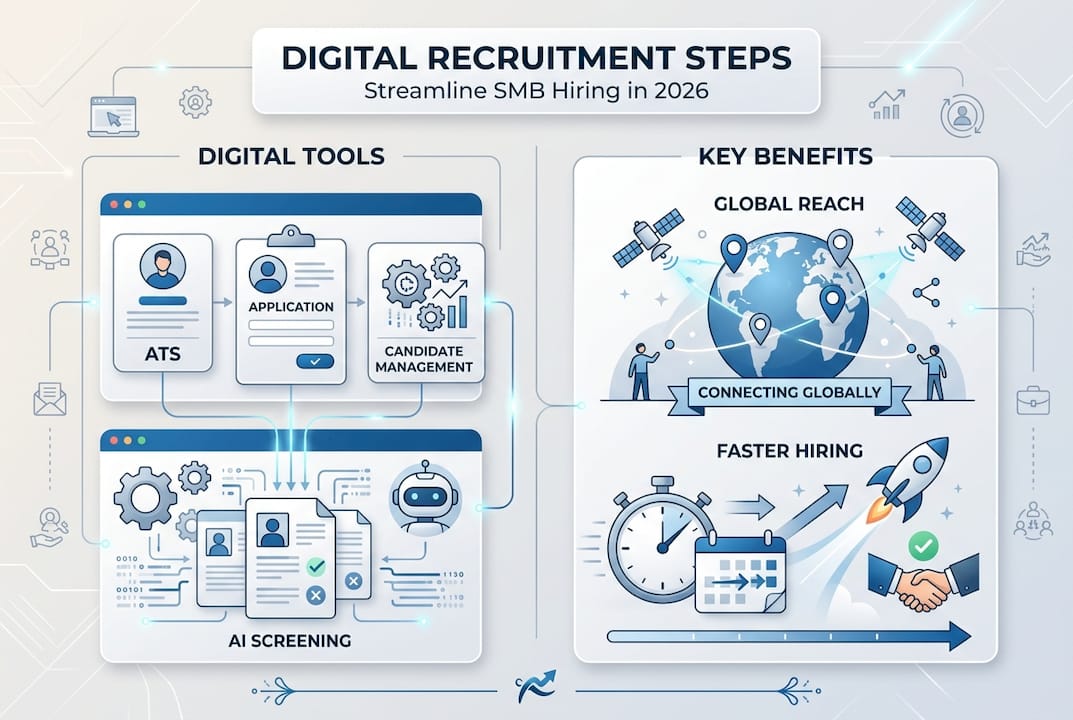
The digital recruitment toolkit: essential technologies and strategies
Now that you understand why digital recruitment can transform SMB hiring, let’s walk through the must-have technologies and strategies for building an efficient process.

Key methodologies include job posting, AI-driven screening, predictive analytics, and combined ATS and CRM automation. Together, these tools create a hiring pipeline that moves faster and produces better results than manual processes alone.
Here is a typical digital recruitment workflow for an SMB:
- Define the role: Write a clear job description with specific skills, experience, and culture requirements
- Post across platforms: Publish on job boards, LinkedIn, and your own careers page simultaneously
- Automate initial screening: Let your ATS filter applications based on your preset criteria
- AI ranking: Use AI tools to score and rank candidates by fit, saving hours of manual review
- Video interviews: Conduct structured first-round interviews remotely to assess communication and personality
- Human review: Your team evaluates top candidates for culture fit and motivation
- Offer and onboard: Use automated workflows to send offers, collect documents, and schedule onboarding
Here is a quick comparison of the most common digital recruitment tools SMBs use:
| Tool | Primary function | Best for |
|---|---|---|
| ATS (e.g., Workable, Breezy) | Application tracking and ranking | High-volume roles |
| AI screening tools | Resume parsing and candidate scoring | Fast initial filtering |
| Video interview platforms | Remote structured interviews | Geographically distributed hiring |
| LinkedIn Recruiter | Passive candidate sourcing | Specialized or senior roles |
| Integrated CRM | Candidate communication and pipeline | Ongoing talent relationship management |
For a deeper look at how these tools connect, explore digital recruitment solutions explained En how digital recruitment works in practice.
Pro Tip: Prioritize platforms that integrate ATS and AI in one system. Switching between disconnected tools creates data gaps and slows your team down.
Digital recruitment vs. manual hiring: pros, cons, and when to blend
Understanding the toolkit is just the start. Here is how digital stacks up against old-school manual hiring, and why the best SMBs blend both.
| Factor | Digital recruitment | Manual hiring |
|---|---|---|
| Speed | Fast, automated screening | Slow, labor-intensive |
| Bereik | Global talent pools | Mostly local or regional |
| Kosten | Lower per-hire cost at scale | Higher admin and time costs |
| Bias risk | Algorithm bias possible | Human bias possible |
| Culture fit assessment | Weaker without human input | Stronger with experienced interviewers |
| Schaalbaarheid | Highly scalable | Limited by team size |
The honest truth is that neither approach is perfect on its own. AI excels in volume tasks but struggles with nuance like culture fit and motivation. A hybrid model, sometimes called the “techno-empath” approach, combines AI efficiency with human insight for the best outcomes.
Here is where each approach works best:
- Digital only: High-volume, entry-level roles where speed and cost matter most
- Manual only: Senior leadership or highly specialized roles where relationship and judgment are critical
- Hybrid (recommended for most SMBs): Mid-level roles where you need both efficiency and cultural alignment
One striking data point: studies show only a 14% overlap between candidates shortlisted by AI and those shortlisted by human recruiters. That gap highlights why human review remains essential, even when AI handles the heavy lifting.
For practical frameworks on combining both approaches, see how to streamline your digital recruitment process and explore digital recruitment strategies for SMBs that work in the real world.
How SMBs can implement and optimize digital recruitment
Comparing approaches highlights why digital is so compelling, but applying it well takes strategy. Here is how you can make digital recruitment work for your SMB.
Follow this step-by-step checklist to get started:
- Set clear hiring criteria: Define must-have skills, experience levels, and cultural values before you open any platform
- Choose the right platforms: Match your tools to your hiring volume and role types. A small team does not need enterprise-level software
- Launch and test: Post your first roles, run your ATS, and track where candidates drop off in the process
- Measure what matters: Focus on quality-of-hire, time-to-hire, and cost-per-hire as your core metrics
- Improve continuously: Use data from each hiring cycle to refine your criteria, job descriptions, and screening questions
The metrics that matter most are straightforward. Monitor quality-of-hire and run bias audits regularly to keep your process fair and effective. Time-to-hire tells you how fast your pipeline moves. Quality-of-hire tells you whether the people you bring on actually perform and stay.
Common pitfalls to avoid:
- Over-relying on automation: AI can filter out great candidates if your criteria are too rigid. Review your screening rules regularly
- Ignoring bias in algorithms: AI tools trained on historical data can replicate past biases. Audit your tools at least twice a year
- Weak onboarding: A strong hire can still fail if onboarding is disorganized. Use automated workflows to make the first 30 days smooth
- Skipping the human interview: Never make a final hiring decision based on AI scores alone. Always conduct at least one human conversation
For a complete action plan, the digital recruitment guide 2026 covers everything from platform selection to onboarding. You can also review examples of digital recruitment strategies that SMBs are using right now to hire faster and smarter.
Pro Tip: Run a quarterly audit of your AI screening tool. Compare its shortlist to a manual review of the same applications. If the overlap is low, your criteria may need adjusting.
Unlock smarter hiring and growth with Go Online Now digital recruitment solutions
Ready to put digital recruitment to work for your SMB? Discover how Go Online Now’s solutions make implementation seamless.
At Go Online Now, we built our digital recruitment solutions specifically for SMBs that want to hire smarter without adding complexity. Our team helps you set up the right tools, define your hiring criteria, and build automated workflows that save you hours every week.
We combine recruitment support with our all-in-one CRM and marketing automation platform, so your hiring and growth efforts work together. Whether you need to fill one role or build an entire remote team, our recruitment solutions for SMBs are designed to cut your hiring time and improve the quality of every hire. And when you pair recruitment with our SMB marketing automation software, you get a complete growth engine under one roof. No scattered tools, no hidden fees, and real human support every step of the way.
Frequently asked questions
What digital tools are most effective for SMB recruitment?
ATS platforms, AI screening tools, and integrated systems that combine ATS with CRM are the most effective options for SMBs. These tools cover the full hiring pipeline, from job posting to ATS automation, in one connected workflow.
How does digital recruitment cut hiring costs for small businesses?
By automating resume filtering and candidate matching, digital recruitment reduces the manual hours your team spends on early-stage screening. ATS and AI screening together lower cost-per-hire significantly compared to fully manual processes.
Are there risks of bias in AI-driven hiring tools?
Yes, AI tools can reflect biases present in the historical data they were trained on. Running regular audits and including human judgment in final decisions, as Gartner’s HR strategy research recommends, is the most reliable way to keep your process fair.
Can digital recruitment improve quality-of-hire?
Digital recruitment improves quality-of-hire when you combine data-driven assessment tools with human oversight at the final stage. Monitoring quality-of-hire metrics alongside regular bias audits gives you the clearest picture of whether your process is working.