

Most SME owners believe digital marketing is just another expense, not realizing it’s the difference between stagnant sales and sustainable growth. Many assume paid ads alone will solve their customer acquisition challenges, while others think strong networks can replace digital strategy entirely. Both views miss the mark. This guide explains why digital marketing capabilities drive measurable performance, how resource constraints shape your approach, and why shifting to owned channels like email and SMS creates lasting results. You’ll learn practical steps to implement digital marketing successfully without breaking your budget.
Key Takeaways
| Point | Details |
|---|---|
| Digital marketing drives growth | Digital marketing capabilities enable SMEs to attract, engage, and convert customers using online channels and data insights. |
| Paid ads plateau growth | Relying on paid digital ads alone can plateau growth and increase costs for SMEs. |
| Owned channels matter | Email and SMS offer sustainable, cost effective channels that foster long term relationships. |
| Networks influence outcomes | Networks can influence results but cannot replace a formal digital marketing strategy. |
| Automation boosts conversions | Marketing automation helps convert leads and scale marketing without proportional budget increases. |
How digital marketing drives SME success
Digital marketing capabilities (DMCs) represent your business’s ability to use online channels strategically to attract, engage, and convert customers. Unlike traditional CRM systems that focus on managing existing customer relationships, digital marketing capabilities encompass content creation, social media engagement, SEO optimization, email campaigns, and data analytics. Research shows these capabilities directly boost SME performance when paired with market orientation, meaning you understand customer needs and adapt accordingly.
Market orientation acts as a multiplier for your digital efforts. When you truly understand what your customers want and how they search for solutions, your digital marketing becomes exponentially more effective. An SME selling accounting services that recognizes clients search for “tax deadline reminders” rather than “comprehensive financial solutions” will create content that actually converts.
“Digital marketing capabilities directly contribute to SME performance beyond CRM capabilities, with market orientation enhancing DMC development.” Journal of Research in Marketing and Entrepreneurship
Core DMC elements every SME should prioritize include:
- Website optimization for search engines and user experience
- Content marketing that addresses customer pain points
- Email list building and nurture sequences
- Social media presence on platforms where your customers spend time
- Analytics tracking to measure what works and what doesn’t
These capabilities work together to create a digital ecosystem that attracts prospects, builds trust, and converts leads into paying customers. A coaching business using digital marketing strategies for SMEs might publish weekly blog posts answering common client questions, capture email addresses through a free resource download, then nurture those leads with automated email sequences showcasing success stories.

Pro Tip: Integrate your digital marketing tools with your sales process and CRM from day one. When your website forms automatically create CRM contacts and trigger email sequences, you eliminate manual data entry and ensure no lead falls through the cracks. This integration is what separates marketing automation software growth strategies from scattered, ineffective efforts.
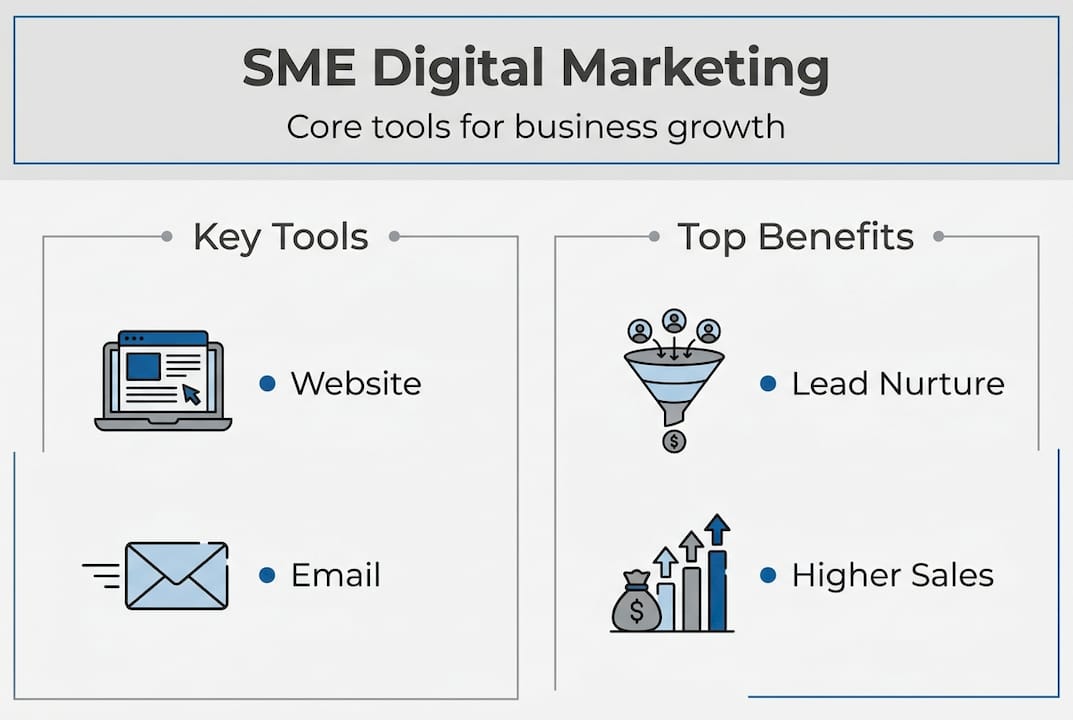
The measurable impact shows up in your bottom line. SMEs that develop strong digital marketing capabilities see higher customer acquisition rates, improved brand awareness, and better customer retention compared to competitors relying solely on traditional methods or word-of-mouth referrals. Understanding these fundamentals through an SME digital marketing basics guide sets the foundation for everything that follows.
Challenges and limits in digital marketing for SMEs
Resource constraints shape every digital marketing decision you make as an SME owner. Unlike large corporations with dedicated marketing teams and six-figure budgets, you’re juggling limited time, money, and expertise. This reality means you can’t execute every digital tactic simultaneously, and some strategies that work for big brands simply won’t deliver proportional returns for your business.
Network capital refers to the relationships, partnerships, and word-of-mouth reputation you’ve built in your industry or community. Research shows that in resource-constrained settings, high network capital can actually substitute for digital marketing effectiveness. If you’re a local salon with a loyal client base who refers friends consistently, your marginal return from increased digital ad spend might be lower than a new competitor starting from zero.
“In resource-constrained settings, high network capital can substitute for digital marketing, reducing its marginal returns due to attention constraints.” Journal of Global Entrepreneurship Research
Attention constraints create another critical limitation. Your potential customers face information overload, scrolling past hundreds of marketing messages daily. Even with perfect targeting, your ads compete against countless other businesses for those few seconds of attention. This saturation means diminishing returns kick in faster than many SME owners expect, especially when relying exclusively on paid advertising.
Common pitfalls of paid-only digital strategies include:
- Rising cost per click as competition increases in your market
- Zero long-term asset building since you rent attention rather than own it
- Immediate traffic loss when budget runs out or campaigns pause
- Difficulty standing out in crowded ad spaces without significant creative investment
- Platform dependency where algorithm changes tank your results overnight
Balancing network leverage with digital investments requires strategic thinking. Your existing relationships provide warm introductions and credibility that cold digital outreach can’t match. Smart SME owners amplify these networks through digital channels rather than replacing them. Ask satisfied clients to leave online reviews, share customer success stories on social media, and create referral programs that make it easy for your network to spread the word digitally.
Begrip why digital marketing for SMBs matters means recognizing both its power and its limitations within your specific context. A B2B service provider with strong industry connections might focus digital efforts on nurturing existing relationships through email newsletters rather than aggressive paid acquisition. Meanwhile, a new e-commerce brand needs digital channels as its primary customer acquisition engine.
The key insight is that effective digital marketing strategies for SMBs acknowledge resource realities upfront and prioritize tactics that build compounding value over time. This perspective shift moves you from chasing quick wins through paid ads toward building sustainable digital assets that continue working long after the initial effort.
Shift to owned channels for sustainable growth
Paid digital channels include any platform where you pay for each impression, click, or conversion: Google Ads, Facebook ads, Instagram sponsored posts, LinkedIn promotions. You’re essentially renting audience access. Owned channels are assets you control directly: your email list, SMS subscriber base, blog, podcast, YouTube channel. You own the relationship and can reach these audiences repeatedly without additional costs.
The performance plateau happens when SMEs pour money into paid ads without building owned audience assets. Initially, paid campaigns deliver strong returns as you reach new prospects. But as you exhaust your addressable market and competition intensifies, customer acquisition costs rise while conversion rates stagnate or decline. You’re stuck on a treadmill, spending more to maintain the same revenue.
| Channel Type | Initial Cost | Long-term Cost | Asset Value | Control Level |
|---|---|---|---|---|
| Paid Ads | Medium to High | Continuous | None | Platform dependent |
| E-mailmarketing | Low | Very Low | High | Full control |
| SMS Marketing | Low | Low | High | Full control |
| SEO/Content | Medium | Very Low | Very High | Full control |
Owned channels create compounding returns. Every subscriber you add to your email list is an asset you can reach repeatedly. A coaching business with 5,000 email subscribers can promote a new service to that entire audience for essentially zero cost. Compare that to paying $2-5 per click to reach the same people through ads. The economics shift dramatically in favor of owned media as your list grows.
Steps to build effective owned channels:
- Create a lead magnet that solves a specific problem for your target customer (checklist, template, guide, video training)
- Add opt-in forms to your website, social media profiles, and anywhere prospects engage with your brand
- Set up a welcome email sequence that delivers the lead magnet and introduces your business
- Develop a regular content calendar for email newsletters (weekly or bi-weekly works for most SMEs)
- Segment your list based on interests, behaviors, or purchase history to send more relevant messages
- Test SMS for time-sensitive offers or appointment reminders if your business model supports it
- Track open rates, click rates, and conversions to optimize your messaging over time
Pro Tip: Start your owned channel strategy with a single marketing automation funnel that captures leads and nurtures them toward your core offer. A real estate agent might offer a “First-Time Home Buyer Checklist” that triggers a 5-email sequence explaining the buying process, showcasing recent listings, and inviting prospects to schedule a consultation. This funnel runs 24/7, converting website visitors into qualified leads without ongoing ad spend.
The strategic shift from paid to owned doesn’t mean abandoning paid channels entirely. Smart SMEs use paid ads to build their owned audiences faster, running campaigns specifically designed to capture email subscribers rather than immediate sales. This approach recognizes that digital marketing role for SMBs centers on building sustainable growth engines, not just generating this month’s revenue.
Implementing marketing automation software for SMBs makes owned channel management practical even with limited time. Automated sequences handle the heavy lifting of lead nurture, freeing you to focus on strategy and customer service. The marketing automation software ROI gains come from this leverage, turning one-time content creation into ongoing lead generation and conversion.
Practical steps to implement digital marketing successfully
Foundational digital marketing activities form the backbone of your online presence. Start with a professional website optimized for both search engines and user experience. Your site should load quickly, work perfectly on mobile devices, and clearly communicate what you offer and why prospects should choose you. Add active social media profiles on platforms where your customers actually spend time, not every platform that exists.
SEO (search engine optimization) ensures potential customers find you when searching for solutions you provide. This means researching keywords your target audience uses, creating content that answers their questions, and building your site’s authority through quality backlinks. Email marketing remains the highest ROI channel for most SMEs, allowing direct communication with prospects and customers who’ve given permission to contact them.
| Marketing Channel | Typical Monthly Cost | Expected ROI | Best For |
|---|---|---|---|
| E-mailmarketing | $20-100 | 4200% average | All SMEs, especially B2B |
| SEO/Content | $200-500 | 1200% average | Long-term sustainable growth |
| Social Media Organic | $0-200 | 800% average | Brand building and engagement |
| Paid Search Ads | $500-2000 | 200% average | Immediate lead generation |
| Social Media Ads | $300-1500 | 150% average | Awareness and retargeting |
Budget allocation should prioritize owned channel development over paid advertising, especially in your first year. A practical split for SMEs with limited budgets: 50% toward building email list and content creation, 30% on SEO and website optimization, 20% on targeted paid campaigns to accelerate list growth. This allocation builds assets that appreciate over time rather than renting temporary attention.
Integrating marketing automation transforms scattered efforts into a cohesive system. Follow these steps:
- Choose an SME digital marketing basics guide platform that combines email, SMS, CRM, and landing pages in one system
- Map your customer journey from first awareness to purchase and identify key touchpoints
- Create automated workflows for each stage: welcome sequences for new subscribers, nurture campaigns for prospects, re-engagement for inactive contacts
- Set up lead scoring to identify your hottest prospects based on email opens, website visits, and content downloads
- Connect your automation platform to your CRM so sales and marketing data flows seamlessly
- Build landing pages for specific offers or lead magnets with forms that trigger automated follow-up
- Configure reporting dashboards to track key metrics weekly
Pro Tip: Track five core metrics religiously: website traffic, email list growth rate, email open rate, conversion rate from lead to customer, and customer acquisition cost. Review these numbers every Monday morning. When you spot trends (positive or negative), you can adjust tactics quickly rather than wasting months on ineffective strategies. Most SMEs fail at digital marketing not from bad tactics but from never measuring results consistently.
The practical reality is that digital marketing capabilities develop through consistent execution over time, not overnight transformation. Start with one channel, master it, then expand. A service business might begin with email marketing and basic SEO, adding social media once those foundations run smoothly. This focused approach beats trying everything simultaneously and executing nothing well.
Implementing marketing automation software SMB conversions requires initial setup time but pays dividends through improved efficiency and higher conversion rates. The automation handles repetitive tasks like welcome emails, appointment reminders, and follow-up sequences, freeing your time for strategy and customer relationships. Effective lead management for small businesses becomes possible even with a team of one when automation does the heavy lifting.
Explore marketing automation solutions for SME growth
Building sustainable digital marketing takes the right tools working together seamlessly. Go Online Now offers marketing automation software designed specifically for SMEs who need proven results without enterprise complexity or costs. Our platform combines email, SMS, CRM, landing pages, and analytics in one system, eliminating the frustration of juggling multiple disconnected tools.
SMEs using our platform see up to 85% more conversions and save 75% of their time on marketing tasks within 90 days. We handle the technical setup, provide real human support, and include done-for-you configuration so you can focus on growing your business instead of wrestling with software. Explore how the right marketing automation software ROI gains and growth acceleration can transform your digital marketing from scattered efforts into a systematic growth engine.
Veelgestelde vragen
What is digital marketing and why is it important for SMEs?
Digital marketing uses online channels like websites, email, social media, and search engines to reach and engage customers. It’s crucial for SMEs because it levels the playing field against larger competitors, allowing you to target specific audiences affordably and measure results precisely. Unlike traditional marketing, digital channels let you start small, test what works, and scale successful tactics without massive upfront investment.
How can SMEs balance digital marketing with limited budgets?
Focus on owned channels like email marketing and content creation that build long-term assets rather than renting attention through paid ads. Start with one or two channels, master them through consistent execution, then expand as you see results. Marketing automation software dramatically improves efficiency by handling repetitive tasks automatically, letting you accomplish more with the same time and budget.
What role does marketing automation play in SME digital marketing?
Marketing automation streamlines repetitive tasks like sending welcome emails, following up with leads, and nurturing prospects through your sales funnel. It ensures consistent communication without manual effort, increases conversion rates by delivering timely and relevant messages, and provides data on what’s working. For resource-constrained SMEs, automation makes sophisticated marketing possible even with small teams.
Should SMEs invest in paid advertising or organic channels first?
Prioritize organic channels like SEO, content marketing, and email list building first because they create compounding assets you own forever. Once you have foundational owned channels established, use paid advertising strategically to accelerate list growth and reach new audiences. This approach avoids the performance plateau that happens when SMEs rely exclusively on paid ads without building owned audience assets.
How long does it take to see results from digital marketing efforts?
Email marketing and paid ads can show results within weeks, while SEO and content marketing typically take 3-6 months to gain traction. The key is consistent execution and measurement. Most SMEs give up too early or constantly switch tactics before giving strategies time to work. Set realistic expectations, track core metrics weekly, and commit to at least 90 days of focused effort before evaluating whether a channel works for your business.
Aanbevolen
- Complete Guide to SME Digital Marketing Basics – Go Online Now
- Understanding Digital Marketing Strategies for SMEs – Go Online Now
- Understanding Why Digital Marketing for SMBs Matters – Go Online Now
- Complete Guide to Why Digital Marketing Matters – Go Online Now
- Top 10 herramientas esenciales de marketing digital | Canal Online