

Hiring the right talent drains time and money for small to mid-sized businesses. Traditional recruitment processes take weeks, cost thousands per hire, and often miss qualified candidates. Digital recruitment offers a faster, smarter alternative by leveraging AI screening, virtual interviews, and automated workflows. This guide walks you through a proven six-step digital recruitment process designed specifically for SMBs in 2026, helping you cut hiring time, reduce costs, and build stronger teams without overwhelming your resources.
Key takeaways
| Point | Details |
|---|---|
| Six-step process | Define roles, source digitally, screen with AI, interview virtually, assess fairly, onboard online |
| AI reduces workload | Automation cuts screening time by 75% but requires human oversight for cultural fit |
| Monitor bias risks | AI tools can perpetuate gender and racial biases without regular audits |
| Belangrijke statistieken bijhouden | Benchmark 180 applicants per hire and $1,200 cost per non-executive position |
| Balance tech and touch | Combine automated efficiency with human judgment for best hiring outcomes |
Understanding the digital recruitment landscape for SMBs in 2026
The recruitment game changed dramatically for small businesses over the past two years. AI adoption reached 84% of SMBs, with companies reporting they reduced hiring needs by 39% through automation. This shift represents a fundamental change in how resource-constrained businesses compete for talent against larger competitors with dedicated HR teams.
Digital recruitment tools now handle tasks that once consumed entire workdays. Applicant tracking systems automatically parse resumes, AI chatbots schedule interviews, and video platforms enable global candidate pools. These technologies level the playing field, giving SMBs access to sophisticated hiring capabilities previously reserved for enterprises with million-dollar budgets.
Current benchmarks paint a clear picture of what efficient digital recruitment looks like for small businesses. The typical SMB reviews approximately 180 applicants per successful hire, with an average cost per non-executive hire of $1,200. These numbers drop significantly when businesses implement structured digital processes that filter candidates effectively before human review begins.
Key trends shaping SMB recruitment in 2026 include:
- Virtual recruiting as the default, not the exception
- Skill-based hiring replacing traditional degree requirements
- Mobile-first application experiences for younger candidates
- Passive candidate sourcing through social platforms
- Data-driven decision making with recruitment analytics
Understanding these benchmarks helps you set realistic goals for your own hiring process. If you’re spending $3,000 per hire or reviewing 400 resumes manually, you’re leaving efficiency on the table. The smb digital recruitment automation landscape offers tools to bring those numbers down without sacrificing quality. Smart businesses recognize that investing in the right digital infrastructure pays dividends through faster time-to-hire and better candidate matches.
The 2025 SMB hiring report reveals another critical insight: companies planning to expand headcount in 2026 are prioritizing recruitment technology investments. This creates a competitive advantage for early adopters who master digital processes before their competitors catch up.
Preparing your SMB for an effective digital recruitment process
Successful digital recruitment starts long before you post a job listing. Your foundation determines whether you attract top talent or waste weeks sorting through mismatched applications. Defining your job role and employer brand comes first, giving candidates a clear picture of what you offer and what you need.
Start by documenting exactly what success looks like in the role. Write specific responsibilities, required skills, and measurable outcomes. Vague job descriptions like “team player needed” attract generic applicants. Precise descriptions like “manage client onboarding calls, respond to support tickets within 2 hours, maintain 95% satisfaction rating” attract candidates who know whether they’re qualified.
Your employer brand matters more than you think, especially when competing against companies offering remote flexibility and modern perks. Candidates research your online presence before applying. Update your website careers page, showcase team culture on social media, and highlight what makes working at your company unique. Authenticity wins over corporate jargon every time.
Choosing the right sourcing channels dramatically impacts candidate quality and cost. Consider these options:
- Job boards: Indeed and LinkedIn for broad reach, niche boards for specialized roles
- Sociale media: Facebook and Instagram for local hires, Twitter for tech talent
- Employee referrals: Your best source for cultural fit and retention
- Professional networks: Industry associations and alumni groups for qualified candidates
Selecting affordable recruitment tools requires balancing features with budget constraints. Applicant tracking systems range from free basic platforms to enterprise solutions costing thousands monthly. Most SMBs succeed with mid-tier options offering resume parsing, automated email responses, and basic analytics. Look for systems that integrate with your existing tools rather than forcing you to learn entirely new workflows.
Plan how you’ll integrate AI screening while maintaining human oversight. AI excels at filtering resumes for keywords, experience levels, and basic qualifications. Humans excel at evaluating communication skills, cultural alignment, and growth potential. The how digital recruitment works framework shows you where each approach fits best in your process.
Pro Tip: Create email templates for common candidate communications before you start recruiting. Acknowledgment emails, interview invitations, and rejection letters take minutes to write now but save hours when you’re managing dozens of applicants simultaneously.
Prepare job postings that speak directly to your ideal candidate’s motivations. Research shows candidates care most about role clarity, growth opportunities, and work-life balance. Lead with these elements rather than burying them under company history paragraphs. The smart digital recruitment strategies guide demonstrates how small wording changes increase application quality by 40%.
Test your application process from a candidate’s perspective. Apply to your own job posting on mobile and desktop. If it takes more than 10 minutes or requires creating accounts on multiple platforms, you’re losing qualified candidates to competitors with smoother experiences.

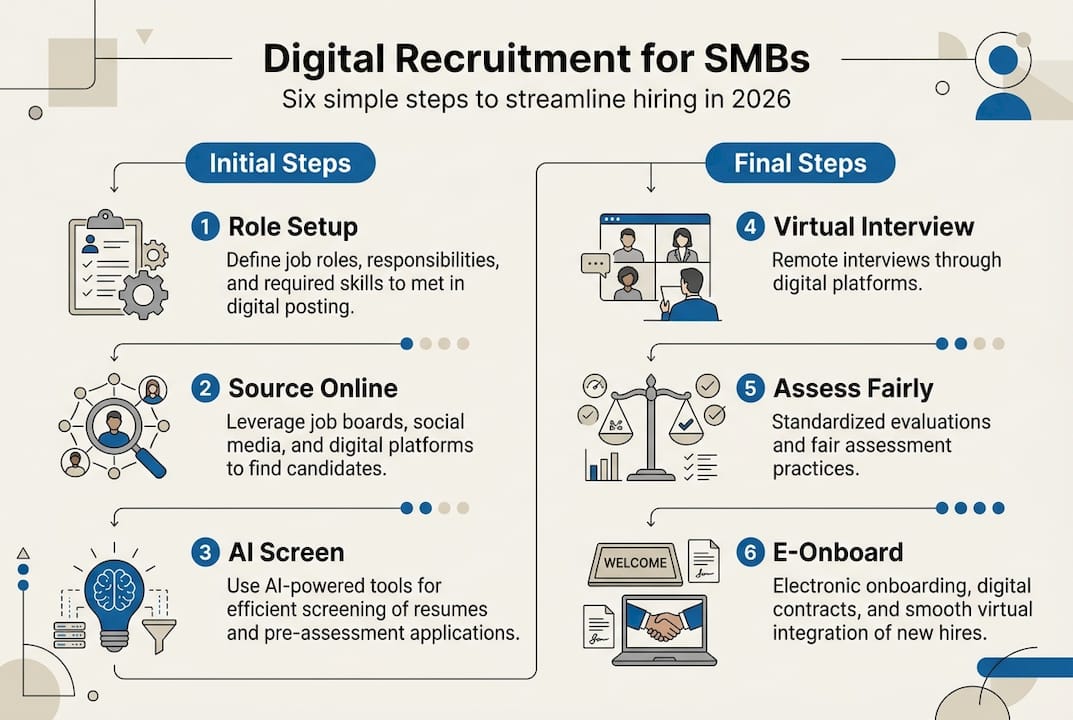
Executing the 6-step digital recruitment process for SMBs
De digital recruitment process typically follows six core steps from initial planning through final onboarding. Each step builds on the previous one, creating a systematic approach that reduces guesswork and improves outcomes. Master this sequence and you’ll hire faster while maintaining quality standards.
Step 1: Define and brand your role
Document the position requirements, compensation range, and growth trajectory. Write a compelling job description that highlights what candidates gain, not just what you need. Share this internally to ensure hiring managers and team members align on expectations before candidates enter your pipeline.
Step 2: Source candidates through digital channels
Post to relevant job boards and activate your employee referral program simultaneously. Leverage social media to reach passive candidates who aren’t actively job hunting but might consider the right opportunity. Track which channels generate the most qualified applicants so you can focus future efforts on high-performing sources.
Step 3: Screen resumes with AI assistance
Configure your applicant tracking system to flag candidates meeting minimum qualifications. AI tools parse resumes for required skills, experience levels, and education credentials in seconds. This initial filter typically reduces your review pile by 60-70%, letting you focus human attention on genuinely qualified candidates.
Step 4: Schedule and conduct virtual interviews
Use automated scheduling tools that sync with your calendar and send candidates available time slots. Conduct initial screenings via video call to assess communication skills and basic fit. Reserve in-person interviews for final candidates only, saving travel time and expenses for both parties.
Step 5: Assess candidates with bias awareness
Evaluate candidates using structured scorecards that measure specific competencies. Involve multiple team members in final decisions to reduce individual biases. Pay attention to whether your AI tools favor certain demographic groups and adjust screening criteria if patterns emerge.
Step 6: Implement digital onboarding
Send offer letters electronically with e-signature capabilities. Provide new hires with online portals for paperwork, training materials, and team introductions before their first day. Digital onboarding reduces administrative burden and helps new employees feel prepared from day one.
The table below compares traditional versus digital approaches at each step:
| Stap | Traditional Method | Digital Method | Time Saved |
|---|---|---|---|
| Role definition | Email chains and meetings | Collaborative docs and templates | 40% |
| Candidate sourcing | Newspaper ads and walk-ins | Job boards and social media | 60% |
| Resume screening | Manual review of every application | AI-powered filtering | 75% |
| Interview scheduling | Phone tag and calendar conflicts | Automated scheduling links | 80% |
| Candidate assessment | Gut feelings and informal notes | Structured scorecards and data | 30% |
| Onboarding | Paper forms and in-person orientation | Digital portals and video training | 50% |
Pro Tip: Build feedback loops into every step. After each hire, review which sourcing channels, screening criteria, and interview questions best predicted success. Refine your process continuously rather than waiting for obvious problems to emerge.
De digital recruitment process for smbs guide provides detailed templates and checklists for each step. The small business hiring playbook 2025 demonstrates how companies reduced time-to-hire by 45% implementing this exact sequence.
Integrating these steps creates momentum that carries candidates smoothly from application to acceptance. Delays between steps lose top talent to faster-moving competitors. The digital recruitment solutions explained framework shows you how to automate transitions between steps so candidates never wonder about next steps or timeline.
Avoiding AI biases and ensuring fairness in your digital hiring
AI screening tools promise efficiency but carry hidden risks that can damage your hiring outcomes and legal standing. AI resume screening exhibits racial and gender biases, often favoring white-sounding names and disadvantaging Black male candidates even when qualifications match exactly. These biases creep in through training data that reflects historical discrimination patterns.
Understanding how bias manifests helps you catch it early. AI tools trained on your company’s past hiring decisions will replicate previous biases, whether intentional or not. If your historical hires skew heavily toward certain demographics, the AI learns to favor similar candidates. This creates a self-perpetuating cycle that narrows your talent pool and exposes you to discrimination claims.
Regular auditing of AI outputs protects against these risks. Review which candidates your system advances versus rejects, looking for demographic patterns that don’t align with the applicant pool. If women represent 50% of applicants but only 20% of AI-selected candidates, your tool needs recalibration. Monthly spot checks catch drift before it becomes systematic.
Strategies for maintaining fairness throughout your digital recruitment process:
- Blind initial screening: Remove names, photos, and demographic indicators before AI review
- Diverse training data: Ensure AI learns from successful hires across all demographic groups
- Human review checkpoints: Require manager approval before AI rejections become final
- Structured interviews: Use identical questions for all candidates to enable fair comparisons
- Multiple evaluators: Include diverse perspectives in hiring decisions to counter individual biases
Cultural fit assessments require special attention because they’re highly subjective and prone to bias. What feels like “good culture fit” often means “similar to current team members,” which perpetuates homogeneity. Replace vague culture fit evaluations with specific behavioral assessments tied to job success. Ask whether candidates demonstrate collaboration, adaptability, and communication skills rather than whether they’d be fun to grab drinks with.
“AI is a tool, not a decision maker. The moment you treat automated screening as the final word rather than a first filter, you’ve abdicated your responsibility to hire fairly and thoughtfully.” – Digital Recruitment Ethics Framework 2026
Combining skill-based hiring with AI insights produces better outcomes than either approach alone. Skills assessments measure actual capabilities rather than credentials or pedigree. AI handles the logistics of distributing tests and compiling results. Humans interpret those results in context, accounting for non-traditional backgrounds and growth potential that algorithms miss.
Leveraging low-cost referral and social sourcing channels naturally improves diversity when you encourage employees to think broadly about their networks. Research shows referred candidates have higher retention rates and faster onboarding, making referrals valuable beyond cost savings. The digital recruitment smes impact analysis demonstrates how intentional sourcing strategies increased minority representation by 35% without lowering qualification standards.
Transparency builds trust with candidates and protects your reputation. Disclose when AI tools screen applications and explain how decisions get made. Candidates appreciate knowing whether a human reviewed their materials or an algorithm rejected them based on keyword matching. This honesty differentiates you from competitors who hide behind opaque processes.
The AI hiring bias research reveals that companies using AI without bias monitoring face 3x higher discrimination complaint rates. Proactive fairness measures cost less than reactive legal defense.
Explore digital recruitment solutions to cut your SMB hiring time
Reducing time-to-hire from weeks to days transforms your competitive position in tight labor markets. Digital recruitment solutions automate repetitive tasks while maintaining the human judgment that separates great hires from adequate ones. The right technology stack cuts recruitment costs by 40% while improving candidate quality through better matching and faster response times.
Ontdekken recruitment solutions smbs cut hiring time to discover tools specifically designed for resource-constrained businesses. These platforms integrate applicant tracking, interview scheduling, and candidate communication in one affordable system. The digital recruitment solutions explained guide walks you through selecting and implementing technology that fits your budget and technical capabilities.
Implementing these solutions drives smarter staffing decisions and sustainable growth. The digital recruitment guide 2026 provides actionable frameworks for building recruitment processes that scale with your business. Start with one or two automation improvements rather than overhauling everything simultaneously, then expand as you see results.
What is the typical cost per hire for SMB digital recruitment?
The average non-executive cost per hire for SMBs sits around $1,200 according to recent benchmarking data. This figure includes job board fees, applicant tracking software, background checks, and the time your team spends reviewing candidates and conducting interviews. Digital recruitment helps control and reduce these costs by automating the most time-intensive tasks like resume screening and interview scheduling.
Companies implementing structured digital processes typically see 30-40% reductions in cost per hire within the first year. The savings come primarily from reducing time-to-hire, which lowers the productivity loss from vacant positions. The SMB digital recruitment automation framework shows you exactly where automation delivers the highest return on investment.
How can SMBs balance AI automation with human judgment?
Use AI for screening resumes against minimum qualifications and scheduling interviews, then rely on humans for assessing cultural fit and making final hiring decisions. AI excels at processing large volumes of data quickly but struggles with nuance, context, and interpersonal dynamics that determine long-term success. Set clear boundaries for where automation ends and human evaluation begins.
Regularly audit AI outputs to detect and mitigate biases that creep into automated systems. Review rejection patterns monthly to ensure your tools aren’t systematically filtering out qualified candidates from specific demographic groups. The digital recruitment smes impact research demonstrates that companies conducting quarterly bias audits maintain 50% more diverse candidate pipelines than those using AI without oversight.
What are common sources for candidate sourcing in SMB digital recruitment?
Job boards like Indeed and LinkedIn generate the highest volume of applicants, while social media platforms like Facebook and Instagram work well for local hiring and roles requiring creativity. Applicant tracking systems centralize candidates from multiple sources, and employee referrals consistently produce the highest quality hires with the best retention rates. Low-cost channels like social referrals enhance both quality and diversity when you encourage employees to think broadly about their networks.
The most effective sourcing strategies combine three to four channels rather than relying on a single source. This diversification protects you when one channel underperforms and exposes your openings to candidates with different job search behaviors. The digital recruitment smart strategies guide provides detailed guidance on optimizing each channel for maximum return on your recruitment investment.