

Over 80 percent of American and British small businesses agree that keeping up with customer communication is one of their biggest hurdles. For coaches and real estate professionals, managing outreach without help can drain valuable time and energy. Email marketing automation puts advanced technology within reach, helping you send the right message at the right time with less hassle and lower costs than ever before.
Email Marketing Automation Fundamentals
Email marketing automation represents a strategic approach that transforms how small businesses communicate with their audiences by leveraging technology to send personalized, timely messages without constant manual intervention. Modern automation technologies enable entrepreneurs to design intelligent communication sequences that adapt dynamically to individual customer behaviors and preferences.
At its core, email marketing automation involves creating predefined workflows that trigger specific emails based on customer actions or predetermined time intervals. These automated campaigns might include welcome series for new subscribers, post-purchase follow-up messages, abandoned cart reminders, or re-engagement sequences targeting inactive customers. By implementing such strategic communication pathways, small businesses can maintain consistent engagement while dramatically reducing administrative workload.

Successful email marketing automation depends on understanding customer data and segmentation. Businesses can leverage information like purchase history, website interactions, and demographic details to craft highly targeted messages. Personalized email campaigns powered by intelligent automation can significantly improve open rates, click-through rates, and overall customer retention by delivering relevant content precisely when recipients are most likely to engage.
Pro tip: Start small by automating one key customer journey, such as a welcome sequence, and progressively expand your automation strategies as you learn and optimize your approach.
Core Features and How They Work
Email marketing automation platforms offer a robust set of features designed to streamline communication and enhance customer engagement for small businesses. Advanced marketing platforms provide sophisticated tools that enable entrepreneurs to create intelligent, responsive email campaigns without requiring extensive technical expertise. These features work together to help businesses design, deploy, and optimize their digital communication strategies with precision and efficiency.
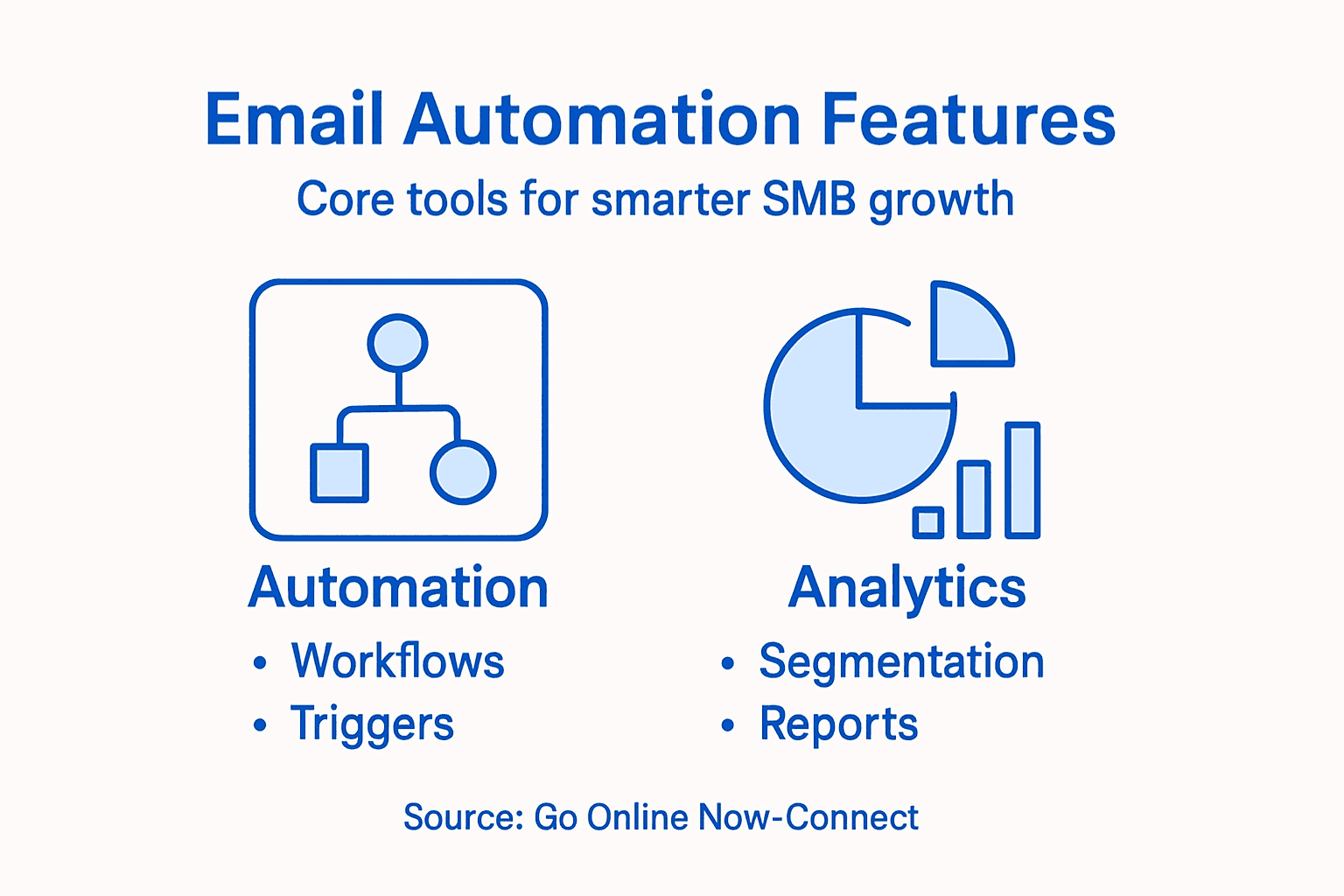
The core features of email marketing automation typically include sophisticated list segmentation, which allows businesses to divide their audience into distinct groups based on specific criteria like demographics, purchase history, or engagement levels. Workflow automation enables the creation of complex, multi-step email sequences that trigger automatically based on specific customer actions. For instance, a new subscriber might receive a welcome series, while a customer who abandons their shopping cart could instantly receive a targeted reminder email. These intelligent workflows ensure that each recipient gets the most relevant message at the most opportune moment.
Advanced tracking and analytics represent another critical feature of email marketing automation. These tools provide real-time insights into campaign performance, tracking metrics such as open rates, click-through rates, conversion rates, and audience engagement. Small businesses can use these detailed reports to continuously refine their messaging, understand customer behavior, and make data-driven decisions about their marketing strategies. A/B testing capabilities further enhance this process by allowing marketers to experiment with different email designs, subject lines, and content to determine the most effective communication approach.
Pro tip: Start by mapping out your customer journey and identify 2-3 key automated workflows that can immediately add value to your current marketing process.
Here’s how core email automation features support small business growth:
| Functie | What It Does | Business Impact |
|---|---|---|
| List Segmentation | Groups contacts by criteria | Enables targeted messaging |
| Workflow Automation | Sends emails triggered by actions | Saves time, boosts relevance |
| Tracking en analyse | Monitors campaign performance | Improves strategy effectiveness |
| A/B-testen | Tests different email elements | Optimizes engagement rates |
Types of Email Marketing Automation
Email marketing automation encompasses several strategic approaches designed to deliver targeted, timely communications across different stages of the customer journey. Email automation types range from welcome sequences and promotional campaigns to behavioral trigger emails, each serving a unique purpose in nurturing customer relationships and driving business growth. Small businesses can leverage these diverse automation strategies to create more personalized and efficient communication pathways.
The most common types of email marketing automation include welcome series, which introduce new subscribers to a brand and establish initial engagement. Behavioral trigger emails represent another powerful category, automatically responding to specific customer actions like website visits, product views, or abandoned shopping carts. Promotional sequences help businesses announce sales, share special offers, and maintain consistent communication with their audience. Lifecycle emails target customers at different stages of their interaction with a brand, such as post-purchase follow-ups, re-engagement campaigns for inactive subscribers, and milestone or anniversary communications that help build long-term customer loyalty.
Advanced email marketing automation also includes sophisticated segmentation strategies that allow businesses to create highly targeted campaigns. Drip campaigns can be designed to deliver a pre-planned series of emails based on specific audience characteristics or interactions, ensuring that each recipient receives content most relevant to their interests and stage in the customer journey. These targeted approaches enable small businesses to create more meaningful connections, improve engagement rates, and ultimately drive conversions by delivering the right message to the right person at the right time.
Pro tip: Map out your customer journey and start by implementing one or two targeted automation sequences that address key interaction points in your specific business model.
Compare the main types of email automation and their business benefits:
| Automation Type | Trigger Event | Key Benefit |
|---|---|---|
| Welcome Series | New subscription | Builds early brand engagement |
| Abandoned Cart Reminders | Cart left without purchase | Recaptures lost sales |
| Promotional Sequence | Scheduled/send offers | Drives short-term revenue |
| Lifecycle Emails | Milestone or inactivity | Strengthens long-term retention |
Real-World Applications for Small Business
Small businesses across various industries are discovering the transformative power of email marketing automation to streamline their customer communication and boost growth. Practical automation strategies enable entrepreneurs to create sophisticated marketing approaches that were previously accessible only to larger corporations with extensive resources. From real estate agents to coaching professionals, businesses can now implement targeted communication strategies that significantly enhance customer engagement and retention.
One of the most impactful applications involves automated welcome sequences for new subscribers or customers. A real estate agency, for instance, can automatically send a series of emails introducing their services, showcasing recent property listings, and providing valuable neighborhood insights immediately after a potential client signs up. Similarly, a coaching business might develop a welcome series that shares initial value through free resources, client testimonials, and a clear overview of their service offerings. Abandoned cart recovery emails represent another critical application, allowing businesses to automatically re-engage potential customers who showed initial interest but didn’t complete a purchase, potentially recovering significant lost revenue.
Lifecycle marketing automation offers small businesses unprecedented opportunities for personalized communication. Trigger-based emails can be designed to respond to specific customer actions, such as sending a follow-up survey after a purchase, providing additional resources based on a customer’s demonstrated interests, or creating re-engagement campaigns for clients who haven’t interacted with the business recently. These targeted approaches allow small businesses to maintain consistent, meaningful communication without requiring constant manual intervention, effectively competing with larger organizations by delivering personalized experiences that make customers feel valued and understood.
Pro tip: Select three key customer interaction points in your business and design targeted automation sequences that provide genuine value at each stage of the customer journey.
Costs, Risks, and Common Pitfalls
While email marketing automation offers tremendous potential for small businesses, it also presents several critical challenges that entrepreneurs must carefully navigate. Email marketing risks demand strategic planning and thoughtful implementation to avoid potential pitfalls that could damage customer relationships and brand reputation. Understanding these potential complications is essential for developing a robust and effective automation strategy.
Costs represent a significant consideration for small businesses exploring marketing automation. Initial investments can range from monthly subscription fees to potential setup and configuration expenses. Some platforms charge based on subscriber count, which means costs increase as your email list grows. Hidden expenses might include integration fees, additional feature access, or required professional services for complex implementations. Small businesses must carefully evaluate their budget and expected return on investment, considering not just the monetary cost but also the time investment required to learn and optimize automation systems effectively.
Privacy compliance and technological risks pose another critical challenge for small businesses implementing email marketing automation. Regulations like the CAN-SPAM Act and General Data Protection Regulation (GDPR) mandate strict guidelines for electronic communication, requiring businesses to obtain proper consent, provide clear unsubscribe mechanisms, and maintain transparent data handling practices. Failing to comply can result in substantial financial penalties and potential legal complications. Technical risks include potential email deliverability issues, such as messages being marked as spam, incorrect segmentation leading to irrelevant communications, or automation sequences that feel impersonal and damage customer trust. Successful implementation requires a delicate balance between technological efficiency and genuine, personalized communication.
Pro tip: Start with a small, carefully designed automation workflow and continuously monitor performance, adjusting your strategy based on real customer engagement data and feedback.
Simplify Your Email Marketing Automation with Go Online Now-Connect
Struggling to keep your email marketing automation both effective and manageable as a small business The article highlights challenges like complex workflows, maintaining personalized communication, and reducing administrative overhead. If you want to leverage intelligent automation without dealing with expensive or over-engineered platforms Go Online Now-Connect is designed just for SMBs and SMEs. Our all-in-one solution combines email marketing automation with CRM, lead nurturing, and reputation management in one affordable, easy-to-use platform that grows with you.
Discover how you can save time while sending targeted emails like welcome series or abandoned cart messages without hassle. Explore our Automation Archives – Go Online Now to learn practical strategies and unlock the full potential of marketing automation. Ready for a smarter growth path Visit https://goonlinenow.co now for a done-for-you setup and real human support that helps your business thrive today. Dive deeper into tailored marketing tactics at our Digital Marketing Archives – Go Online Now and start transforming your customer engagement efforts effortlessly.
Veelgestelde vragen
What is email marketing automation?
Email marketing automation is a strategic approach that allows businesses to send personalized and timely emails to their audiences automatically based on specific customer actions or predefined time intervals.
How can small businesses benefit from email marketing automation?
Small businesses can benefit from email marketing automation by saving time on manual tasks, ensuring consistent communication, enhancing customer engagement through personalized messages, and ultimately driving conversions.
What are the key features of email marketing automation platforms?
Key features include list segmentation, workflow automation for multi-step email sequences, advanced tracking and analytics, and A/B testing capabilities to optimize campaigns and increase engagement rates.
What types of email marketing automation should small businesses consider?
Small businesses should consider types like welcome series for new subscribers, abandoned cart reminders, promotional sequences, and lifecycle emails to effectively nurture customer relationships and increase retention.
Aanbevolen
- Marketing Automation Software: Complete Guide for SMBs – Go Online Now
- Marketing Automation Software: Complete Guide for SMBs – Go Online Now
- Marketing Automation Software: Smarter Growth for SMBs – Go Online Now
- 7 Affordable Marketing Automation Tips for SMB Success – Go Online Now
- Salesforce pour PME | Yelido